
UMJ Expert Explains Public Economic Conditions Amid Purchasing Power Pressures
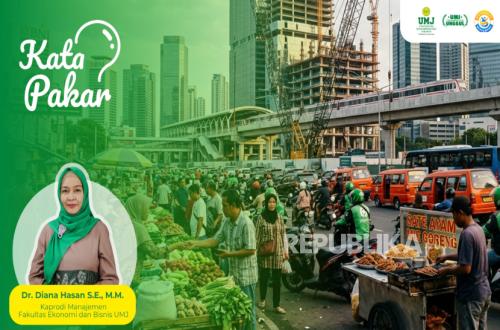
Indonesia’s current economic conditions show dynamics that need to be examined in a balanced way between macroeconomic achievements and the reality felt by the public. Although national economic growth is still showing positive performance, some people at the lower levels are still facing pressures in the form of rising living costs, changes in the prices of basic necessities, and limited incomes.
Economist at the Faculty of Economics and Business, Universitas Muhammadiyah Jakarta (FEB UMJ), Dr Diana Hasan SE, MM, assesses that the government needs to read the public’s economic conditions not only based on macroeconomic indicators, but also through data and socio-economic realities at the regional level.
Macroeconomically, Indonesia’s economy grew strongly at around 5.29 percent in the second quarter of 2026. However, at the lower levels, the public is facing serious challenges such as rising goods prices due to global pressures, the weakening rupiah, and a reduced ability to save, which is putting many people into survival mode.
Diana, who is also a member of the Economic and Employment Council of the Central Board of Aisyiyah, explained that one of the most palpable problems is the weakening of public purchasing power. Increasingly tight living costs are leaving the public with increasingly limited room to save. In addition, pressure on the rupiah exchange rate against the US dollar can also have an impact on the prices of imported goods and industrial logistics costs.
“Amid these conditions, the groups most vulnerable to economic pressures include informal sector workers, the vulnerable middle class, and low-income households,” she explained.
Informal sector workers such as daily labourers, online motorcycle taxi drivers, small traders, and freelancers tend not to have fixed incomes or adequate social security. Meanwhile, the vulnerable middle class group, or aspiring middle class, consists of people who have just emerged from poverty but have limited savings, making them easily fall back into vulnerable conditions when the prices of basic necessities rise.
“Low-income households are also very vulnerable because most of their income is used to meet basic needs, especially food,” she explained in a statement on Friday (28/8/2026).
The Head of the Management Study Programme at FEB UMJ explained that to identify vulnerable groups in society, the government needs to utilise an integrated socio-economic data system. One of these is the National Single Socio-Economic Data (DTSEN), which integrates various public welfare data into a ranking based on welfare levels. In addition, there is the Socio-Economic Registration (Regsosek) as well as data sourced from various ministries and agencies, including the National Population and Family Planning Board (BKKBN), the Ministry of Home Affairs through the Population and Civil Registration Agency (Dukcapil), and Statistics Indonesia (BPS).
Nevertheless, data accuracy remains one of the main challenges in formulating targeted economic policies. Data on poverty and the informal sector that is not updated regularly can cause the government to have difficulty obtaining a real picture of public conditions.
Apart from data issues, the government is facing global economic dynamics that are moving quickly and are difficult to predict. Changes in world oil prices, global interest rates, and exchange rate conditions can have a direct impact on the national and regional economy.
In this context, regional governments have a strategic role because they are closer to public conditions. Regional governments can provide a more specific economic picture regarding unemployment, purchasing power, business conditions, and economic potential in each region.
“Each region has different potential, such as agriculture, fisheries, or small trade centres. A specific economic picture helps the government map the leading potential of the region,” she said.
Accurate local data also helps the government provide interventions that are more suited to needs. For example, micro, small, and medium enterprise (MSME) actors in a region can receive training, mentoring, and capital support based on the characteristics and needs of their businesses. These efforts can be carried out through government programmes or collaboration with industry, universities, and various other parties.
Various current government policies have shown responsive efforts through social protection programmes and price controls. However, the effectiveness of these policies still needs to be continuously strengthened so that their impact can be felt more evenly.
Some lower-middle-class people are still facing purchasing power pressures due to fluctuating prices of basic necessities and real incomes that are not yet fully adequate. This condition is increasingly becoming a challenge for informal sector workers who have lower levels of social protection.
To maintain purchasing power while encouraging economic growth, the government is considered to need to implement expansive and targeted fiscal policies. These policies can be carried out through a combination of social protection, providing incentives to the real sector, and controlling food prices.
The government also needs to ensure that the economic data used as the basis for policy truly reflects conditions on the ground. According to her, one of the important efforts currently being undertaken is the 2026 Economic Census by BPS, which aims to collect data on the economic conditions and business activities of the public more comprehensively.
“Mapping the conditions of millions of business actors, especially the micro, small, and medium enterprise (MSME) sector, cannot rely solely on estimates or mere assumptions,” she said.
The availability of valid information, she explained, is essentially the main foundation so that development programmes, business assistance, and fiscal policies can be right on target.
Source: jawawa.id (https://jawawa.id/newsitem/umj-expert-explains-public-economic-conditions-amid-purchasing-power-pressures-1787889104)
Originally published by Republika (https://news.republika.co.id/berita/tkgmnd472/pakar-umj-jelaskan-kondisi-ekonomi-masyarakat-di-tengah-tekanan-daya-beli), translated from Indonesian