
UM Bandung Promotes Family Food Independence Through Verticulture
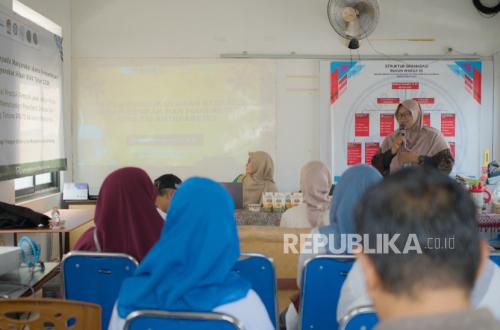
Family food self-sufficiency does not always have to start with a large plot of land. In dense urban residential areas, even a narrow yard can be transformed into a source of healthy food through a verticulture farming system.
This was the idea championed by the Food Technology programme at Universitas Muhammadiyah (UM) Bandung through its Community Service (PKM) programme in Manjahlega subdistrict, Rancasari district, Bandung City, on Sunday (2/8/2026).
The programme not only teaches vertical cultivation techniques but also integrates spice-processing innovation into functional food products with the potential to support diabetes prevention efforts. The approach simultaneously brings together aspects of food security, public health, economic empowerment and entrepreneurship based on local potential.
Sakina Yeti Kiptiyah, head of the PKM team from UM Bandung’s Food Technology programme, explained that the activity is part of a community service programme under the community partnership empowerment scheme, funded by the BIMA grant from the Ministry of Higher Education, Science and Technology for 2026. The theme is mentoring innovation in spice-based processed products that can be developed as functional foods to help reduce the risk of diabetes.
“Diabetes cases in Indonesia continue to rise. Therefore, preventive measures are needed through the use of local foods, particularly spices that have potential as healthy food ingredients. We want the public not only to be able to grow them, but also to process them into value-added products,” she said.
She explained that the programme began with training on building verticulture installations, or tiered planting systems suitable for urban environments with limited land. Various types of spice plants are then cultivated in the system, to be subsequently processed into food products with both economic value and health benefits.
According to Sakina, the approach is expected to encourage the community to become more self-sufficient in meeting their families’ food needs, while also opening up business opportunities based on local herbal products. These products will also receive support in packaging, branding and marketing strategies so that they can compete in the market.
“Our hope is that the community can maximise the potential of local spices into products that become widely known and serve as a healthier food alternative. We have also designed this programme to be sustainable so that it can have a real impact on reducing the prevalence of diabetes in Indonesia,” she said.
Khairiah, head of the Food Technology programme at UM Bandung, appreciated the implementation of the PKM. According to her, community service is a tangible manifestation of the role of higher education institutions in transforming academic knowledge into solutions that the public can directly benefit from.
“Programmes like this are expected to continue because they provide real benefits. Universities do not only produce research, but also bring innovations capable of improving the quality of people’s lives,” she said.