
Ultra Micro Holding Helps Mur Dwi Astuti Succeed as a Farmer in Merauke
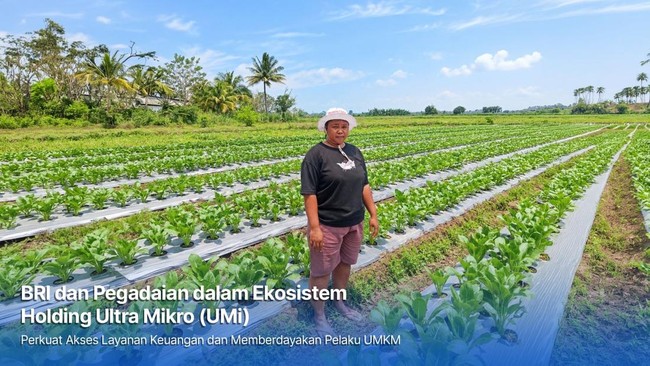
Jakarta, CNBC Indonesia – For Mur Dwi Astuti, developing a rice farming business in Merauke, Papua, has been no easy journey. Beyond the diligence required to manage the land, farmers must contend with changing weather, water shortages and pest infestations that can affect harvests.
Amid these challenges, access to capital is one of the key factors in keeping the business running and growing.
Mur’s journey in meeting her financial needs unfolded gradually.
Before tapping banking facilities, the Merauke native first became acquainted with gold pawning services at Pegadaian. That experience not only helped her meet financial needs, but also became part of the learning process of managing money and keeping the business going.
As her business developed, Mur’s capital needs grew. After running the business for more than a year at its previous scale, she turned to BRI’s Micro People’s Business Credit (KUR) to support various farming operational needs.
That financing access opened the way for Mur to expand her cultivated land from one hectare to three. A larger area, however, did not make the challenges any lighter.
According to Mur, weather conditions and pest attacks remain frequent problems. During the dry season in particular, water becomes scarce, meaning farming activities cannot run optimally.
“We depend on the seasons — if the rice does well, we get good results; if not, then it’s bad,” she said, quoted on Tuesday (15/9/2026).
When her capital needs grew larger, Mur sought alternative financing that could productively support her farming activities. She chose BRI Micro KUR, one reason being that the scheme does not require her to provide additional collateral.
During the application process, Mur also received assistance from BRI officers. She said communication was direct, with reasonably quick responses.
“We just contacted the officer directly, they asked us questions, and we were served,” she said.
The BRI Micro KUR was subsequently used for various farming operational needs, from cultivation and paying workers to the cost of using agricultural equipment. That capital support helped Mur scale up her business, with the land she now manages reaching three hectares.
As the business grew, Mur also noticed a change in how she managed money. She admitted she previously struggled to keep her business finances in order. With guidance from BRI, she began learning to set aside some money to reuse as capital for the next planting cycle.
“Because we weren’t able to manage our finances yet. Then we were helped by BRI, so we can save money more easily,” said Mur.
For Mur, the ability to manage finances is an essential part of sustaining a farming business that depends heavily on the seasons. Additional capital not only helped with operations, but also gave her room to expand the land gradually.
The experience has also been a journey of economic independence for Mur as a woman working in the agricultural sector.
“What matters is that we’re willing to try — women can definitely do it too,” she said.
Today, with her land having grown from one to three hectares, Mur still faces the challenges of seasonal change and water availability. However, her experience of gaining access to financing has made her bolder in seeing opportunities to develop the business.
She encouraged other farmers and small business owners not to hesitate to take the step, as long as they can meet their obligations. In a separate statement, BRI Corporate Secretary Dhanny said Mur’s journey in Merauke illustrates how the Ultra Micro (UMi) Holding ecosystem — comprising BRI, Pegadaian and PNM — can open financing access for business owners gradually, in line with their needs and business development.
“Mur’s experience of first using gold pawning at Pegadaian, then switching to BRI Micro KUR, shows there is room for business owners to grow and move up a class as their capital needs increase,” he said.
Through the synergy within the Ultra Micro Holding, BRI, Pegadaian and PNM continue to strengthen access to financial services for ultra-micro, micro and small communities. This access is expected not only to help people obtain financing, but also to encourage them to develop their businesses sustainably.