
Ukrainian Drones Reach 2,500km, Reportedly Setting Russian Plants Ablaze
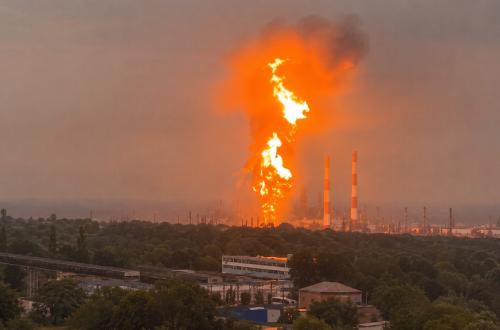
JAKARTA — Two Russian petrochemical plants producing synthetic rubber and chemicals for a range of industrial uses, including the defence sector, were reportedly targeted by Ukrainian drones on Saturday (24 October 2026). The attacks were said to have triggered major fires at the Tolyattikauchuk facility in the Samara region and Omsky Kauchuk in the city of Omsk, western Siberia.
Both plants are part of Russia’s petrochemical industry, which supplies raw materials for tyres, vehicle components, polymer products and other industrial equipment. Some products from the sector have dual uses, serving both civilian and military purposes.
The independent Russian investigative outlet The Insider reported on Saturday (24 October 2026) that both facilities had been targeted on the same day. Footage circulated by war-monitoring channels showed flames and plumes of smoke in the industrial areas reportedly hit.
However, the level of confirmation differs between the two attacks. Ukraine’s military officially claimed to have struck Tolyattikauchuk, while the identification of Omsky Kauchuk as a target has mainly come from war-monitoring reports and open-source analysis.
Reuters reported on Saturday (24 October 2026) that Russian authorities had acknowledged damage to an industrial facility in Tolyatti following a drone attack. Ukraine’s General Staff later said its forces had struck Tolyattikauchuk as part of an operation against facilities considered to support Russia’s military capabilities.
The attack in Tolyatti was reported to have taken place in the early hours. Several explosions were heard before flames appeared in the industrial area.
Samara Governor Vyacheslav Fedorishchev had earlier warned of a drone threat. Flights at Samara Airport were also temporarily restricted as a precaution.
Tolyatti Mayor Ilya Sukhikh confirmed that several industrial facilities had been damaged in the attack, but did not name all the companies affected.
According to preliminary reports from local authorities, there were no deaths or injuries in Tolyatti.
Tolyattikauchuk is a petrochemical company within the Russian energy group Tatneft. It produces several types of synthetic rubber, including isoprene, styrene-butadiene and butyl rubber, as well as a range of industrial chemicals.
Company data cited by The Insider has previously described Tolyattikauchuk as accounting for around a quarter of Russia’s synthetic-rubber market. It is unclear whether that share still applied in 2026.
The facility’s significant role in the petrochemical industry means an attack could affect downstream industrial supply chains in Russia. The actual impact, however, will depend on the extent of the damage, the production capacity disrupted and how long repairs take.
Strikes reach Siberia, thousands of kilometres from Ukraine
In a separate development on the same day, a drone attack was also reported in the industrial area of Omsk, western Siberia.
Depending on the point of measurement, the city lies more than 2,500 kilometres from the Ukrainian border. The distance illustrates the reported reach of attacks on Russian industrial facilities far from the front line.
The Insider said the war-monitoring Telegram channel Exilenova+ had reported a drone attack on the Omsky Kauchuk facility, followed by a fire at the plant.
Preliminary geolocation analysis published by the channel identified the suspected impact area near installations D-3 and D-5. Installation D-3 was said to be associated with the production of methyl tert-butyl ether (MTBE), a chemical used in the fuel industry.
However, the identification of the location and damage to the two installations has not been independently verified.
Omsk Governor Vitaly Khotsenko confirmed a drone attack on an industrial area in the north of the city, but did not specifically name Omsky Kauchuk as one of the facilities hit.
Omsky Kauchuk is part of the Titan group, a Russian petrochemical company. It produces synthetic rubber, phenol, acetone, MTBE and other chemicals.
The attack in Omsk was also reported to have affected a logistics facility belonging to e-commerce company Ozon.
The company confirmed a fire after a drone hit its logistics facility. Workers were evacuated and preliminary reports said there were no injuries.
Ozon subsequently took steps to deal with goods stored at the affected facility and warned of possible disruption to the fulfilment of some customer orders.
As of Sunday (25 October 2026), there were no verified reports on the scale of the damage or how much Omsky Kauchuk’s production capacity had been disrupted.
Why is the synthetic-rubber industry being targeted?
The attacks on Tolyattikauchuk and Omsky Kauchuk have drawn attention because the petrochemical industry is an important link in both the economy and the production of modern military equipment.
Synthetic rubber is used to make tyres, industrial hoses, seals, coatings, vibration dampers and various technical components required for vehicles and machinery.
Rubber products are also used in military vehicles, including logistics trucks and armoured vehicles, as well as in equipment supporting combat operations.
Certain synthetic polymers are also used in the production of solid rocket and missile propellants.
One example is hydroxyl-terminated polybutadiene (HTPB), a polymer used as a binder in solid-propellant formulations. It helps maintain the structure and mechanical properties of the propellant mixture.
However, not all types of synthetic rubber can be used directly as a binder in missile propellant.
The Insider stressed that the existence of a synthetic-rubber production facility does not in itself prove that a company makes specialised polymers for rocket fuel.
There is no independent evidence confirming that Tolyattikauchuk and Omsky Kauchuk directly produce HTPB or supply it to Russian missile manufacturers.
The two plants’ links to the defence industry should therefore be understood in a broader context: they are part of a petrochemical sector that produces raw materials for many industrial uses, including products that can be used in military equipment.
From a strategic perspective, attacks on facilities of this kind could disrupt industrial supply chains without directly hitting weapons-assembly plants.
Modern defence industries rely on extensive supplier networks, spanning basic chemicals, polymers, specialist metals, electronic components and various mechanical parts.
Disruption at one supplier can affect production in other sectors if adequate stocks or alternative sources of supply are unavailable.
Nevertheless, there is no evidence that the latest attacks on the two petrochemical plants have reduced Russia’s missile or weapons production capacity.