
Ukraine War Exposes NATO Weaknesses: Is the Alliance Truly Ready to Face Russia?
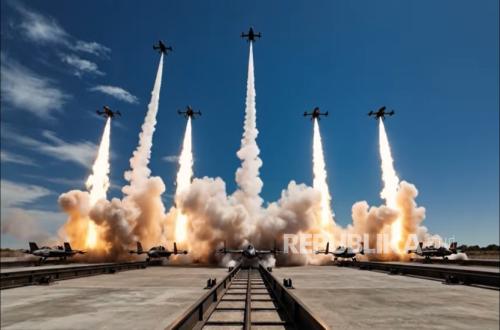
The Russia-Ukraine war is entering its fifth year, bringing lessons that are not entirely comfortable for the North Atlantic Treaty Organization (NATO). Low-cost drones worth thousands of dollars are altering tank movements, electronic warfare networks are disrupting communications, and missiles and unmanned aerial vehicles (Upons) are striking far behind the front lines. Meanwhile, ammunition supplies and air defence systems are being consumed at rates far exceeding many peacetime military plans.
Questions regarding NATO’s readiness resurfaced on Thursday (17/09/2026), when Russia launched a massive wave of missile and drone attacks against Kyiv and several other Ukrainian regions. Poland deployed fighter jets and temporarily closed the Rzeszow and Lublin airports as a precautionary measure, although Warsaw later stated that no airspace violations had occurred. Reuters reported on Thursday, 17 September 2026, that Russian strikes hit at least eight Ukrainian regions, demonstrating the intensity of long-range attacks that modern defences must confront.
On the same day, Reuters published a special report addressing a question increasingly posed by defence officials and analysts: if NATO were one day forced to face a high-intensity war similar to Ukraine, would its military structure be prepared?
Five Ukrainian and Western defence officials told Reuters on Thursday, 17 September 2026, that the battlefield is evolving so rapidly that some NATO weapons and tactics risk becoming obsolete. Ukraine can modify software, tactics, and technology within weeks, whereas defence procurement systems in NATO countries often operate on timelines of years or even decades.
The answer is not simple. NATO possesses immense air, economic, technological, and combined military strength. The alliance has also increased defence spending, strengthened its eastern flank, boosted weapons production, and begun adopting lessons from Ukraine. However, the war has exposed several gaps that have not yet been fully closed: air defence, the ability to counter mass-produced cheap drones, ammunition stockpiles, the speed of innovation, logistics, troop protection, and Europe’s continued dependence on United States military capabilities.
The Battlefield is Changing Faster
One of the most striking changes comes from drones. The war in Ukraine has shown that small unmanned aerial vehicles no longer serve solely as reconnaissance tools. FPV (First Person View) drones can hunt vehicles, personnel, and artillery positions, while one-way attack drones can be deployed in large numbers to overwhelm air defences far behind the battlefield.
The International Institute for Strategic Studies (IISS), in its report ‘The Defence of Europe in a New Era’ published on Wednesday, 16 September 2026, noted that the Ukrainian battlefield has evolved into an environment of near-constant surveillance. In several parts of the front line, areas reachable by drone observation and attack have expanded into ‘kill zones’ spanning dozens of kilometres. This condition forces troops to disperse, hide, enhance camouflage, and reduce the concentration of large groups of personnel or vehicles.
This presents a challenge for militaries that, for decades, have trained the deployment of units, vehicles, and logistics hubs based on certain assumptions regarding air cover.
Oleksandr Pivnenko, a commander in the Ukrainian National Guard, shared his experience observing foreign personnel undergoing training with his troops. While they were deemed proficient in assaulting positions, the habits required for modern warfare have not always been ingrained.
“They are good at assaulting positions,” Pivnenko told Reuters, as reported on Thursday, 17 September 2026. However, he questioned what would happen if drones were overhead while ground units were not even monitoring the sky.
The issue is not that NATO troops lack an understanding of drones; in fact, NATO is currently running various drone and counter-drone programmes. The problem highlighted by Ukraine is the speed of change: as soon as a defence system becomes effective, the adversary changes radio frequencies, software, flight altitudes, attack tactics, or drone types. This innovation cycle can occur within a matter of weeks.