
UKI highlights protection of customary land and risks of adat commodification
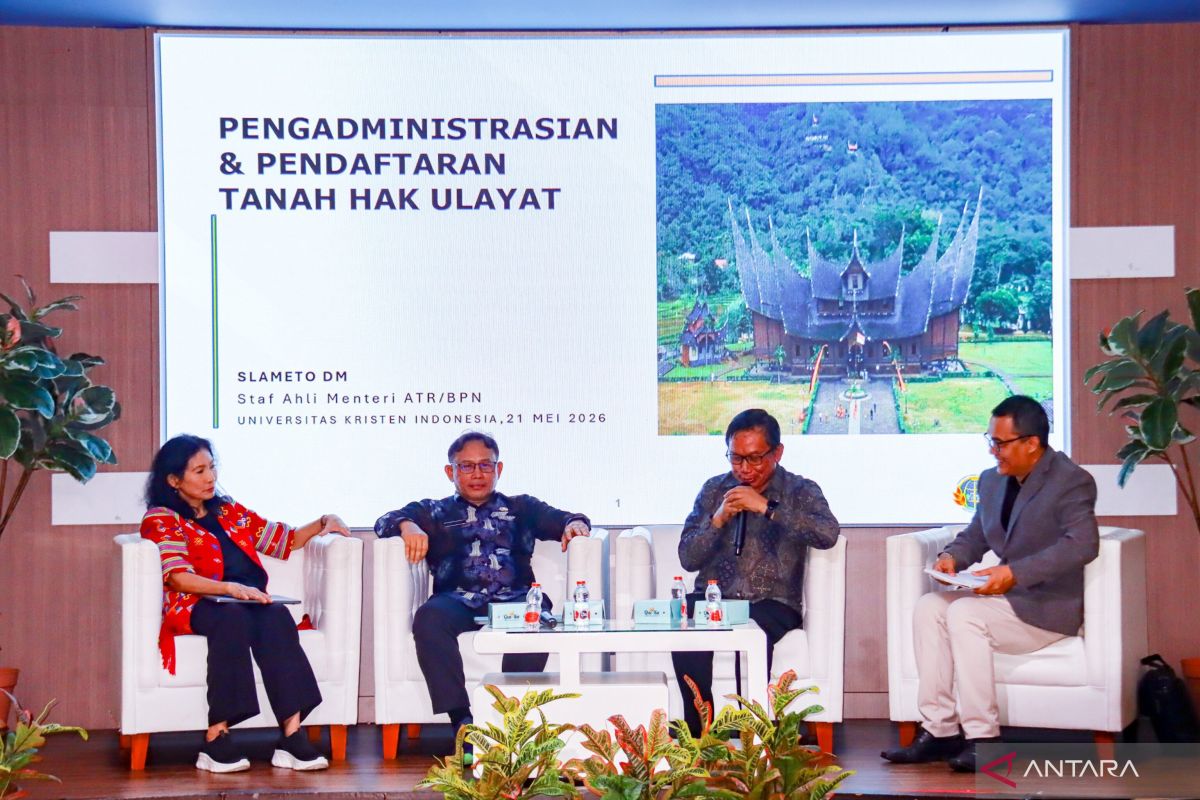
Jakarta (ANTARA) - The Master of Laws programme in the Faculty of Law at Universitas Kristen Indonesia (UKI) has highlighted the protection of ulayat land and the risks of adat commodification.
Slameto Dwi Martono, Special Assistant to the Minister of ATR/BPN for Agrarian Law and Indigenous Peoples, said in Jakarta on Friday that the existence of adat communities predates the Unitary State of the Republic of Indonesia, so their rights must be respected and protected by the state.
“Consequently, the state must provide legal certainty and certainty of land rights for adat communities as long as they are alive and do not contravene the principles of the Unitary Republic of Indonesia,” Slameto added.
He explained that the issuance of Ministerial Regulation ATR/BPN Number 14 of 2024 is a government step to administer and register ulayat land that has long lacked comprehensive data.
Since 2021, the Ministry of ATR/BPN has reportedly conducted inventories together with universities, local governments, NGOs, and adat leaders across various provinces.
Slameto also acknowledged that the policy’s implementation still faces a number of field challenges, from overlapping forest areas to inter-adat disputes and issues with unclear border delineations.
“Not only does it provide legal certainty for adat communities, but it could also improve welfare by empowering adat communities’ ulayat land,” Slameto said.
Meanwhile, Alkadri, Assistant for Government and People’s Welfare of Lebak Regency in Banten, described the practice of protecting ulayat rights in Lebak Regency, particularly for the Badui and Kesepuhan adat communities.
He said Lebak is one of the regions that has issued regional regulations and local head of region decrees recognising adat communities and their ulayat areas.
“Lebak is one of the examples of areas that have successfully protected adat ulayat rights and the Badui people,” Alkadri said.
He explained that the Badui people still strictly maintain customs, including prohibitions on electricity, vehicles, and modern buildings. In particular, the Badui Dalam community maintains a simple way of life and adherence to adat rules across generations.
Alkadri regards formal recognition of adat communities as an important step to prevent agrarian conflicts, such as those on Rempang Island.
He warned that adat territories could be considered state land if they have not received legal recognition from the local government.
“This Regulation tries to bring ulayat land into the national administrative system, but normative conflicts arise because ulayat rights are communal and cross-generational,” Diana said.
He said the concept of joint ownership in the regulation could also create new problems because ownership status still requires a clear legal subject. This situation is feared to open space for adat elites to control ulayat land for personal or group interests.
“Ulayat land could become a commodity sold by adat elites, eroding ulayat rights over time,” Diana said.
Nevertheless, she sees that adat land still has great potential to support a community-based economy if managed properly.
She cited the development of adat cooperatives, ecotourism, adat forest products, and local cultural products as potential economic sources for communities without eroding adat values.