
UK Threatened with Recession
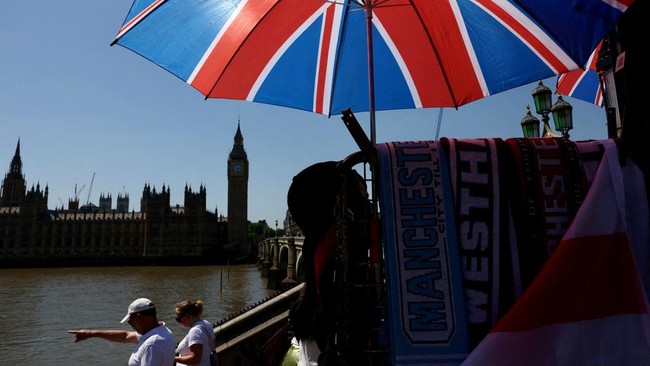
The United Kingdom, the world’s oldest monarchy, is now on the brink of recession. A recession is a condition when a country’s economic activity declines over a certain period, marked by Gross Domestic Product (GDP) contracting for two consecutive quarters or more.
Citing Reuters on Monday (3/8/2026), a prolonged closure of the Strait of Hormuz could drag the UK into recession. The warning was issued by accounting consultancy EY, which estimates the British economy will begin to contract in 2027 if the strategic shipping lane is not reopened before the middle of next year.
In its latest report, EY estimates the UK economy can still grow 0.8% in 2026 and 1.2% in 2027, assuming the Strait of Hormuz is reopened by the end of September this year at the latest. However, if the route, which carries about a fifth of the world’s oil trade, remains closed until early or mid-2027, UK economic growth is expected to slow to just 0.5% in 2026 before contracting by 0.2% in 2027.
“We estimate the UK can avoid a deeper economic slowdown if the Strait of Hormuz is reopened within the next few months. However, if the closure continues into 2027, inflation will rise and the economy is likely to contract next year,” said Peter Arnold, Chief Economist at EY UK.
EY also warned that the closure of the Strait of Hormuz would drive up energy prices, fuelling inflation. In this scenario, UK inflation is forecast to surge to 6.4% by the end of 2026. Conversely, if the strait is reopened soon, inflation is expected to peak at around 3.5% this year.
The Bank of England (BoE) has previously warned of similar risks. In a scenario where oil and gas prices remain 30%-60% higher than market expectations, the central bank still forecasts the economy will grow close to 1% in 2027, with inflation projected at around 4.5%.
Despite this, EY’s projections are far more pessimistic, as they factor in the impact of a prolonged Strait of Hormuz closure on the UK’s energy supply and economic activity. EY expects the Bank of England to hold its benchmark interest rate steady throughout this year before cutting it from 3.75% to 3.25% through two reductions in April and July 2027 to support economic growth.
The Strait of Hormuz is one of the world’s most important energy shipping lanes. Disruption to maritime traffic in the region is feared to trigger a spike in global oil and gas prices, ultimately increasing inflationary pressures and slowing economic growth in various countries, including the United Kingdom.