
UIN KHAS Jember Launches Professional Certification Body to Boost Graduates’ Job-Market Competitiveness
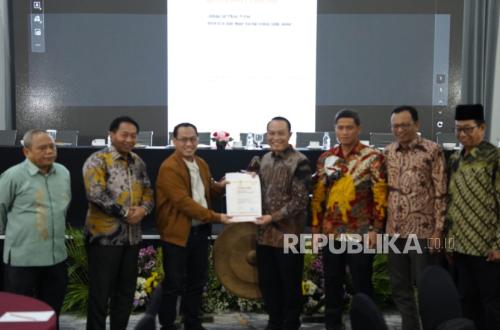
SURABAYA — Kiai Haji Achmad Siddiq State Islamic University (UIN KHAS) Jember has officially launched a Professional Certification Body (LSP) after obtaining a licence from the National Professional Certification Agency (BNSP). The LSP is expected to help assure the quality of graduates and strengthen students’ competitiveness in the job market.
The launch marks a step by UIN KHAS Jember towards recognising students’ competencies through certificates issued under BNSP-licensed certification schemes.
“Thank God, after receiving the licence certificate from BNSP, we are officially announcing to the academic community, especially students and the public, that UIN KHAS Jember now has its own LSP. This institution will help ensure that graduates are ready to compete in the job market by holding competency certificates,” said Prof Sahiron Syamsuddin, Director of Islamic Higher Education (PTKI) and Acting Rector of UIN KHAS Jember, at the launch in Surabaya, East Java.
Prof Sahiron said the LSP was expected to increase public confidence in UIN KHAS Jember and the quality of its graduates. Competency certification means students may hold not only an academic degree at undergraduate, master’s or doctoral level, but also a competency certificate relevant to their study programme and expertise.
“With these two valuable documents—a degree and a competency certificate—we hope UIN KHAS Jember graduates will find it easier to secure work because they have specific skills recognised through a BNSP-licensed competency certificate. This gives graduates added value as they face competition in the world of work,” he said.
A long-term effort to improve graduate quality
UIN KHAS Jember Vice-Rector I Prof HM Khusnul Amal said the establishment of the LSP was the result of a long effort and reflected the university’s responsibility to ensure that students gain competencies suited to the needs of society and the workplace.
He said competency certification was important so that students completing their studies would have not only academic knowledge, but also skills tested and assessed under certification schemes.
“With this BNSP competency certificate, we demonstrate that UIN KHAS Jember graduates are, God willing, ready to contribute to society. They can put their acquired knowledge to use and access jobs suited to their interests and expertise, supported by proof of competency certification,” Prof Amal said.
He explained that setting up the LSP had involved several stages, including raising awareness of the importance of a BNSP-licensed professional certification body, training competency assessors, a full assessment and an initial competency test witnessed directly by BNSP.
“Reaching the point where we have our own LSP has certainly been a long and exhausting struggle. Together with the LSP team, led by Dr Mahmudah, and all its staff, we prepared day and night so that UIN KHAS Jember could have a BNSP-licensed LSP,” he said.
He said the team’s cooperation, solidarity, division of responsibilities and unity had ultimately enabled UIN KHAS Jember to establish its own LSP.
“Thank God, through continued cooperation and unity, today we have been able to launch the UIN KHAS Jember LSP. After the launch, we will continue improving certification services by testing students who meet the competency-assessment requirements,” Prof Amal added.
BNSP encourages the development of certification schemes
BNSP Commissioner Dr KH Mohammad Nur Hayid welcomed the launch of the UIN KHAS Jember LSP and congratulated the university’s leaders and academic community on the achievement.
Gus Hayid said he hoped the BNSP licence would provide an opportunity to improve teaching quality and the system for assessing graduates. This would give UIN KHAS Jember graduates measurable, recognised competencies and make them better prepared to compete for jobs and serve their communities.
“On behalf of BNSP, I am very pleased that UIN KHAS Jember now has its own professional certification body. With this LSP, students who meet the requirements can have their competencies assessed through the university’s internal LSP, within the scope of its licence,” he said.
He said professional assessments conducted in line with competency standards would give graduates an advantage in accessing employment opportunities and serving the community.
Gus Hayid, who is also Deputy Secretary-General of the Nahdlatul Ulama Executive Board (PBNU), added that BNSP would continue supporting the development of LSPs, including UIN KHAS Jember’s, by expanding certification schemes in line with the needs and graduate profiles of each study programme.
He said developing certification schemes was an important task following the launch. Every study programme was expected to propose new schemes so that students across faculties could have their competencies recognised in their respective fields.
“After this launch, the next task will of course be to develop certification schemes. I hope all study programmes and departments in every faculty will submit new schemes in the future, in line with their intended graduate profiles,” he said.
With more certification schemes, Gus Hayid added, students would have a wider choice of competency tests suited to their interests and expertise.
“God willing, with new schemes, all students will eventually be able to take competency tests suited to their interests and abilities, and then obtain recognition through BNSP competency certificates in accordance with the applicable rules,” he said.
The launch of the UIN KHAS Jember LSP was held alongside the university’s leadership coordination meeting. Attendees included university leaders, vice-rectors, deans, vice-deans, heads and secretaries of study programmes, and LSP management.