
UII and Guidance Counsellors Analyse Pressures Facing Gen Z
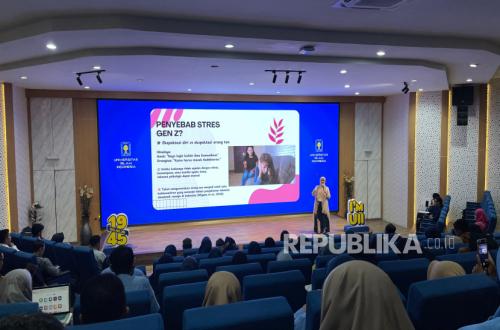
Universitas Islam Indonesia (UII) has officially launched its New Student Admissions (PMB) for the 2027/2028 Academic Year as part of a series of activities held with hundreds of Guidance and Counselling (BK) teachers from the DIY and Central Java regions. The event served as a platform for UII to introduce the admissions process while strengthening synergy with schools through guidance counsellors.
UII Vice Rector I, Prof. Riyanto, stated that the launch of the 2027/2028 admissions is a primary component of the programme. UII invited school counsellors to build communication and strengthen the relationship between higher education institutions and schools.
“Today, UII is launching the 2027 admissions for the 2027-2028 Academic Year. As part of today’s series, we invited BK teachers from DIY to attend,” said Riyanto during the BK Teachers Seminar themed ‘Mind the Gap: Bridging the Expectations and Reality of Gen Z’ at the Prof. Sardjito General Lecture Hall, UII Integrated Campus, on Tuesday (15/9/2026).
According to Riyanto, synergy with guidance counsellors is vital because they interact directly with students preparing for higher education after completing high school, vocational school, or Islamic high school levels.
“The hope is that we maintain synergy between school guidance counsellors and UII,” he said. Through this relationship, UII can also disseminate information regarding student admissions and available educational options to prospective students, particularly for SMA, SMK, and MA students.
As part of the programme, UII also presented awards to ten schools that contributed the highest number of students to the 2026 UII admissions. This recognition serves as both an appreciation and an effort to maintain UII’s relationship with schools.
In addition to introducing the admissions programme, UII addressed issues close to students’ lives through a seminar on Generation Z. Libbie Annatagia, a lecturer at the UII Faculty of Psychology, explained that the ‘Mind the Gap’ theme was chosen to discuss the disparity between the expectations and realities faced by Gen Z.
According to Libbie, Gen Z possesses several advantages as a generation raised alongside technology. They are considered tech-savvy, creative, and attentive to global issues.
“Gen Z are digital natives, meaning they are very proficient and fluent in the use of technology,” said Libbie.
However, despite these advantages, Gen Z faces numerous challenges. Dependency on technology and social media, fear of missing out (FOMO), the desire for instant gratification, and mental health issues are challenges that need to be understood.
“Gen Z is often referred to as the ‘strawberry generation’. A strawberry generation is one where the packaging looks attractive on the outside, but there is sometimes fragility within,” said Libbie.
Libbie explained that the pressures experienced by adolescents can stem from academic stress, peer issues, and social judgement. Economic and environmental factors can also exacerbate the pressures faced by students.
To help students manage these pressures, guidance counsellors can introduce adaptive coping strategies. These strategies can be implemented through emotional management, cognitive approaches, or religious approaches.
Emotional management can be achieved through relaxation, breathing exercises, or sharing stories with friends or family. Meanwhile, a cognitive approach involves helping students view problems and seek alternative problem-solving strategies.
According to Libble, guidance counsellors play a crucial role in accompanying Gen Z. This role is not only performed when students face problems but also in helping students determine their direction and develop their potential.
“There are several roles a guidance counsellor can take. The first is as a navigational guide,” she said.
In addition to being a navigator, guidance counsellors can act as facilitators, growth companions, mediators between students, schools, and parents, and serve as a ‘safe anchor’ for students.
“A guidance counsellor can be a safe anchor, providing a safe and comfortable place for students to share their stories,” said Libbie.
The seminar was not merely a presentation of material. Guidance counsellors also shared experiences encountered directly in the school environment, allowing research findings to be reconciled with field conditions.
Through the launch of the 2027/2028 admissions paired with the seminar, UII is not only introducing its new student intake but also opening a space for collaboration with schools. The meeting is part of UII’s effort to build relationships with counsellors while understanding the needs and challenges students face in determining their further education.