
UIA Rector Praises Academic Quality of Ahmad Haikal Hasan's Thesis
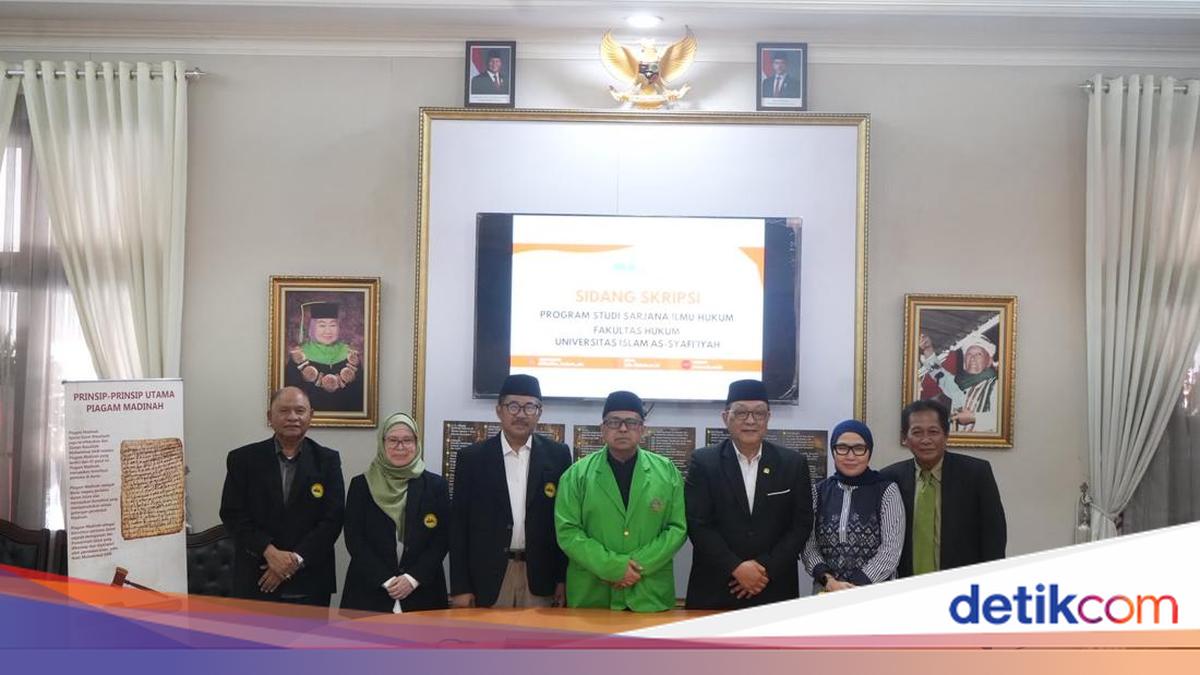
The Rector of Universitas Islam As-Syafi’iyah (UIA) Jakarta, Professor Dr Masduki Ahmad, has assessed that the thesis defended by the Head of the Halal Product Assurance Agency (BPJPH), Ahmad Haikal Hasan (known as Babe Haikal), possesses extraordinary academic quality. According to Masduki, the weight of the study is comparable to a doctoral dissertation, as it presents a new perspective on the relationship between the Charter of Medina, the Jakarta Charter, and the Constitution of the Republic of Indonesia.
“I read books for no less than seven hours every day, yet I found many novelties in Babe Haikal’s thesis,” Masduki stated in a written release on Saturday (1/8/2026).
This assessment was delivered by Masduki after presiding over the thesis defence at the UIA Campus in Jakarta on Friday (31/7). He noted that the research successfully uncovered several historical facts that have previously lacked in-depth study. “Today, Babe Haikal defended a thesis discussing the Charter of Medina and its connection to the Jakarta Charter and the Constitution of the Republic of An Indonesia. Many things previously obscured by the dust of history are now being revealed. Hopefully, subsequent researchers will be able to deepen the theme he has initiated,” said Masduki.
Masduki noted that the perspective presented by Haikal differs from the mainstream thought of some intellectual circles. However, the arguments were deemed very strong as they are based on the study of ‘kitab turats’ (classical Islamic literature) which is rarely studied by the younger generation. “He opened ancient books that are seldom read by the current generation. The perspective he presents is very enlightening, especially for us as a university that integrates science and religion. This can serve as an inspiration for future researchers,” said Masduki.
Masduki, who has long researched the Charter of Medina, explained that the historic document inspired the nation’s founders in formulating the foundations of Indonesian statehood. According to Masduki, the scholars and independence figures successfully adopted the universal values of the Charter of Medina while considering the pluralistic character of the Indonesian nation.
Masduki added that the study conducted by Haikal has high relevance to Indonesia’s current situation, particularly when issues of religion and identity politics frequently emerge ahead of general elections. “Amidst the emergence of religious and identity politics issues during every election momentum, this research provides a perspective that the concept of Indonesian nationality is actually aligned with Islamic values,” said Masduki.
On this occasion, Masduki also appreciated Haikal’s enthusiasm for seeking knowledge. Despite already holding a doctorate (S3) and serving as the Head of BPJPH, he continued his Bachelor of Laws (S1) studies at UIA, following all academic processes like any other student. During the session on Friday (31/7), the defence was witnessed by the Rector of UIA and the board of the UIA Foundation. Throughout his studies, Haikal completed all lecture stages and academic obligations without receiving any special treatment.
According to Masduki, such dedication serves as an example of the spirit of lifelong learning, regardless of age, position, or social status. He expressed hope that the results of Haikal’s research could serve as an academic reference and open new avenues of study regarding the relationship between Islamic values and the constitution in the national and state life of Indonesia.