
UI Professor: New BI Governor Must Be Able to Balance Stability and Growth
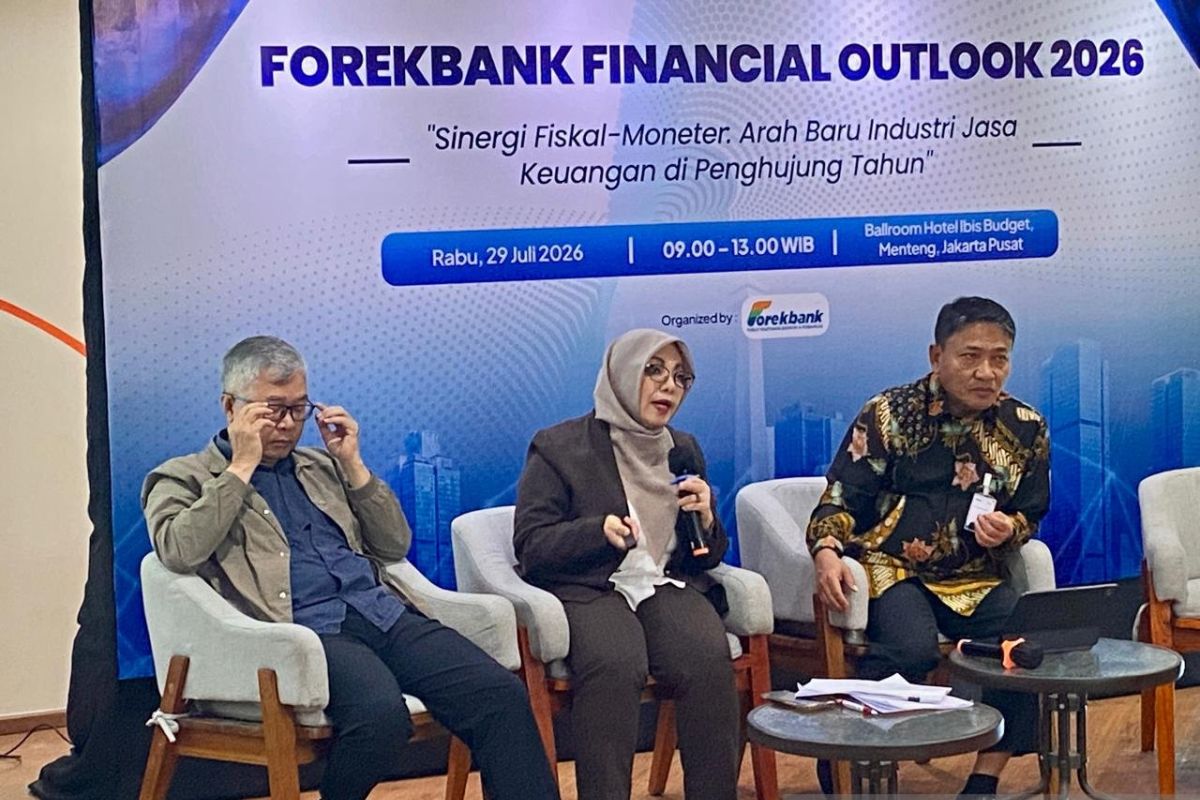
Jakarta (ANTARA) - Telisa Aulia Falianty, a professor at the Faculty of Economics and Business at the University of Indonesia (FEB UI), has reminded that the new Governor of Bank Indonesia (BI) faces no easy challenge: the ability to balance economic stability with growth.
Telisa explained that the task of maintaining stability whilst promoting economic growth and job creation frequently involves trade-offs, requiring the skill to find a point of equilibrium.
“If at some point we face a trade-off, how do we find the middle way? That indeed requires artistry. We need a central bank governor who can carry out the heavier task today, because BI has been given the mandate not only to safeguard stability but also to drive economic growth,” Telisa said at the Forekbank Financial Outlook 2026 discussion in Jakarta on Wednesday.
The new mandate to help drive economic growth is enshrined in the Financial Sector Development and Strengthening Law (UU P2SK).
Telisa explained that this task is not easy, because on one hand BI must maintain stability by preventing crises, controlling inflation, and safeguarding the exchange rate, whilst on the other it is also required to support growth through liquidity provision and higher credit disbursement.
Beyond shouldering this difficult task, she added that the new BI governor must also be a competent, professional figure with experience and deep understanding of the financial sector.
Telisa reminded that the credibility of the central bank governor is crucial for maintaining market confidence, since a loss of trust in central bank independence could lead to potential capital outflows.
As an example, she cited Turkey’s experience, where a change of central bank governor perceived as laden with political intervention triggered currency depreciation and capital outflows.
Although BI now holds a mandate to help drive economic growth, Telisa believes monetary policy must in principle remain oriented towards stability.
“If everything goes full throttle, who applies the brakes? Monetary policy must be pro-stability. Even with a pro-growth element, the priority must remain pro-stability. If both go full throttle, we could crash,” she said.
She also emphasised that central bank independence must be protected from political intervention so that the credibility of monetary policy is not undermined.
In addition, she assessed that synergy between monetary and fiscal policy must continue to be strengthened. According to her, the relationship between BI and the Ministry of Finance must be harmonious and mutually supportive, so that neither policy becomes too dominant.
“Fiscal cannot be too dominant over monetary, nor monetary over fiscal. They must be in synergy, because mutual dominance is very bad for the economy,” Telisa said.
On Monday (27 July), Bank Indonesia announced the resignation of Perry Warjiyo from his post as BI Governor, undertaken voluntarily for personal reasons. The resignation took place on Saturday (25 July).
Following Perry Warjiyo’s resignation, BI, through a Board of Governors Meeting (RDG) on Sunday (26 July), appointed Senior Deputy Governor Destry Damayanti as Acting Governor of BI. The appointment of the interim official was in accordance with Article 50 paragraph (2) of the Bank Indonesia Law.
At a press conference at the Jakarta Presidential Palace complex on Monday evening, Destry confirmed that the government has not yet submitted a recommendation for a candidate to replace Perry Warjiyo, who resigned from his post as BI Governor.
Destry explained that the mechanism for filling the position of BI Governor is regulated under the Bank Indonesia Law. Should a governor resign voluntarily, the process of selecting a replacement will begin in accordance with prevailing provisions.
She said the process starts with the nomination of Board of Governors members who meet the requirements. The candidate will then be selected and appointed by the president with the approval of the House of Representatives (DPR).