
UI Professor: Indonesia’s Foreign Policy Depends on Leadership Style
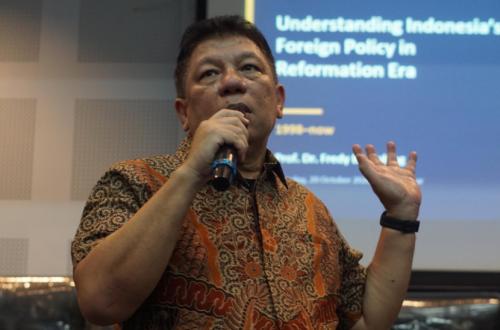
MAKASSAR — Indonesia’s foreign policy is shaped not only by national interests and global dynamics, but also by the leadership style of those making decisions. Leaders must be able to listen to public aspirations and put the interests of the people above their own or those of particular groups.
Professor Fredy BL Tobing, a professor of international relations at the Faculty of Social and Political Sciences of the University of Indonesia (FISIP UI), made the remarks during a guest lecture entitled “Indonesia’s Foreign Policy: From Theory to Practice” at Hasanuddin University (Unhas) in Makassar on Tuesday (20 October 2026).
“All the factors involved in decision-making are important, but ultimately it comes down to the leadership style of the decision-maker. A good leader listens closely to what will benefit society, and a wise statesman is prepared to sacrifice for the interests of all the people,” Fredy said.
The guest lecture, organised by the International Relations departments of FISIP UI and FISIP Unhas, discussed the development of Indonesian foreign policy since the Reformasi period and the challenges facing diplomacy amid changes to the global order.
Fredy explained that foreign policy cannot be separated from domestic politics. The Constitution provides the basis for formulating national interests, which are then translated into foreign policy; diplomacy is the instrument for implementing that policy.
Indonesia’s independent and active foreign policy, Fredy said, is rooted in the Preamble to the 1945 Constitution, particularly its first and fourth paragraphs. Translating that principle into concrete policy remains a challenge, however, given shifts in the international strategic environment and domestic political dynamics.
Since the 1998 Reformasi, Indonesia has also faced key priorities including democratisation, human rights, strengthening the rule of law and tackling terrorism. These priorities have helped shape the direction and priorities of the country’s foreign policy.
Fredy also introduced frameworks for analysing decision-making, including Graham Allison’s models and John P Lovell’s foreign policy strategy matrix. These frameworks help explain how different interests and considerations interact before the government determines its position on international issues.
Meanwhile, Associate Professor Asra Virgianita, PhD, of the FISIP UI Department of International Relations, discussed South-South Cooperation. Cooperation among developing countries, she said, is a diplomatic instrument that can strengthen Indonesia’s autonomy while expanding its international partnerships.
Asra said the focus of South-South Cooperation had evolved. Initially founded on anti-colonial sentiment and solidarity among developing countries, it has also developed into an instrument of economic diplomacy and development.
She divided its evolution into three phases: Concertation from 1945 to 1981, Containment from 1981 to 1995, and Cooptation vs Confrontation from 1995 to the present.
Unlike aid arrangements determined solely by donor countries, South-South Cooperation should ideally be demand-driven, based on the needs of recipient countries. This approach creates opportunities for developing countries to share knowledge, development experience and institutional capacity.
Asra nevertheless warned that the cooperation faces challenges. Competing national interests, limited domestic support, the sustainability of funding and institutional governance can all affect its effectiveness.
“South-South Cooperation is not an ideal form, but it is a modality that we can develop as part of Indonesia’s foreign policy. Indonesia’s story in South-South Cooperation is not well represented in the literature because it has not been widely researched, and we need to encourage more work in this area,” Asra said.
During the discussion, students asked about the risk of dominance by particular countries in South-South Cooperation, Indonesia’s role in South-South and triangular cooperation, and strategies for building Indonesia’s image as a development partner.
In response to concerns about dominance, Asra said a balancing strategy could help maintain an equilibrium between countries’ interests. This would need to be accompanied by stronger national capabilities and alternative sources of financing, so that Indonesia does not become overly dependent on external sources.
The guest lecture, chaired by FISIP Unhas international relations lecturer Abdul Razaq Z. Cangara, was part of academic collaboration between UI and Unhas, bringing theoretical perspectives into dialogue with the practice of Indonesian diplomacy.
The discussion highlighted two complementary aspects of foreign policy: the quality of leadership in setting its direction and the country’s ability to build international partnerships in support of national interests.
Source: jawawa.id (https://jawawa.id/newsitem/ui-professor-indonesias-foreign-policy-depends-on-leadership-style-1792561887)
Originally published by Republika (https://news.republika.co.id/berita/tn8sp1393/guru-besar-ui-politik-luar-negeri-indonesia-bergantung-pada-gaya-kepemimpinan), translated from Indonesian