
UI Professor: Governance Crucial for Medicine Sales in Minimarkets
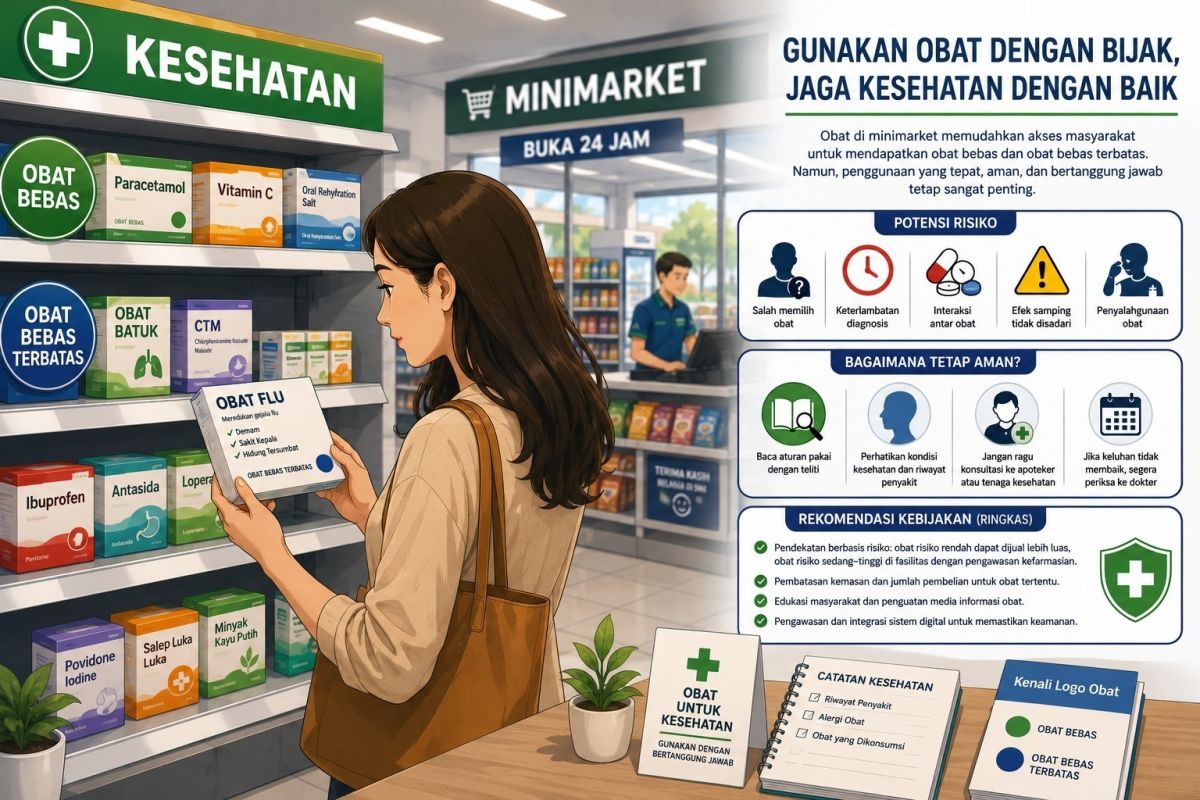
Professor Rani Sauriasari, a Professor of Clinical Pharmacy at the University of Indonesia’s Faculty of Pharmacy, has emphasised the importance of risk-based governance for medicine sales in minimarkets. “Medicine is not merely a commodity on a shelf, but a health intervention that can heal as well as harm if used without proper understanding,” Rani Sauriasari stated at the UI Depok campus on Thursday.
The sale of medicine in minimarkets is not a new phenomenon in Indonesia. Since the 1990s, the public has been accustomed to finding flu, headache, or cough medicines on modern retail shelves. However, this practice has long operated without regulatory certainty. Recently, the government has strengthened regulations through the Decree of the Minister of Health Number HK.02.01/MENKES/972/2025 and BPOM Regulation Number 5 of 2026, which regulate the distribution and supervision of over-the-counter and limited over-the-counter medicines in hypermarkets, supermarkets, and minimarkets.
This legal legitimacy is further reinforced by Law Number 17 of 2023 concerning Health and Government Regulation Number 28 of 2024, which includes modern retail as a legal channel for the distribution of non-prescription medicines outside of pharmacies. Professor Rani noted that this policy holds strong logic given Indonesia’s geography as an archipelagic nation where access to pharmacies and pharmaceutical professionals remains uneven. Minimarkets can serve as vital access points for the public to obtain simple medicines quickly.
However, unlike pharmacies, minimarkets do not provide a communication mechanism with pharmaceutical professionals. The absence of triage or initial patient assessment poses risks such as incorrect medication selection, delayed diagnosis of serious illnesses, drug interactions, and potential misuse. The policy brief highlights that not all over-the-counter medicines carry the same level of risk. Flu medicines containing pseudoephedrine, cough medicines with dextromethorphan, sedative antihistamines such as CTM, and multi-component combination medicines pose higher risks if obtained by consumers without supervision.
Consequently, the proposed recommendation is a risk-based approach: low-risk medicines may be sold more widely, while medium-to-high-risk medicines should only be available in facilities under the supervision of pharmaceutical professionals. International practices show similar patterns; in the United Kingdom, Japan, Denmark, Sweden, and South Korea, only certain categories of medicine are permitted for sale outside of pharmacies. In the United States, the ‘behind-the-counter’ system is used, where medicines with specific risks are not placed freely on shelves but must be requested through staff with limits on purchase quantities and identity recording.
Professor Rani proposed a moderate idea: strengthening the governance of medicine sales in minimarkets through restrictions on package sizes, purchase quantities, consumer education, the integration of digital monitoring systems, and the option to introduce medicine outlet units under pharmaceutical supervision within certain retail outlets. The policy brief, titled “Policy Recommendations for the Governance of Over-the-Counter and Limited Over-the-Counter Medicines in Other Facilities,” was co-authored by a research team from the UI Faculty of Pharmacy under the Health Innovation Study and Policy (HITS-Pol) research cluster.