
Uhamka's Eurasia Course 2026 Seminar Builds Cross-Language and International Cultural Insight
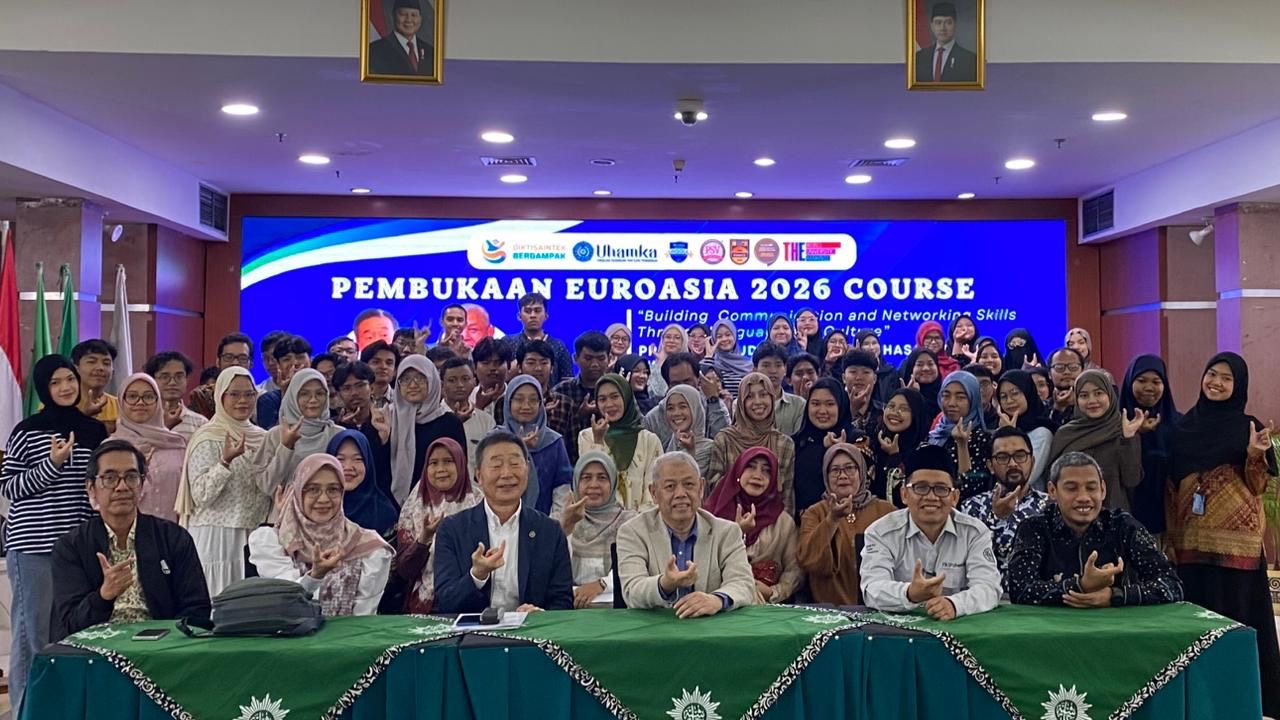
Universitas Muhammadiyah Prof. Dr. Hamka (Uhamka), through its Japanese Language Education Study Programme at the Faculty of Teacher Training and Education (FKIP), has successfully implemented a grant programme from the Eurasia Foundation via the Eurasia Course 2026 Seminar. The event runs from 5 March to 22 June 2026 at the Uhamka FKIP Campus. The Eurasia Course Seminar is a grant programme awarded to Uhamka’s Japanese Language Education FKIP by the Eurasia Foundation. It provides education on cultural and linguistic differences between countries, divided into 15 sessions, to broaden students’ knowledge in realising the internationalisation of higher education in line with SDG 10 on reducing inequalities. The Eurasia Seminar agenda was officially opened by Uhamka Rector Prof. Gunawan Suryoputro and featured 15 national and international speakers. Chairman of the Eurasia Foundation, Yoji Sato, delivered material inviting participants to understand the essence of humanity, life, and universal truth through cross-cultural, philosophical, spiritual, and scientific approaches. The ultimate goal is to build world peace and enhance human moral awareness. Chung Joon Kon from the Eurasia Foundation presented material titled ‘Towards a New Community’. This session invited participants to understand the essence of humanity, life, and universal truth through cross-cultural, philosophical, spiritual, and scientific approaches. He asserted that the world currently needs a new paradigm for building a global community. While the state retains an important role, humanity must move towards broader, more open forms of cooperation that respect diversity. By reducing the boundaries and barriers that separate people, the global community can create a more peaceful, just, prosperous, and harmonious life. The envisioned new community prioritises humanity, tolerance, and cross-national collaboration for a shared future. Loch Leaksmy from the Royal University of Phnom Penh, Cambodia, presented material demonstrating how education can transform an individual’s life and even contribute to nation-building. Despite growing up in a conflict-ridden and constrained Cambodia, Loch Leaksmy managed to develop herself through education and the Japanese language. Her journey is proof that a passion for learning, courage to face challenges, and willingness to give back to society can bring positive change to oneself and the surrounding environment. The key message is that education, hard work, and social awareness are the keys to building a better future. Katagiri Junji from Tottori University, Japan, presented material on rubric-based assessment of Japanese communication skills. The material emphasised that Japanese communication ability is assessed not only on linguistic accuracy but also on content, interaction skills, fluency, and comprehensibility. Using rubrics helps students conduct objective self-evaluations, receive peer feedback, and improve communication skills in a more targeted and effective manner. Hisanori Kato from Chuo University, Japan, discussed the mentality of Japanese people in the global era, providing students with new insights. Mikihiro Moriyama from Nanzan University, Japan, presented material explaining that cultural understanding is crucial in language learning as it enhances communication skills and reduces misunderstandings. Although Indonesia and Japan share many cultural similarities, learners still need to understand differences in values and communication styles to interact more effectively and appreciate each other’s cultures. Prof. Gunawan Suryoputro expressed appreciation for the Eurasia grant programme as a step towards realising the internationalisation of higher education by providing insights from national and international experts. ‘This Eurasia Seminar is the implementation of a grant programme received by Uhamka’s Japanese Language Education FKIP from the Eurasia Foundation, serving as a means to broaden students’ insights into the cultural, historical, and linguistic differences of various countries, especially Japan, thereby increasing their motivation to study and deepen their knowledge of foreign languages, including Japanese,’ he said. Meanwhile, Yoji Sato, Founder of the Eurasia Foundation, expressed his high hopes for broader follow-up cooperation, starting with this Eurasia Course activity with Uhamka. ‘This cooperation is the first step in the collaboration between the Eurasia Foundation and Uhamka, and hopefully, in the future, it can be expanded to include academic networks in education and collaborative research,’ concluded Yoji Sato.