
UGM’s GIFTS 2026 Concludes, Bringing Innovators and Industry Together to Accelerate Commercialisation
YOGYAKARTA — Universitas Gadjah Mada’s (UGM) Global Innovation and Future Technology Summit (GIFTS) 2026 officially concluded at the university’s Gelanggang Inovasi dan Kreatif (GIK) on Thursday (22 October 2026). The event brought together innovators, universities, industry, investors, government and strategic partners in a collaborative ecosystem to accelerate the commercialisation of research and innovation.
Under the theme “Cultivation: Culture – Innovation – Business Acceleration”, GIFTS 2026 was designed not merely as a forum for exchanging ideas, but as a platform to connect innovation with real-world needs, research with industry, and business potential with investors and users.
GIFTS 2026 was organised by UGM Science Techno Park through the PRIME STeP programme, in collaboration with Gelanggang Inovasi dan Kreativitas, Kadin DIY, Meet The Investor and ICONIC, with support from various partners in the innovation ecosystem.
The programme comprised pre-event and main-event activities on 21–22 October 2026, with around 70 sessions held in parallel. These included Business Matchmaking, Investor Speed Dating, Pasar Inovasi, the Formind Annual Meeting, business talk shows, Collaboration Class, Startup Grooming, Research to Business Grooming, an Intellectual Property Management and Technology Transfer Forum, a gathering of university-owned enterprises, a Doctoral Research Forum, focus group discussions, a CPD workshop, Sharing Senja and other collaborative activities.
At the GIFTS 2026 opening ceremony, Fauzan Adziman, Director General of Research and Development at the Ministry of Higher Education, Science and Technology, said Indonesia had abundant talent, knowledge and innovation potential. However, this potential would not automatically become an advantage. Indonesia’s challenge, he said, was not simply to produce more research, but to develop the capacity to advance and apply research outcomes, and extend their benefits, so they could better address the needs of industry, society and national development.
“Relations between universities, industry and government cannot stop at meetings or agreements. We need to work together from the point when a problem is defined, through technology testing, to the sustainable implementation of solutions,” the Director General said in his opening remarks, delivered online.
That message was a key foundation for GIFTS 2026, which connected innovators with industry, investors, off-takers, government and strategic partners through matchmaking and collaboration forums.
One of the summit’s achievements came through Business Matchmaking and Investor Speed Dating. A total of 204 startups registered for the speed-dating programme, from Yogyakarta, Bali, Surabaya, Bandung and Jakarta. Of these, 76 were selected to take part in matchmaking with investors and potential partners.
Meanwhile, within the PRIME STeP ecosystem, 177 research projects and innovations underwent a selection process conducted by KADIN DIY. Of these, 100 were selected for further business matchmaking, and 27 succeeded in securing partners. The results indicate that GIFTS is beginning to move innovations from research towards partnership, rather than stopping at showcases or exchanges of ideas.
“Through GIFTS 2026, we hope to see concrete follow-up: industry needs finding solutions, research outcomes securing development partners, and collaborations with clear objectives and measures of success,” said UGM Rector Professor Ova Emilia.
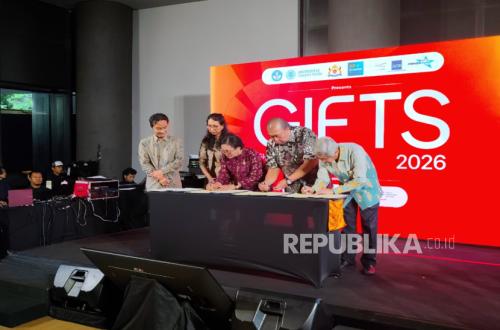
A commitment to collaboration was one of the key outcomes of GIFTS 2026. Seven cooperation agreements were signed at the opening ceremony. More than 50 cooperation documents and letters of intent (LoIs) were also signed ceremonially during the event. They included memoranda of understanding, cooperation agreements, non-disclosure agreements and LoIs involving various stakeholders in the innovation ecosystem.
UGM Vice-Rector for Research, Business Development and Cooperation Danang Sri Hadmoko said the signing of the documents was a starting point for building more concrete partnerships.
“Agreements reached through GIFTS are expected to lead to product development, investment, licensing and technology transfer, joint development with industry, production, and the adoption of innovations by users,” he said.
GIFTS 2026 also demonstrated the importance of Science Techno Parks as links between universities and the business and industrial sectors. UGM organised the summit with support from the Promoting Research and Innovation through Modern and Efficient Science and Technology Parks (PRIME STeP) programme, in collaboration with KADIN, Meet The Investor (MTI) and the Infrastructure and Construction Innovation Conference and Workshop (ICONIC). Cross-STP collaboration through Pasar Inovasi also showed that strengthening the commercialisation ecosystem requires broader networks.
Through this cooperation, universities do not have to bring research outcomes to users alone, but can build connections with industry, investors, government and strategic partners.
In his opening remarks, Fauzan also stressed that technological independence did not mean closing Indonesia off from the world. It meant having the capacity to understand, select, adapt and develop strategic technologies in the national interest. Global cooperation, he said, should strengthen national capabilities rather than prolong dependence.
“The success of innovation is therefore measured not only by economic growth and competitiveness, but also by who benefits, how much national capacity is enhanced, and how social and environmental impacts are managed,” he said.
That message was reflected in GIFTS 2026 sessions addressing food, energy, water, the environment, disaster management, waste, the seed industry and the cocoa ecosystem. The theme of Cultivation was therefore not limited to business acceleration, but also concerned how innovation grows from culture, local needs, ethics and responsibility towards society and the environment.
GIFTS 2026 showed that commercialisation requires an ecosystem. Universities generate knowledge and innovation; industry brings needs and production capabilities; investors provide access to financing; and government strengthens the ecosystem and policy. Society, meanwhile, is both the user and the ultimate beneficiary.
The success of commercialisation should therefore not be judged simply by the volume of research produced, but by how far knowledge becomes innovation, innovation becomes products and businesses, and those products and businesses deliver benefits to society. “This is the spirit we want to continue building through GIFTS: from research to innovation, from innovation to business, and from business to impact,” Fauzan said.
Source: jawawa.id (https://jawawa.id/newsitem/ugms-gifts-2026-concludes-bringing-innovators-and-industry-together-to-accelerate-commercialisation-1792749178)
Originally published by Republika (https://rejogja.republika.co.id/berita/tncqq8291/gifts-2026-di-ugm-resmi-ditutup-pertemukan-para-inovator-dan-industri-untuk-percepat-hilirisasi), translated from Indonesian