
UGM's FK-KMK Hosts 2026 Summer Course on Health Issues in Disaster Management
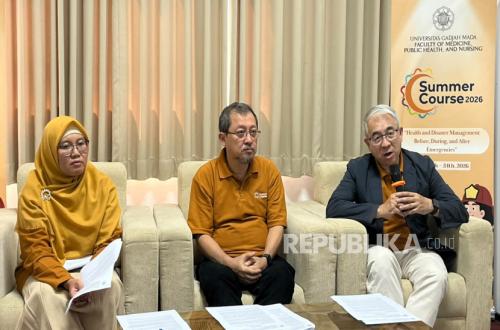
The Faculty of Medicine, Public Health, and Nursing (FK-KMK) at Universitas Gadjah Mada (UGM) is hosting the Summer Course 2026 on Interprofessional Healthcare-Health and Disaster Management from 13–24 July 2026. The programme aims to address the various health challenges that arise before, during, and after disasters.
Vice Dean for Academic and Student Affairs at FK-KMK UGM, dr Ahmad Hamim Sadewa, stated that disasters are unpredictable events requiring thorough preparedness. He noted that disaster management cannot rely on a single sector but requires cross-professional and cross-disciplinary collaboration. “This programme serves as an international learning platform that brings together students and academics from various disciplines to strengthen collaborative capacity in facing health challenges during disaster situations,” Hamim said during a press conference on Monday (13/7/2026).
Hamim observed that coordination problems frequently recur when disasters strike. “When a disaster occurs, it’s as if we are caught off guard, there is a lack of coordination,” he said. “Why does this happen repeatedly? When a disaster occurs, the expectation is that we are already prepared and have good management in place.” He added that strengthening human resource capacity must be done early so that mitigation, emergency response, and recovery processes can run more effectively. The programme is also part of UGM’s contribution to supporting the development of a sustainable health system and increasing community capacity to face disaster risks at both local and global levels.
Summer Course 2026 Chairperson, Melyza Perdana, explained that the programme is being attended by 81 undergraduate, professional, and postgraduate students from UGM, other domestic universities, and various international partner institutions. Participants come from Indonesia, Palestine, the United Kingdom, Austria, Turkey, Spain, Kyrgyzstan, the Netherlands, Timor Leste, Thailand, and Malaysia. Learning is not limited to health students but also includes participants from engineering, biology, and philosophy backgrounds, as disaster management requires a multidisciplinary approach.
Through the interprofessional education (IPE) approach, participants will study topics including strengthening resilient health systems, disaster preparedness, emergency health services, refugee management, mental health and psychosocial support, disaster victim identification, post-disaster recovery, and nutritional management in emergencies. The programme also includes field visits to the Sleman District Disaster Management Agency (BPBD) in Pakem, permanent housing for Merapi eruption survivors, and the UGM Academic Hospital to study hospital-based disaster management systems.
Assoc. Prof. Fu-Chih Lai from Taipei Medical University, Taiwan, was invited to share international perspectives. He highlighted the similarities between Taiwan and Indonesia as disaster-prone countries facing earthquakes and volcanic activity, creating opportunities for mutual learning on preparedness and emergency response systems. He cited Taiwan’s early warning system that automatically sends notifications to all mobile phones, including those of foreign nationals, and expressed interest in discussing how Indonesia manages information dissemination and assistance for international tourists during disasters. He also expressed hope for strengthened cooperation between UGM and Taipei Medical University through student exchanges, academic collaboration, and disaster research.