
UGM Team Reveals Source of Fire Terror at Fia's House Linked to PVC Resin, Not Gas
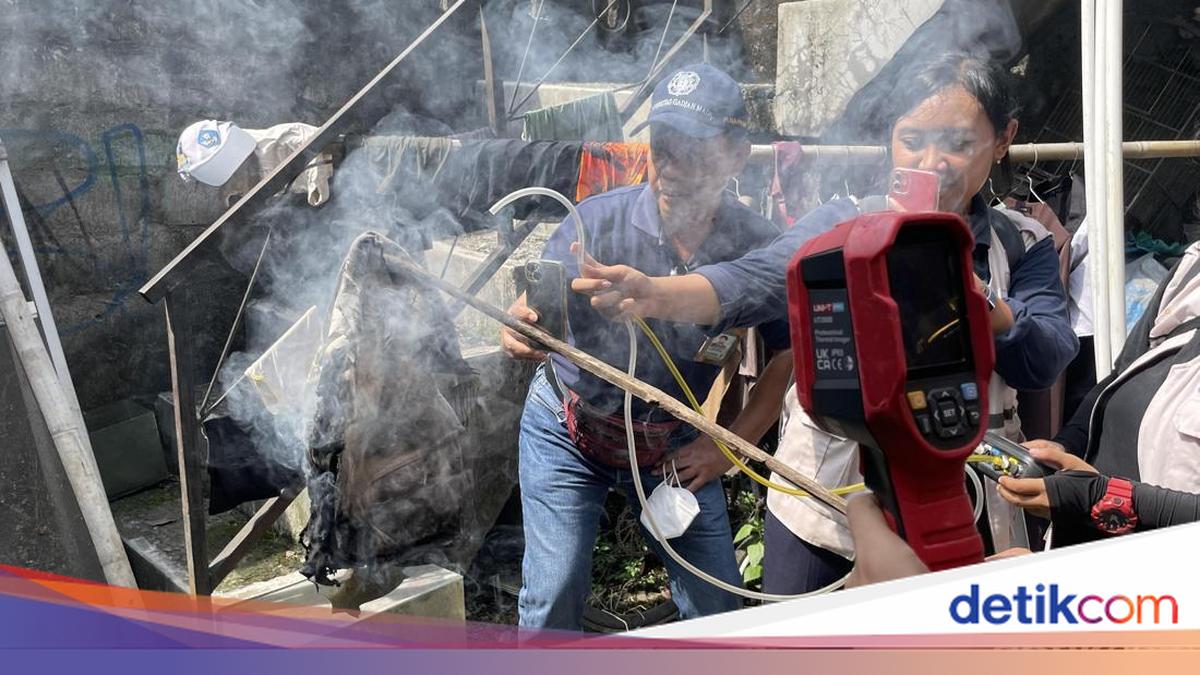
The Centre for Entropy Deceleration Studies (PKPE) at the Faculty of Engineering, Universitas Gadjah Mada (UGM), has concluded that the fire terror phenomenon at a resident’s house in Seyegan, Sleman, is not related to gas. The appearance of the fires is suspected to be linked to polyvinyl chloride (PVC) resin.
“The fire source is not from natural gas seepage beneath the surface (floor); there is no thermal anomaly and no gas was found that could self-ignite naturally at room temperature,” explained PKPE FT UGM team leader, Prof Alva Edy Tontowi, to reporters at FT UGM on Saturday (13/6/2026).
Based on research results and referring to the Fire Triangle Theory Principle, the team concluded that the electromagnetic field was measured at a safe level, meaning it was not the ignition source for the flames. The fire that burned materials in this case is likely associated with the presence of PVC resin, which is easily flammable when it encounters an ignition source. This suspicion arose after PVC resin was found on the burnt material.
“This resin was found in the combustion residue based on FTIR method testing,” Alva stated. The team also analysed several burnt materials using the Headspace GC (Gas Chromatography) method. The results showed that the material did not burn due to hydrogen gas.
“The analysis results could only detect the presence of CO2 gas and did not find residual hydrocarbon elements or solvents that could be used as fire accelerants,” said Alva. On Friday (12/6), the team took additional samples from fire residue on ceramic wall surfaces and wood/plywood, and analysed them using the FTIR method.
“The FTIR analysis results show that these samples contain polyvinyl chloride (PVC), which is not commonly found on ceramic wall surfaces or wood/plywood,” he clarified.
Alva stated that these results mark the conclusion of the research into the fire phenomenon at Mutfia’s house in Seyegan, Sleman. The study’s findings have also been submitted to the Sleman Regional Disaster Management Agency (BPBD).
“On this occasion, the PKPE FT UGM Team declares that the research on the fire phenomenon that has been conducted is now complete. Henceforth, the PKPE FT UGM Team submits these updated research results to BPBD Sleman,” he asserted.
It was previously known that the PKPE FT UGM team had suspected the fire phenomenon at Fia’s house was related to the presence of hydrogen gas originating from chicken slaughter waste. This has now been dismissed.
“Previously, it was suspected that the hydrogen gas was associated with pyrophoric gas originating from chicken cutting waste,” he explained. Spatially, from altitude observation results using a drone and Thermal Infrared sensor conducted in the early hours at the fire location up to a 200-metre radius around it, no thermal anomaly was indicated.
Furthermore, electromagnetic field measurements, which were suspected to potentially act as a flame igniter, showed that the electric and magnetic fields at the incident location were at normal or safe levels. “Subsurface mapping results using Georadar and Geoelectric technology did not find any subsurface layer acting as a natural gas source, and the cracks found are interpreted as not containing natural gas,” he revealed.
Source: jawawa.id (https://jawawa.id/newsitem/ugm-team-reveals-source-of-fire-terror-at-fias-house-linked-to-pvc-resin-not-gas-1781401983)
Originally published by detikJogja (https://www.detik.com/jogja/berita/d-8530612/tim-ugm-ungkap-sumber-teror-api-di-rumah-fia-terkait-resin-pvc-bukan-gas), translated from Indonesian