
UGM Team Discovers Underground Anomaly Near Seyegan 'Fire House'
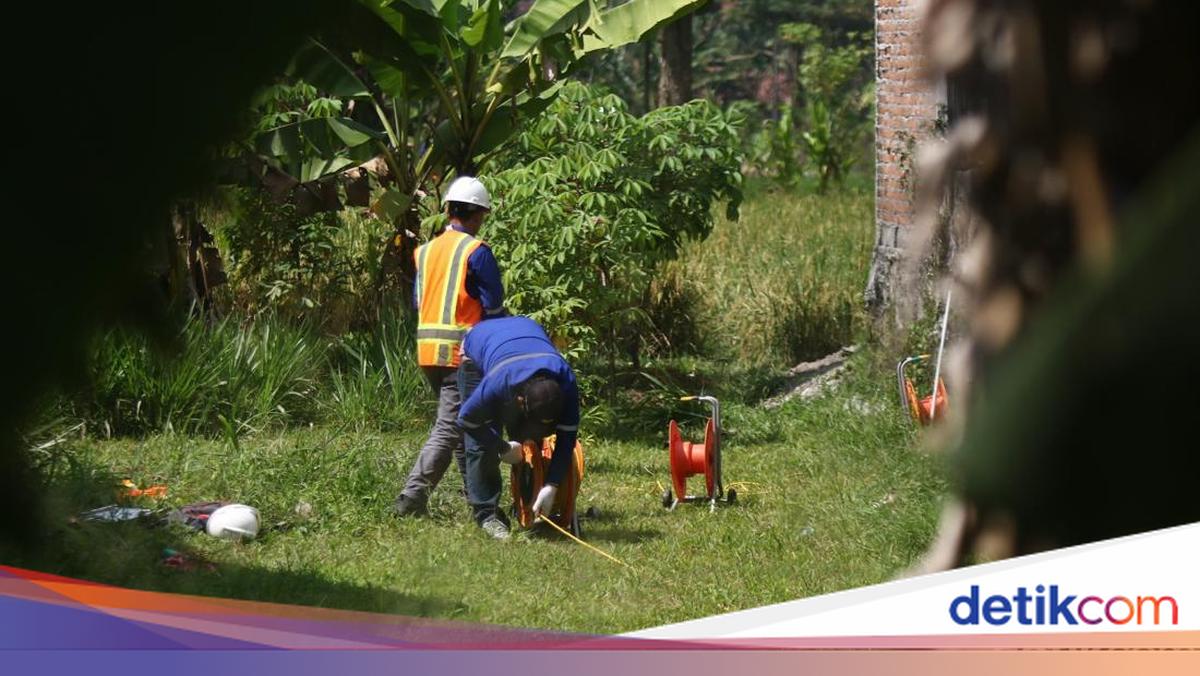
A research team from Gadjames Mada University (UGM) has conducted underground mapping using geoelectrical methods around the home of Mutfiana, a resident of Seyegan, Sleman, who has experienced repeated fires. The results show that researchers have discovered anomalies in the soil layers near the house.
Saptono Budi Samodra, a researcher from the Laboratory of Exploration Geophysics, Department of Geological Engineering, FT UGM, explained that this geoelectrical method is similar to the one previously used by researchers from UPN. However, the UGM team is focusing on capturing more detailed variations in the soil layers.
“Previously, the UPN team conducted two-dimensional geoelectrics with relatively wide spacing to focus on depth. We are using much shorter spacing, around 1 metre, around the house to capture more detailed variations of what exists in the immediate vicinity,” Saptono told reporters in Seyegan on Tuesday (9/6/2026).
Saptono elaborated that the two-dimensional geoelectrics will be conducted along two tracks, while the one-dimensional geoelectrics will be performed at two specific points. The measurements are concentrated around the house where the fires occurred and are intended to complement the data provided by UPN.
“We are covering the south, north, east, and west sides of the house to localise the findings. Since we are working in collaboration with other teams, and UPN has already conducted a broader regional geoelectrical survey, we are providing the detail around the house,” he said.
Geoelectrical measurements cannot be read instantly like georadar measurements. However, preliminary results indicate several anomalies beneath the surface. Currently, an anomaly has been detected south of Mutfiana’s house.
“There is a different resistivity anomaly, which indicates different materials underground. If the pattern shifts, it could indicate the presence of fissures or buried objects with different electrical properties,” he explained.
Nevertheless, the data requires further processing. The team will model and analyse the findings using one-dimensional geoelectrical methods to examine the soil layers. This is also intended to test the hypothesis from UPN researchers regarding the presence of swamp deposits that could potentially be a source of gas.
“After finding indications of cracks, whether those cracks are filled with gas or not will depend on the underground source. It could simply be a fissure that is not being traversed by gas, which would have no impact. However, if there is a gas source below, it could have a significant impact on what is happening on the surface,” he concluded.
To date, the spontaneous fire incidents that have been burning various items in Mutfiana’s home in Seyegan, Sleman, have been ongoing since Saturday (23/5).
There have been recorded hundreds of incidents over the past two weeks. The homeowner hopes for a swift resolution, especially following reports that items in a neighbour’s house have also been affected by fire.
“The most important thing for me is to find a solution so this ends quickly. It is exhausting,” said Fia.
Source: jawawa.id (https://jawawa.id/newsitem/ugm-team-discovers-underground-anomaly-near-seyegan-fire-house-1781002478)
Originally published by detikJogja (https://www.detik.com/jogja/berita/d-8524885/tim-ugm-temukan-anomali-di-bawah-tanah-sekitar-rumah-api-seyegan), translated from Indonesian