
UGM Team Detects Cracks Suspected to be Gas Pathways Triggering Fires in Sleman House
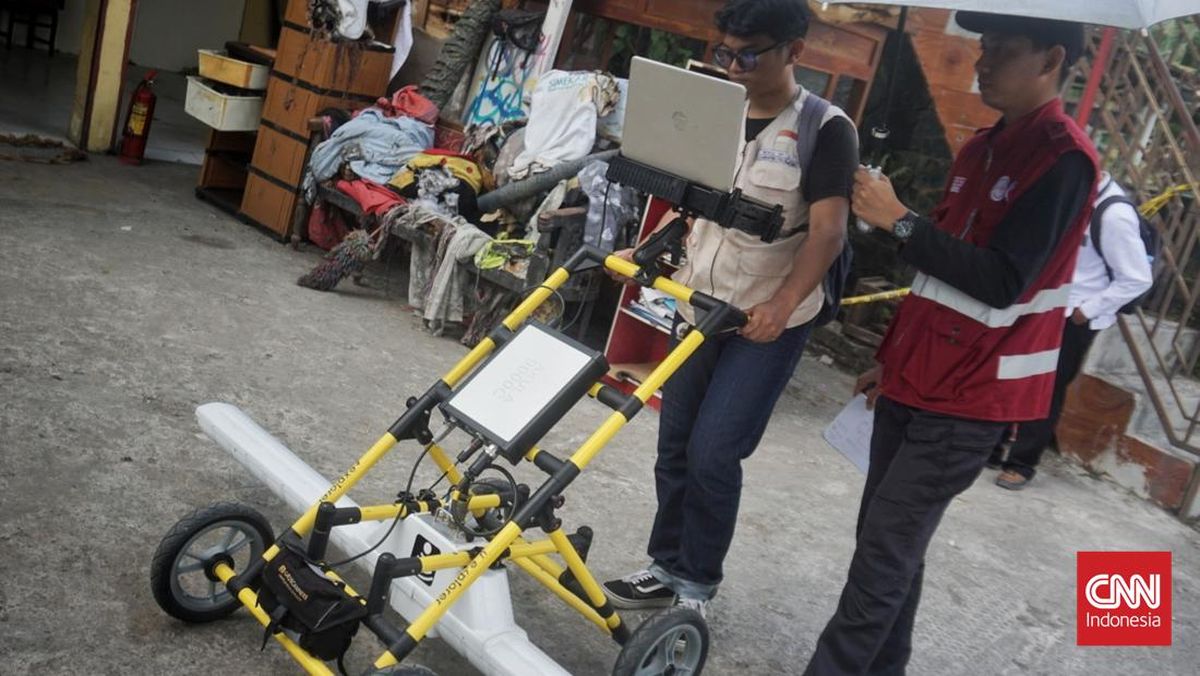
A research team from Universitas Gadjram Mada (UGM) has discovered several cracks at varying depths beneath the floor surface of Mutfiana’s house in Seyegan, Sleman, DIY. These subsurface cracks are suspected to act as conduits for compounds potentially linked to the recurring fire phenomena at the residence.
The cracks were identified using ground-penetrating radar (GPR) by the team from the Laboratory of Exploratory Geophysics, Department of Geological Engineering, UGM. Saptono Budi Samodra, a researcher on the team, stated that they attempted to detect specific points previously reported as locations where flames emerged. “The surface fill was visible on the device, but beneath that, in the original soil, there are patterns or crack structures appearing in several places,” Saptono said during a visit to the house on Monday (8/6).
The GPR device operates using 60 MHz electromagnetic wave pulses to map subsurface structures. Waves are transmitted into the ground and reflected back to the surface when they encounter materials of different densities for analysis. The detected cracks appear as hairline fractures or larger dimensions cutting through several soil layers, some perpendicular and some tilted, yet potentially synchronised with the fire emergence points.
While the depth of the cracks varies, Saptono noted that the electromagnetic waves from the GPR are limited to a maximum depth of 20 metres. The team is currently presenting preliminary readings, which require further data processing to confirm the link between the cracks and the flammable compounds. Future steps include using geoelectrical surveys for deeper measurements and manual drilling to examine the soil layers.
This geological investigation seeks to explore alternatives to the preliminary conclusion by the Centre for Entropy Slowing Studies (PKPE) of the UGM Faculty of Engineering, which suggested that the fires were triggered by hydrogen (H2) and phosphine (PH3) gases. The PKPE hypothesis posits that these gases result from the fermentation of organic waste, such as a mixture of manure, wastewater, and chicken feathers, from the poultry slaughtering business operated by the resident. Saptono emphasised that his team is looking for geological causes unrelated to the poultry business.
Fia, the resident, reported that fires have occurred 113 times within 17 days of the initial incident. She noted that the daily intensity of spontaneous combustion has been decreasing, which experts suggest may be due to increased human presence in the house reducing available oxygen levels.
Simultaneously, a research team from UPN Veteran Yogyakarta, led by Professor Basuki Rahmat, is investigating potential geological gas sources. They have identified source rocks in a nearby river area, approximately 300 metres from the house, suspecting that natural gases, including methane (CH4) and hydrogen, could originate from dark, organic-rich siltstone deposits. The UPN team has also conducted geomagnetic surveys to search for ultrabasic and volcanic rocks capable of producing hydrogen, alongside geoelectrical surveys to map subsurface rock layers and detect cavities that could serve as gas pathways.