
UGM Students' Statement on Budiman et al. Discussion: Not a Genuine Forum
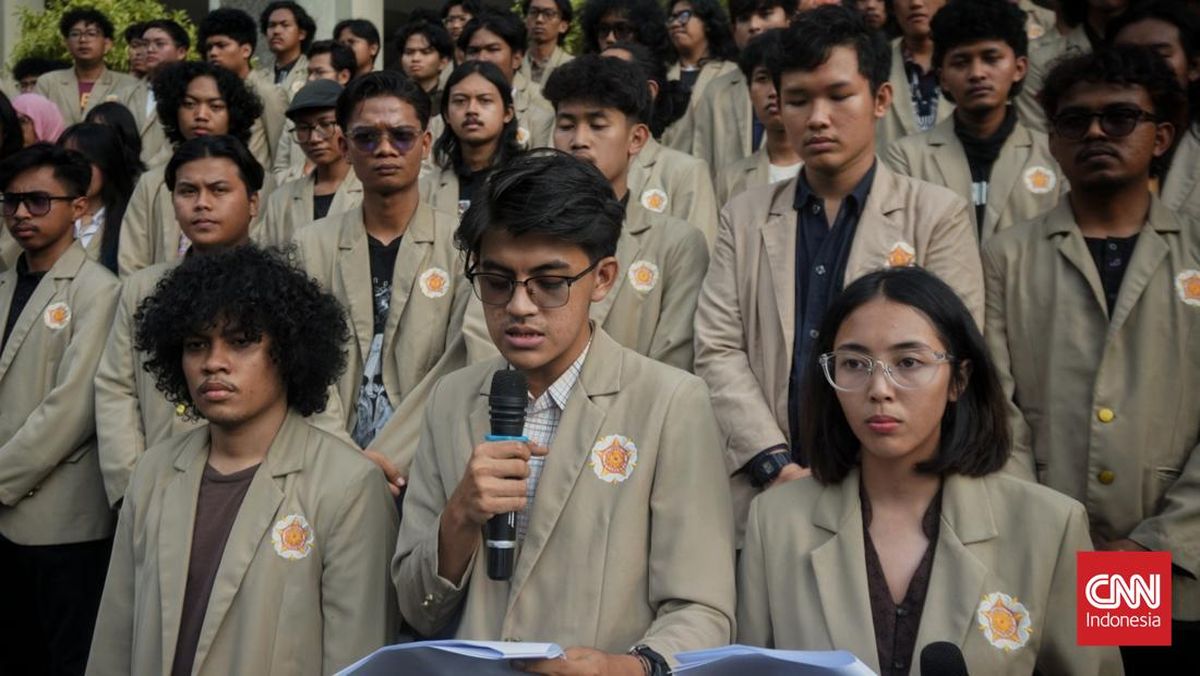
A group of Universitas Gadjah Mada (UGM) students has declared that the ‘kopdar’ (casual meet-up) discussion event they disrupted on Monday night (15/6) at the GIK Joglo, UGM, was not a ‘genuine’ forum. The statement was read out on Wednesday afternoon (17/6) at the Balairung hall, Sleman, explaining their actions against the forum which featured Minister of Agrarian Affairs and Spatial Planning/National Land Agency Nusron Wahid, Deputy Minister of Agriculture Sudaryono, and Head of the Poverty Alleviation Acceleration Agency Budiman Sudjatmiko. The event was themed ‘Pancasila Unites the Indonesian Nation’.
In their statement, the students emphasised that the action at GIK was an expression of their distrust towards a government that has repeatedly and clearly oppressed the people. Upon learning of the event, including the list of attending officials and their supporting media outlets, students who felt disgusted gathered and refused to remain silent. ‘After we entered GIK one by one, our suspicion that this forum was not a genuine discussion forum was increasingly affirmed,’ the statement read. They argued that the event, labelled as a discussion platform, was merely a showcase for government achievements, with an unequal share of speaking time that prevented substantive correspondence.
‘Amidst all the shouting, clashes, and objects thrown onto the stage from various directions and parties, the only thing that should be highlighted is our disgust and distrust towards a government that first oppressed its people with violence,’ they stated. They questioned whether they were not allowed to show their disappointment, distrust, and anger after government violence had been laid bare through corruption, evictions, arrests, and killings. The students asserted that the recurring violence, which increasingly disgusts them, proves that the logic of blaming ‘rogue individuals’ can no longer be justified.
They assessed that the anger which erupted in the forum did not appear suddenly but was an accumulation of disappointment with various government policies deemed not pro-people. The students described the series of violent acts as the result of structural decay continuously maintained by the regime. They cited policies such as the Free Nutritious Meals programme (MBG), which they claim sacrificed the education budget, the food estate project alleged to be a pretext for seizing the living space of indigenous communities in Papua, and the revision of the TNI Law and the Police Bill, which they say expands state occupation of civilian space.
The UGM students also stressed that they have never rejected dialogue or discussion. However, they questioned how a substantive, solution-oriented, and equal discussion could take place with government officials they consider untrustworthy and not aligned with the people’s interests. Consequently, they deemed the forum held at GIK did not meet the requirements for an equal and open dialogue space. The anger of the protesters, they noted, was also triggered by recent economic issues, highlighting the weakening rupiah exchange rate, the swelling state budget deficit, and the narrowing fiscal space impacting education, health, and social protection sectors.
They also touched on the increase in Pertamax fuel prices, which they believe could potentially increase fiscal pressure through a larger energy subsidy burden. At the same time, the students highlighted a wave of layoffs (PHK) worsening public conditions, noting that tens of thousands of workers have lost their jobs throughout 2025 while various industrial sectors remain under pressure. This situation, they said, leaves many people merely struggling to meet daily needs amidst economic uncertainty. They also criticised the large budget allocations for the defence and security sectors, arguing that the hundreds of trillions of rupiah received by the Ministry of Defence, the National Police, the State Intelligence Agency (BIN), and the National Narcotics Agency (BNN) indicate a government tendency to expand hegemony through state security apparatuses. They also mentioned plans to establish Reserve Component (Komcad) battalions in every district and city as part of the militarisation of public space.
In their statement, the students also highlighted various issues concerning democracy and human rights. They questioned the enforcement of human rights, the rule of law, and government accountability by citing cases of state violence, alleged extrajudicial killings, restrictions on civil liberties, and the criminalisation of activists. They also highlighted the situation in Papua and assessed that the government has consistently failed to show openness regarding various allegations of violations occurring in the region.
As a result, the students challenged the government to prove its commitment to democracy through concrete actions. They demanded the release of all political prisoners and amnesty for those criminalised, an end to restrictions on demonstrations, the withdrawal of the military from civilian spaces and the revocation of the TNI and Police Laws, and a halt to the criminalisation of activists. According to them, fulfilling these demands is a real measure of whether the government truly sides with the people. ‘If these demands cannot be met, then it is clear to us that the government never has and never will,’ they said. In addition to addressing the government, the statement also contained an appeal to UGM Rector Ova Emilia, urging her as a representative of UGM to take a stand.