
UGM Students Explain Why They Stormed Discussion Event: 'Take Officials to the Street'
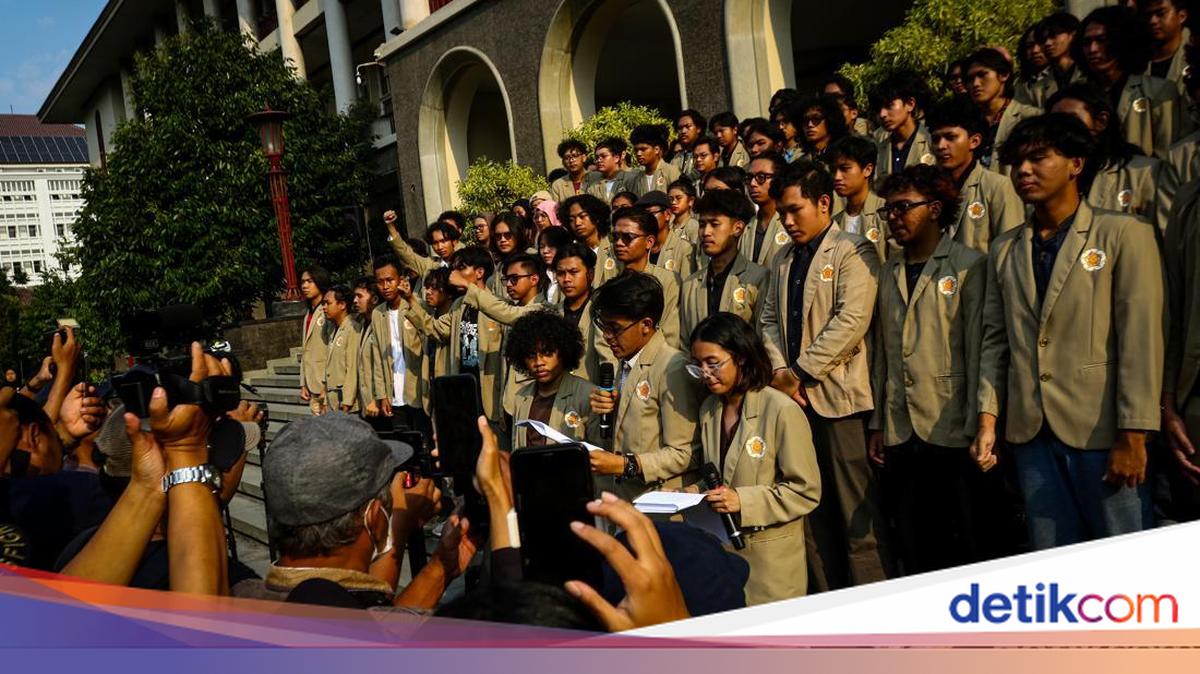
Students from Gadjah Mada University (UGM) have spoken out about their reasons for storming a discussion event at the UGM Innovation and Creativity Centre (GIK) on Monday evening (15/6). The students stated they wanted to take the officials attending the event to the street, a neutral space, to question their allegiance to the people. The event that evening was attended by the Minister of Agrarian Affairs and Spatial Planning/National Land Agency, Nusron Wahid; Deputy Minister of Agriculture, Sudaryono; and Head of the Agency for the Acceleration of Poverty Alleviation, Budiman Sudjatmiko. The event initially proceeded smoothly. Then, a number of students suddenly climbed onto the stage and unfurled protest banners. The situation escalated after more people joined those on stage, and the three officials were eventually evacuated. However, hundreds of students blocked them outside the UGM GIK. Nusron Wahid and Sudaryono briefly sat down to dialogue with the crowd, but the talks reached a deadlock. As both men left the location under escort, a shoving match occurred between students and security personnel. UGM student spokesperson Gladwin said the action was carried out collectively. They stated that what happened during the protest was a form of expression of disappointment with a government that has repeatedly oppressed the people. “Essentially, we collectively went there because we were restless, and whatever happened there is a form of our expression,” Gladwin said during a press conference and reading of the UGM students’ statement of position at Balairung on Wednesday (17/6/2026). He dismissed the notion that the students had intended to disband the discussion from the outset. According to him, the students came to convey their aspirations and criticism to the officials present at the forum. “It is a form of expression that we consider valid because of the oppression that the people have felt, and we have felt, all this time. So what happened there, whether it is called a disruption or anything else, what needs to be emphasised is that yesterday’s expression occurred because of the government’s lack of allegiance to the people that has been ongoing,” he asserted. Sarah, one of the UGM student representatives, while reading the chronology of events, said the students’ arrival stemmed from a post about the state officials’ visit to UGM accompanied by pro-government media. “We, who were already fed up, then gathered and refused to stay silent. After one by one we entered the GIK, our suspicion that this forum was not a genuine discussion forum was increasingly affirmed,” she said. “The event labelled as a ‘discussion’ platform turned out to be merely a showcase for ‘government achievements’ with a clearly unequal share of speaking time to produce substantive correspondence,” she added. Sarah stated that the anger at the GIK was triggered by many things, such as the increasingly plummeting Rupiah exchange rate, the rise in non-subsidised fuel prices feared to cause a domino effect, and the wave of layoffs sweeping tens of thousands of workers. “It must be emphasised that UGM students are never anti-dialogue or anti-discussion. However, we earnestly ask our friends to explain to us how we can possibly have a substantive, solution-oriented, and equal discussion with government officials who are clearly untrustworthy and do not side with the people,” she said. Another UGM student representative, Mesa, said that in the context of democracy, discussions should not be held in a political space conditioned by the ruling power, but rather in a space based on the principle of equal interests and allegiance to the people. “Therefore, our first instinct was to take those state officials to the street; to a space not conditioned by the ruling power, and then question their allegiance,” Mesa said. With all the facts clearly evident, Mesa said the answers they gave showed their lack of allegiance to the people. “Instead of admitting mistakes, they actually asked one of the protesters to see the conditions in Papua firsthand. We do not want the conditions in Papua to be seen only by a handful of us,” he said. “If it is true that there is no oppression and violence against the people in Papua, then show it to the entire Indonesian public. Show this by opening the widest possible access for the press to cover conditions in Papua and withdraw all military troops that have been spreading terror among the people,” he continued. Therefore, if the government truly wants to uphold democratic principles, they challenge the government to prove it. They demand the government prove it starting from the most basic thing, by guaranteeing the security of civilian spaces for voicing opinions. The UGM students also conveyed the following demands to the government: Free all political prisoners and grant amnesty to comrades who have been criminalised; Stop restricting demonstrations, as happened with UI students at the HI roundabout; Withdraw the military from civilian spaces and revoke the TNI Law and the POLRI Law; Stop the criminalisation of activists. “If these demands cannot be met, then it is clear to us that the government has never and will never side with the people, so that democracy itself has essentially died. Therefore, the only way out of this situation is to reclaim power into the hands of the people by any means necessary to restore civilian supremacy,” they asserted. In this regard, they also believe that academics should show a true intellectual stance by discussing the facts as they are. The students urged UGM Rector Ova Emilia, who represents UGM as an academic institution, to show her stance and allegiance to the facts that are already clearly evident. “Affirm that UGM no longer trusts the Prabowo-Gibran administration, which has repeatedly and clearly shown its lack of allegiance to the people, and affirm that.”