
UGM Students Criticise Dialogue Held After Policies Are Already Made
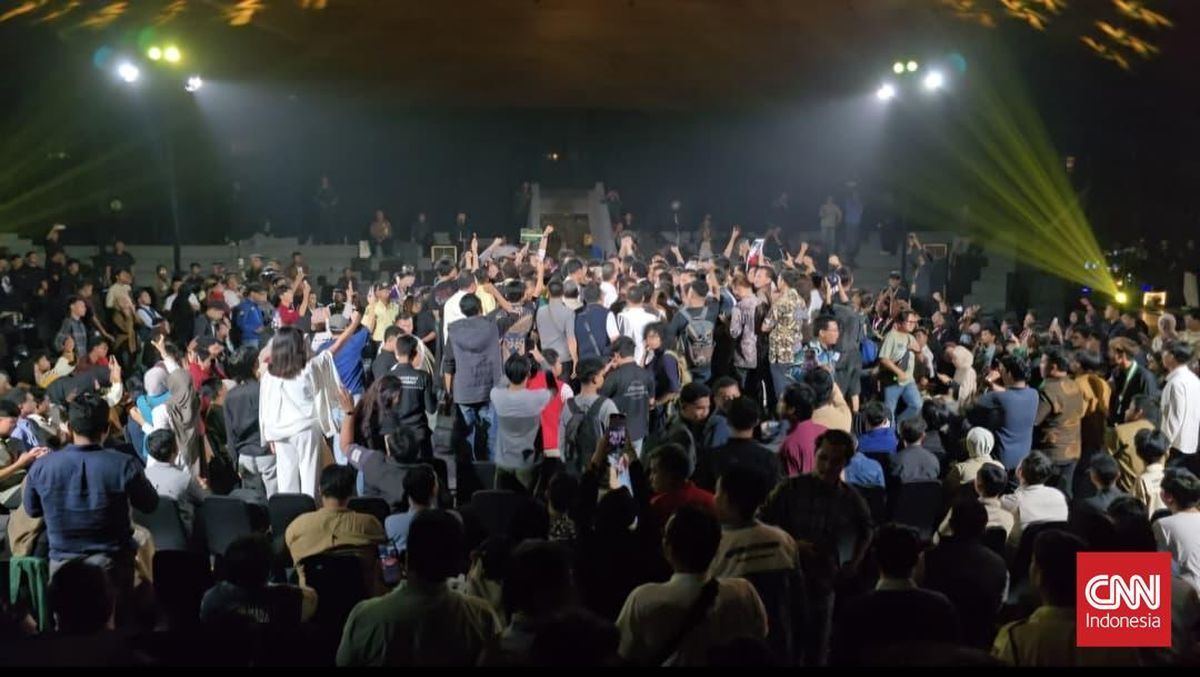
A group of Universitas Gadjah Mada (UGM) students who disrupted a casual discussion forum featuring three state officials at the UGM Innovation and Creativity Hall (GIK) in Sleman, Yogyakarta, on Monday (15/6) have asserted they are not anti-dialogue. Instead, they criticised the fact that such dialogues are only held after policies have already been enacted.
This stance was conveyed through a joint statement read out on the veranda of the UGM Balairung on Wednesday (17/6) afternoon. The statement included an explanation of their action in storming the ‘Kopdar Bareng Mas Dar’ forum at GIK.
For context, the discussion event featured Minister of Agrarian Affairs and Spatial Planning/National Land Agency Nusron Wahid, Deputy Minister of Agriculture Sudaryono, and Head of the Agency for the Acceleration of Poverty Alleviation Budiman Sudjatmiko. Minister of State Secretary Prasetyo Hadi, who was scheduled to attend based on event poster information, was not present that evening. The forum for state officials within the UGM environment that night was themed ‘Pancasila as the Unifier of the Indonesian Nation’.
“It must be emphasised that UGM students have never been against dialogue or discussion. However, we earnestly ask our friends to explain to us how we can possibly engage in substantive, solution-oriented, and equal discussions with government figures who are clearly untrustworthy and do not side with the people,” read the UGM students’ statement.
The cross-faculty, cross-organisation student body questioned why dialogue spaces are only opened by the government or lawmakers after a policy has been decided, rather than during its formulation in accordance with the meaningful participation principles regulated by legislation. This was conveyed by student representatives during a question-and-answer session following the reading of the statement.
“After that incident took place, the three officials will surely issue a statement. But the core point is our conviction that the forum held yesterday was not a genuine forum, as can be seen from its representation,” said student spokesperson Gladwin, standing with his colleagues on the UGM Balairung veranda. “And how they finally opened a dialogue after the policy was established. And how, in the end, the discussion space will never be substantive with an event format resembling a semi-seminar or a Q&A forum,” he continued.
Through the statement, it was affirmed that the students’ action at GIK the previous day was an expression of distrust towards a government they believe has repeatedly oppressed the people. The students admitted they were fed up and refused to remain silent upon learning that the gathering would be held, including the list of attending officials and their supporting media outlets.
“After one by one we entered GIK, our suspicion that this forum was not a genuine discussion forum was increasingly affirmed,” they explained. According to the students, the event labelled as a discussion platform turned out to be merely a showcase for government achievements, with an unequal share of speaking time that prevented substantive correspondence.
“Thus, amidst all the shouting, clashes, and items thrown onto the stage from various directions and parties, the only thing that should be highlighted is one thing: our disgust and distrust towards a government that first oppresses its people with violence,” they stated. “After the government’s violence has been so blatantly exposed through corruption, evictions, arrests, and even killings, are we not allowed to show a little disappointment, distrust, and anger? The repeated violence that increasingly disgusts us is proof that the logic of ‘rogue elements’ can no longer be justified,” the student body continued.
They said the anger that erupted in the forum did not appear suddenly but was an accumulation of disappointment over various government policies deemed not in favour of the people. In their statement, the students cited a series of violent acts as the result of structural decay continuously maintained by the regime. They pointed to policies such as the Free Nutritious Meal programme, which they argue sacrifices the education budget, the food estate project cited as a pretext for seizing the living spaces of indigenous communities in Papua, and the revision of the TNI Law and the draft Police Law, which they believe expand state occupation of civilian spaces.
Recent economic issues have also fuelled the protesters’ anger, ranging from the weakening of the rupiah exchange rate, the ballooning state budget deficit, and the narrowing fiscal space impacting the education, health, and social protection sectors. The students also highlighted the wave of layoffs, which they say is worsening the public’s condition. Tens of thousands of workers have lost their jobs throughout 2025, while various industrial sectors remain under pressure.
Criticism was also directed at the large government budget allocation to the defence and security sectors. The hundreds of trillions of Rupiah received by the Ministry of Defence, the National Police, the State Intelligence Agency, and the National Narcotics Agency indicate a government tendency to expand hegemony through state security apparatuses. They also touched on the plan to form Reserve Component battalions in every district/city, which they view as part of the militarisation of public spaces.
In the statement, the students underscored various issues of democracy and human rights. They questioned human rights enforcement, the rule of law, and government accountability by mentioning a number of cases of state apparatus violence, alleged extrajudicial killings, restrictions on civilian space, and the criminalisation of activists.
Besides being addressed to the government, the statement also contained demands for UGM Rector Ova Emilia. The students asked Ova, as a representative of UGM, to show a stance and take sides regarding the facts they presented. They demanded Ova take a firm position.