
UGM Students Clarify Disruption of Officials' Discussion: A Form of Expression
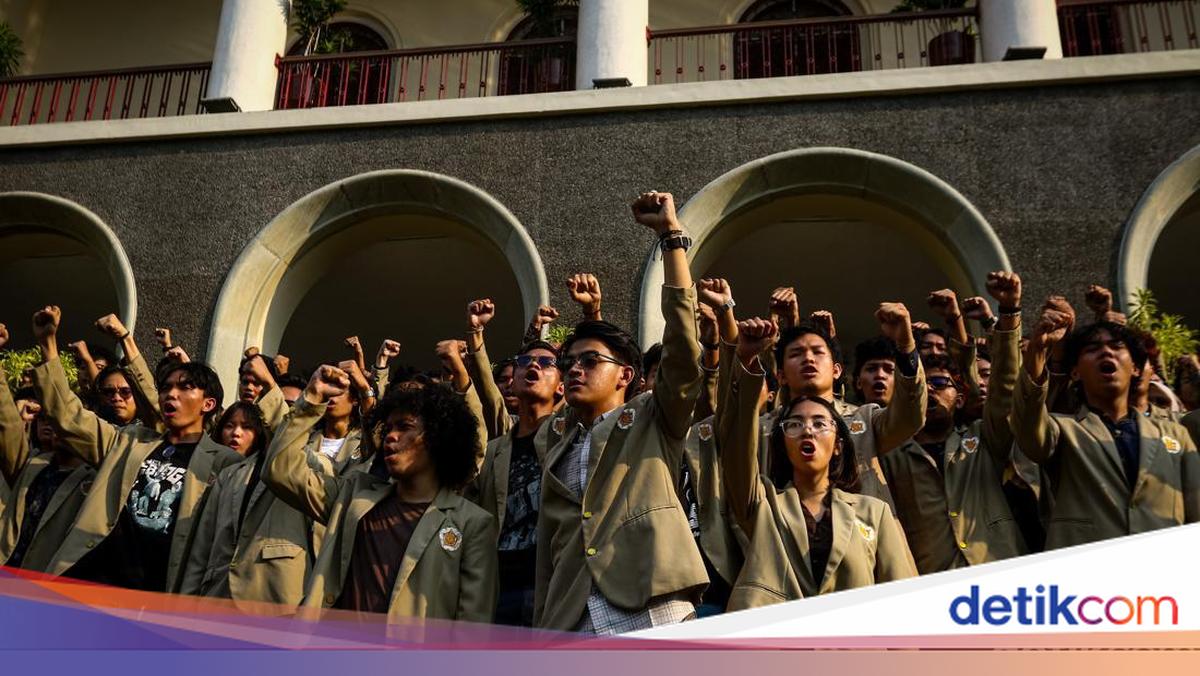
Social media has been flooded with narratives regarding the disruption of a discussion at the Gadjah Mada University (UGM) Innovation and Creativity Centre (GIK) by students on Monday night (15/6). The event was attended by the Minister of ATR/BPN, Nusron Wahid; the Deputy Minister of Agriculture, Sudaryono; and the Head of the Agency for the Acceleration of Poverty Alleviation, Budiman Sudjatmiko.
UGM student spokesperson, Gladwin, stated that the action was carried out collectively. They asserted that the incident was an expression of disappointment towards a government that they believe repeatedly oppresses the people.
“Essentially, we acted collectively because we were uneasy being there, and whatever happened there was a form of our expression,” Gladwin told reporters during a press conference and the reading of the UGM students’ statement of stance at the university hall on Wednesday (17/6/2026).
He dismissed the notion that the students initially intended to shut down the discussion. According to him, the students arrived to convey aspirations and criticism to the officials present in the forum.
“It is a valid form of expression because of the oppression that the people have been feeling. Therefore, whether what happened there is called a stoppage or anything else, the point to emphasise is that yesterday’s expression occurred because of the government’s lack of alignment with the people,” he asserted.
Meanwhile, Sarah, one of the UGM student representatives, explained the chronology of the event, stating that the students’ arrival was prompted by information regarding the visit of state officials to UGM alongside pro-government media.
“Those of us who were fed up gathered and refused to remain silent. As we entered the GIK one by one, our suspicion that this forum was not a genuine discussion forum was further confirmed,” said Sarah.
“The event, labelled as a ‘discussion’ platform, turned out to be merely a stage to showcase ‘government achievements,’ with a speaking proportion that was clearly unbalanced to produce substantive correspondence,” she continued.
She stated that the anger at the GIK was triggered by several factors, such as the declining value of the Rupiah, the rise in non-subsidised fuel prices which is feared to have a domino effect, and the wave of layoffs affecting tens of thousands of workers.
“It must be emphasised that UGM students are not anti-dialogue or anti-discussion. However, we earnestly request our peers to explain to us how we can engage in substantive, solution-oriented, and equal discussion with government officials who clearly cannot be trusted and do not side with the people,” she said.
Another UGM student representative, Mesa, stated that in a democratic context, discussions should not be held in political spaces conditioned by the ruling power, but rather in spaces based on the principle of shared interests and alignment with the people.
“Therefore, our first instinct was to bring these state officials to the streets; to a space not conditioned by the authorities, to question their allegiance,” said Mesa.
Mesa argued that the responses provided by the officials demonstrated their lack of support for the people.
“Instead of admitting mistakes, they asked one of the protesters to see the conditions in Papua directly. We do not want the conditions in Papua to be seen only by a small group of us,” she said.
“If there truly is no oppression and violence against the people in Papua, then show it to the entire Indonesian people. Show this by providing wide access for the press to report on the conditions in Papua and withdraw all military forces that have been spreading terror among the people,” she continued.
Consequently, if the government truly wishes to uphold democratic principles, they are being challenged to prove it. The students requested that the government prove it through the most fundamental way: by guaranteeing the security of civil space for voicing opinions.
During the session, UGM students also presented several demands to the government:
Release all political prisoners and grant amnesty to criminalised activists.
Cease the restriction of demonstrations, such as the incident involving UI students at the Bundaran HI.
Withdraw the military from civil spaces and revoke the TNI and POLRI Laws.
Stop the criminalisation of activists.
“If these demands cannot be met, it is clear to us that the government never has, and will never, side with the people, meaning democracy itself has essentially died. The only way out of this situation is to reclaim power into the hands of the people by any means necessary to restore civil supremacy,” she asserted.
In this regard, they also believe that academics should demonstrate true intellectual integrity by discussing facts as they are.
Therefore, they urged Ova Emilia, representing UGM as an academic institution, to show a stance aligned with the evident facts.
“Assert that UGM no longer trusts the Prabowo-Gibran administration, which has repeatedly shown its lack of alignment with the people, and assert that UGM, as an institution, fully supports all forms of struggle by the people who are currently attempting to reclaim their usurped rights,” she concluded.