
UGM Student Union Issues Statement After Protesters Disrupt Discussion with Budiman and Nusron Wahid
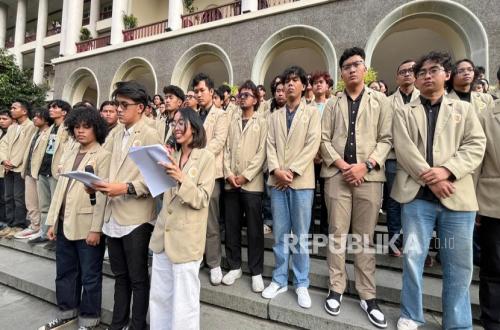
The Student Union of Universitas Gadjah Mada (Sema KM UGM) has issued a formal statement following an action by students who stormed and disrupted a discussion titled “Pancasila: Unifier of the Indonesian Nation” at the UGM Innovation and Creativity Centre (GIK) on Monday night, 15 June 2026. The discussion featured Budiman Sudjatmiko, Head of the Poverty Alleviation Acceleration Agency; Nusron Wahid, Minister of ATR/BPN; and Sudaryono, Deputy Minister of Agriculture, as speakers. However, the forum, which was intended to be a constructive dialogue, ended in confrontation.
Following the presentations by the three officials, a group of students approached the venue while the discussion was underway. They argued that the speakers were unfit to discuss the principles of Pancasella given the current state of the nation. In a statement read by student representative Sarah, the action was described as an expression of distrust towards a government perceived to have repeatedly engaged in actions that harm and oppress the people.
“It must be emphasised that what occurred on the night of 15 June at GIK was an expression of our distrust towards a government that has clearly and repeatedly oppressed its people,” said Sarah in the statement released by Sema UGM.
Students initially learned of the arrival of several state officials at UGM through various social media posts. They subsequently converged on the event, judging that the forum, while claimed to be a discussion, did not provide an equal space for dialogue. Sema UGM assessed that the event, featuring the Head of the Poverty Alleviation Acceleration Agency, the Minister of ATR/BPN, and the Deputy Minister of Agriculture, served more as a platform to showcase government achievements rather than a substantive discussion space.
“Amidst the shouting, clashes, and objects thrown towards the stage from various directions, the only thing that should be highlighted is our shared sense of disgust and distrust towards a government that has first oppressed its people through violence,” she added.
Sema UGM also outlined several reasons underlying the students’ anger. They highlighted various issues ranging from national economic policies and government projects to the revision of the TNI and Polri Laws, as well as the state of democracy and human rights enforcement in Indonesia. Students believe that various government policies have shown a tendency to expand state power into civil spaces. They also pointed to alleged repressive practices against critics and various unresolved human rights violation cases.
Furthermore, students raised concerns regarding economic conditions that they believe are increasingly burdening the public. The statement cited rising fuel prices, waves of layoffs, and pressures on the education and social protection sectors as factors strengthening their disappointment with the government.
Sema UGM also touched upon the situation in Papua, which emerged as a key issue during the interaction between students and officials after the discussion. They argued that the government must provide wider access to the public and the media to directly observe the conditions in Papua if it wishes to refute allegations of human rights violations and violence.
“If it is true that there is no oppression or violence against the people in Papua, then show it to the entire Indonesian people. Demonstrate this by providing full access to the press to report on the conditions in Papua and by withdrawing all military forces that have been spreading terror among the people,” Sarah concluded.