
UGM Rector Questions Notion of Abolishing Study Programs Considered Insufficiently Relevant
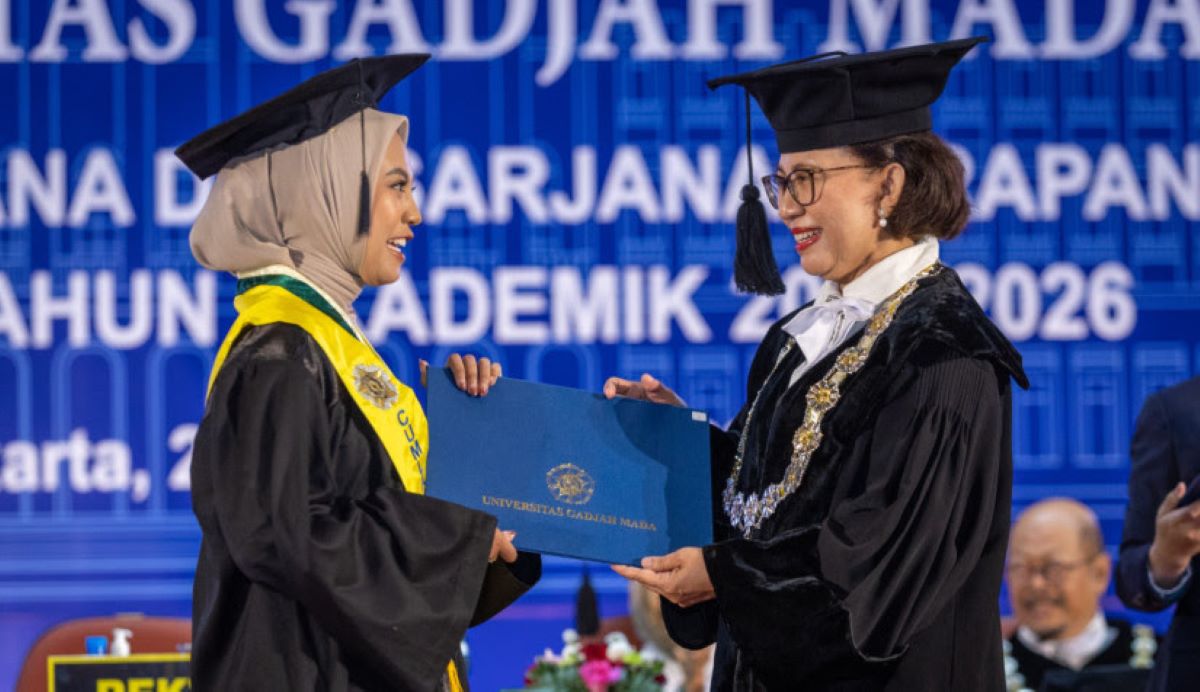
UGM Rector, Prof. dr. Ova Emilia, M.Med.Ed., Sp.OG(K)., Ph.D, argues that study programmes previously considered less relevant are, in fact, aligning with industry needs, social life, sustainability, and the advancement of knowledge itself. According to the Rector, among 28 fields of study listed in QS World University Rankings by subject, three social science disciplines rank among the world’s top 100. Theology sits in the global top 45 as a strategically important area, while Anthropology and Development Studies also occupy positions within the top 100 worldwide. ‘Strengthening these fields reflects the quality of UGM’s scholarly work being increasingly recognised globally and shows that academic development is targeted and sustainable,’ he said. He made these remarks in his speech at the Graduation Ceremony for the Bachelor and Applied Bachelor Programmes, Period III, 2026, at Grha Sabha Pramana on Wednesday, 20 May.
Further, the Rector noted that development of the university’s academic programmes is done comprehensively, including through the strengthening of social sciences and humanities that earn global recognition. ‘Education serves as a space of freedom that brings justice and progress for society, because human needs are not always measured solely by industrial demands but also by the needs of life itself,’ he said.
In his address, the Rector also stressed the importance of producing graduates who have a tangible impact on society. He explained that an academic degree does not end with administrative achievements or securing a job. The campus learning experience is expected to shape integrity, critical thinking, and the courage to face future challenges.
Various collaborative learning experiences, research, KKN-PPM (community service), and student activities provide spaces for character formation for UGM students. ‘Becoming an UGM graduate is not merely about holding a degree, but about becoming a person with an outstanding moral character who can contribute to community life,’ he affirmed.
Anies Baswedan, a member of the Expert Council of the Central Board of KAGAMA, in his address urged graduates to view life after graduation realistically yet with hope. He reminded that graduates enter the workforce in an economy that is not easy, with a job market that is increasingly competitive. Yet he argued that generations born in difficult times are often the most resilient. He explained that challenges are not to be feared but are spaces for learning that build resilience.
‘Generations that graduate in hard times often become the strongest because they learn to endure, read situations, and grow amid constraints,’ he said. Anies also shared reflections on the meaning of the first job for young graduates. For him, the first job does not always provide an ideal position or large earnings but plays an important role in shaping character. He valued the ability to maintain integrity, keep promises, and complete simple tasks diligently as foundational to a long-term career journey. In professional life, a person is formed by small decisions made consistently every day. ‘Do not wait for a perfect job to give your best, because the future is often built from small decisions carried out with responsibility,’ he said.
Meanwhile, a representative graduate from the Faculty of Veterinary Medicine, Siham Hamda Zaula, shared a personal journey about her academic path as an autistic person with a disability. She said she had long felt different due to social misunderstanding and easily becoming overwhelmed in crowded environments. This experience made university life not always easy, especially when facing anxiety and external pressures. Yet the campus environment gradually helped her understand that everyone grows in their own way. ‘Today I have learned that being disabled does not mean being unable, because everyone has their own path and time,’ she said. Siham also expressed appreciation for lecturers, family, and UGM’s Disability Services Unit for supporting her throughout her studies. According to her, support that seems simple often becomes a crucial factor for disabled students to continue pursuing their dreams. She called on graduates to help build a more inclusive and open environment for differences. For her, diversity is not just about acceptance but about embracing it as a shared strength in social life. ‘I hope we can all build a future that provides a safe space for anyone who feels different, because difference is a strength,’ she said. (H-2)
The discourse on closing study programmes in Indonesian higher education resurfaced in April 2026. The idea of closing study programmes is seen as requiring careful study. Academics and the DPR emphasise repositioning rather than merely eliminating programmes. The aspiration to become a developed and prosperous country is not determined solely by economic and technological development but also by the existence of a fair and integrity-driven legal system.