
UGM Faculty Proposes Continuous Assessment System to Strengthen Medical Graduate Quality
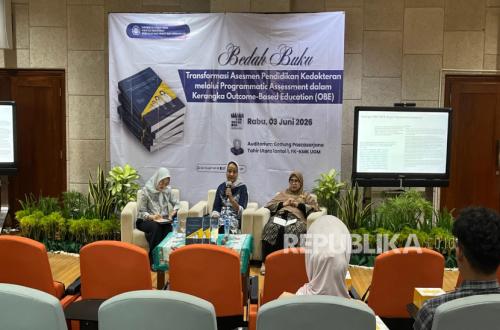
The Faculty of Medicine, Public Health, and Nursing (FK-KMK) at Universitas Gadjah Mada (UGM) held a book review session titled ‘Transformation of Medical Education Assessment through Programmatic Assessment within the Framework of Outcome-Based Education (OBE)’ at the UGM Postgraduate Building Auditorium on Wednesday (3/6/202.6). The book is a collaborative effort involving 78 lecturers from various institutions under the Indonesian Association of Medical Education Institutions (AIPKI), offering updates to assessment systems in medical education.
Prof. Dr. Mora Claramita, the book editor and a lecturer in the Department of Medical Education and Bioethics at FK-KMK UGM, explained that the book resulted from a long process beginning during the Covid-19 pandemic. Various discussions, webinars, research, and national academic forums served as the foundation for the idea of the importance of continuous assessment, or programmatic assessment, in health profession education.
According to Mora, the current system for medical graduation relies heavily on summative assessments, specifically a single major examination at the end of the education period. This condition is believed to encourage students to focus solely on passing the exam, while the daily learning processes that build a doctor’s competence receive less attention. In reality, becoming a doctor is not determined by a single exam, but through the consistent development of competence built throughout the educational period.
“We do not need to rely on one single assessment. From a collection of learning records, it can be clearly seen that the student has met the expected competencies,” she stated on Wednesday.
Through the concept of programmatic assessment, Dr Mora noted that assessment is conducted longitudinally by utilising various assessment data documented in student portfolios. This data includes both quantitative and qualitative aspects collected from undergraduate, professional, and specialist education. This system allows educators to monitor student progress more comprehensively and provide continuous feedback.
Dr Mora emphasised that the core of continuous assessment is not merely the collection of grades, but the provision of constructive feedback to encourage student self-reflection. Based on research involving students, clinical lecturers, and various stakeholders through 12 Focus Group Discussions (FGD), one of the most frequent issues in medical education is the lack of meaningful feedback and a persistent teacher-centred learning culture.
“We posed two simple questions: what is the main problem in the current medical education curriculum, and what is the main problem in its assessment system? Through 12 FGDs, several consistent findings emerged. The most frequent finding was the lack of constructive feedback. Additionally, learning remains very teacher-centred, even though medical education has long implemented Problem-Based Learning and has now adopted OBE. The lack of dialogue between lecturers and students is also a recurring issue,” she said.
Dr Ahmad Hamim Sadewa, Vice Dean for Academic and Student Affairs at FK-KMK UGM, viewed programmatic assessment as an important innovation that needs continuous development in medical education. He noted that the greatest challenge is not just understanding the concept, but integrating it into long-standing educational systems. He hopes that with a more comprehensive assessment system, the quality of medical graduates in Indonesia can continue to improve.
Meanwhile, the Manager of UGM Press, Dr I Wayan Mustika, stated that the publication of this book is a concrete contribution to supporting the transformation of higher education. He emphasised that an Outcome-Based Education (OBE) curriculum will not achieve optimal results without a robust assessment system. He also expressed hope that the ideas in the book would serve as a reference for medical and public health education and inspire the development of educational systems in other fields.