
UGM Expert Suggests Scheduling and Route Diversification to Resolve Jogja Last Friday Ride Polemic
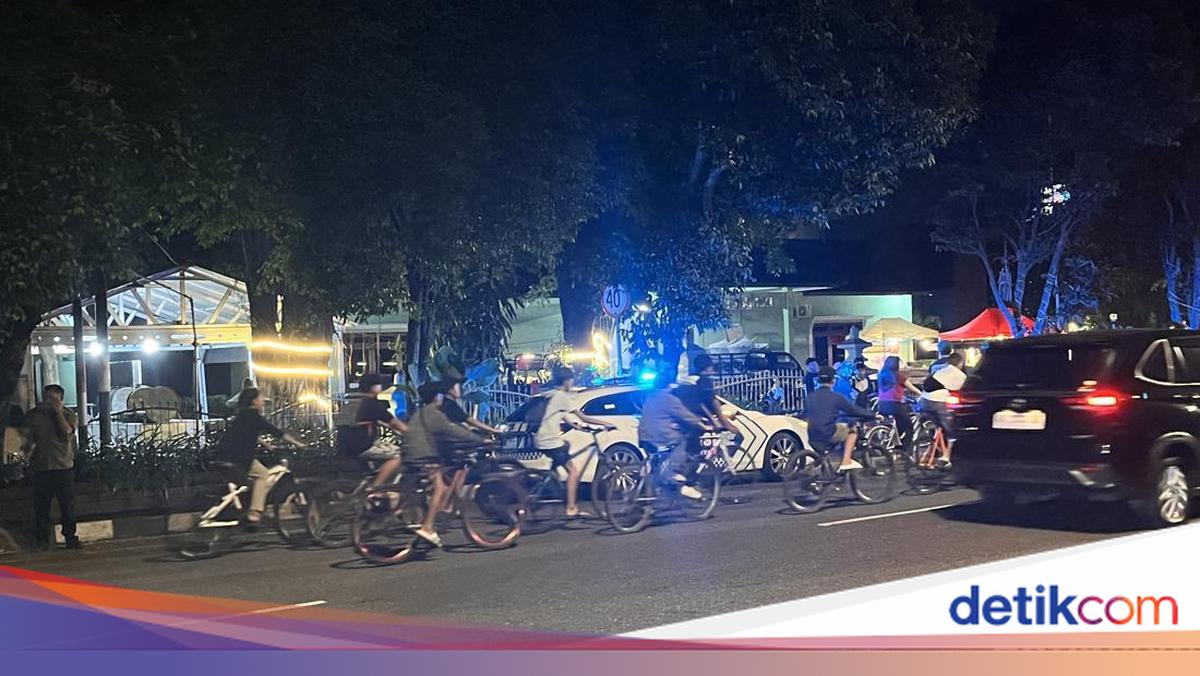
A transport expert from Universitas Gadjah Mada (UGM) has proposed that the Yogyakarta City Government partner with several cycling communities to organise the Jogja Last Friday Ride (JLFR). The event has recently become a source of controversy, as it is considered disruptive to traffic flow.
Dr Ir Dewanti, Head of the UGM Centre for Transportation and Logistics Studies (Pustral), said cycling is in essence an environmentally friendly mode of transport that aligns with the low emission zone concept applied in the Malioboro area.
“If we look at it, cycling is genuinely good in the context of movement because it is non-polluting. It is actually well suited to Malioboro, which has been designated a low emission zone. Cycling as a mode of transport supports that concept,” Dewanti said when contacted by detikJogja on Monday (13 July 2026).
However, when cyclists gather en masse at the same time, this can create several problems. Dewanti noted that JLFR participation running into the hundreds or thousands presents its own challenge. According to her, road capacity in the Malioboro area was not designed to accommodate the simultaneous movement of such large numbers of cyclists.
“The problem arises when the numbers become very large. The road space is largely taken up by the group of cyclists, which has the potential to disrupt the smooth flow of other traffic,” she said.
Dewanti said cycling on such a massive scale also risks obstructing access to public facilities, including people’s access to Tugu Station and the movement of logistics vehicles and emergency vehicles such as ambulances.
“If members of the public want to get to the station, for instance, they could be delayed. The same applies if an ambulance needs to pass through. Moving hundreds or thousands of cyclists aside is certainly not something that can be done quickly,” she explained.
Suggestion of Scheduling and Different Routes
Regarding the Yogyakarta City Government’s restriction on JLFR entering the Malioboro area, Dewanti argued the plan should be understood as an effort at regulation, not a ban on cycling activity.
She proposed that JLFR be managed in a more structured way through scheduling and route arrangements, so participants do not enter the Malioboro area all at once.
“Could the groups be managed in terms of time and space? So that not everyone enters Malioboro at the same time. There could be scheduling — for example, certain hours on certain routes, or a different route the following month,” she said.
Cooperation with Cycling Communities
Dewanti acknowledged, however, that a key problem is that JLFR has no clear organisation or person in charge. She said this makes it difficult for the government and authorities to coordinate or take action should problems arise on the ground.
“As I see it, the problem is there is no organiser. So who do you talk to? I cannot imagine the Transportation Agency or the police having to coordinate with whom. If there is an accident or friction with other road users, who should be held responsible?” she explained.
Dewanti expressed hope that collaboration could be established between the government and cycling communities so that JLFR could be run in a more orderly fashion.
“Perhaps the Transportation Agency could work together with local cycling communities. That way JLFR could become more organised, better arranged. The routes could also alternate, so they do not always have to go into Malioboro,” she said.
She stressed that the JLFR initiative is fundamentally a positive campaign to encourage people to cycle. However, the event still needs to be managed so its benefits are not accompanied by negative impacts on public mobility.
“In principle, the problem arises because of the sheer numbers. The initiative is good as a cycling campaign. If more people cycle every day, that is certainly better, but the mass events need to be regulated so they do not create problems for other road users,” she explained.
JLFR Restricted from Entering Malioboro
JLFR, the cycling event held on the last Friday night of each month, has been restricted from entering Malioboro. The Yogyakarta City Government considers that the large number of cyclists coming to Malioboro disrupts traffic. The absence of any leadership within the event has made coordination difficult for the city government.
“That is my hope, and I have conveyed it to the cycling communities — if I am not mistaken it is on the fourth Friday, the last Friday — that the cycling is well coordinated and does not swarm into crowded public spaces such as the core zone and buffer zone in Yogyakarta City,” Hasto told journalists on Thursday (9 July 2026).
“Under these circumstances, we are indeed managing the situation. On weekend nights, if we are swarmed by cyclists without rules and without coordination, it becomes very difficult. So in the end we closed off certain routes at those times,” he added.
Hasto stressed that the restriction does not mean prohibiting people from cycling in Yogyakarta. He hopes JLFR can proceed in a more orderly manner through better coordination.
“I hope that although this community has no formal structure, no chairman and no organisation, I am sure there are in fact leaders who can provide direction,” he said.
Yogyakarta Police Explanation
Previously, the police said the restriction on cyclists in the Malioboro area was a response to complaints from street vendors.
“Essentially, our directive to stay out of Malioboro has been running for some time, following the incident at edition 184 or 185. We adopted a temporary policy because we had tried to communicate with friends in JLFR but received no answer, no response. A total ban would not be possible, after all,” said Alvian Hidayat, Head of the Traffic Unit at Yogyakarta Police, when contacted by detikJogja on Thursday (2 July).
Alvian explained that his side had not prohibited the cyclists from carrying out their activity. They were simply asked not to pass through Malioboro. Although some JLFR cyclists still pass along the edge of Malioboro, he said their numbers have fallen sharply compared with before.
“As a precautionary measure, we positioned personnel at the main entrances, in front of Hotel De Djokja and in front of the Pos Teteg post at Loco Cafe. When cyclists arrive, we direct them to continue straight west, towards Pasar Kembang,” he said.
He also admitted that his side was overwhelmed in managing the JLFR activity because there is no clear organisation or person in charge, making coordination difficult.
“That is precisely what has become an obstacle for the government in communicating with the cyclists there. Everything requires communication so that it can all be properly arranged and no party feels disadvantaged,” he explained.
JLFR Ready to Evaluate
The Jogja Last Friday Ride (JLFR) side has spoken out regarding the route restrictions in the Malioboro area, stating that it is ready to evaluate.
In a statement received by detikJogja, JLFR highlighted the irony that congestion caused by the dominance of motor vehicles is regarded as normal, while residents’ activities such as cycling and walking in public spaces are seen as a nuisance.
“The irony today is not merely a debate about a cycling event, but about how we view road space,” JLFR wrote in its statement of position, conveyed through a representative who declined to be named, on Thursday (9 July).
JLFR stressed that from the outset the community was not formed to take over the roads or obstruct people’s activities. According to the group, the Last Friday Ride aims to celebrate cycling culture while reminding everyone that roads are public spaces that should be enjoyed by all users fairly, safely and with mutual respect.
“We are aware that every activity in public spaces must be conducted in an orderly manner, respecting the rules and minimising the impact on the community. If there are shortcomings in its execution, we are open to evaluation and improvement,” the statement read.
“If there are shortcomings in its execution, we are open to evaluation and improvement,” the statement continued.
Source: jawawa.id (https://jawawa.id/newsitem/ugm-expert-suggests-scheduling-and-route-diversification-to-resolve-jogja-last-friday-ride-polemic-1783990223)
Originally published by detikJogja (https://www.detik.com/jogja/berita/d-8572755/saran-pakar-ugm-soal-polemik-jogja-last-friday-ride), translated from Indonesian