
UGM Economist Criticises Mass Formation of 'Red and White' Village Cooperatives as Flawed in Design
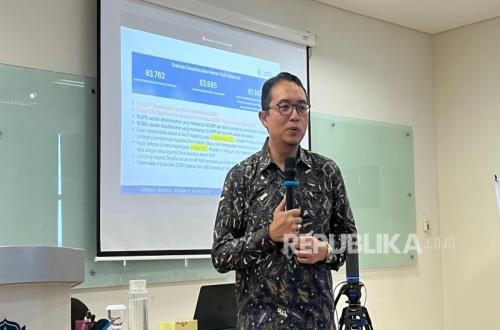
YOGYAKARTA – The programme to establish Red-and-White Village/Urban Village Cooperatives (KDMP) on a massive scale has been deemed in need of evaluation. Universitas Gadjah Mada (UGM) economist Amirullah Setya Hardi said the programme’s design risks deviating from the basic principles of cooperatives as regulated by law.
Cooperatives are fundamentally established to meet the needs of their members. Yet in the KDMP design, cooperatives are instead burdened with various government agendas and targets. He judged that this condition risks distancing cooperatives from their identity as business entities owned and controlled by their members.
“What exactly is the purpose of KDMP? There are many. Is that right? It shouldn’t be, because a cooperative’s purpose is singular — to meet the needs of its members, that’s all. If members’ needs are met, then the cooperative will prosper,” Amirullah said at the Economic & Business Journalism Academy forum at the UGM Faculty of Economics and Business on Friday (24/7/2026).
Public welfare should be the knock-on effect of cooperative members’ needs being fulfilled. Therefore, a cooperative should not, from the outset, be established to pursue multiple development targets at once.
Amirullah went on to highlight the establishment of KDMPs on a massive scale within a relatively short time. As is known, the government previously targeted the creation of around 80,000 village/urban village cooperatives across Indonesia.
Based on the data presented, of Indonesia’s 83,762 villages/urban villages, 81,147 already have a KDMP established through Special Village/Deliberation Meetings. He argued that such a large number of established cooperatives must not be the sole measure of the programme’s success. In his view, establishing cooperatives simultaneously on a large scale risks being done without in-depth assessment of the needs, feasibility and economic capacity of each village.
“In a short time, everything on the agenda has been accomplished,” he said.
“I’m not blaming anyone, but is this essential for claiming that quantity has increased alongside quality? I think that’s something to note,” he said.
The UGM economist noted that a healthy cooperative cannot be created instantly. A cooperative must go through a process, have active members, and be able to run business activities that deliver real benefits to its members.
Moreover, he argued, not every village has the need or economic feasibility to establish a new cooperative. Therefore, cooperative formation should stem from needs and processes that grow organically within the community, rather than merely chasing numerical targets.
Amirullah also reminded the government not to become trapped in pride over the number of cooperatives successfully established. The success of KDMP should instead be measured by organisational health, member participation, the holding of Annual Members’ Meetings (RAT), legality, and the cooperative’s ability to run its business independently.
“Remember, a cooperative must be healthy,” he said. “We must not simply take pride in having formed so many cooperatives, while the RAT is patchy, the business identification numbers are patchy, and so on,” he added.
Furthermore, Amirullah considered evaluation of the KDMP programme design important so that success is not measured solely by the number of cooperatives formed. The primary yardstick of success must be the extent to which cooperatives can improve their members’ welfare.
He said the government also needs to involve academics and various stakeholders in guiding the KDMP programme. Such input should not stop at the discussion stage but must be followed up in refining the programme’s design and implementation.
“That is what we can then link to the government’s success in guiding society towards prosperity,” he said.
Source: jawawa.id (https://jawawa.id/newsitem/ugm-economist-criticises-mass-formation-of-red-and-white-village-cooperatives-as-flawed-in-design-1785037882)
Originally published by Republika (https://rejogja.republika.co.id/berita/tirgvj291/soroti-pembentukan-kdmp-secara-masif-ekonom-ugm-nilai-desainnya-melenceng), translated from Indonesian