
UGM Doctoral Research: 'Manungsa Tanpa Tenger' Concept as a Path to Liberation from Modern Identity Crisis
In the increasingly fragmented contemporary social landscape, identity often acts as a double-edged sword. On one hand, it provides a sense of security, direction, and group affiliation; on the other, an overly rigid attachment to primordial or ideological identities is prone to triggering sharp polarisation, social exclusion, and prolonged conflict.
Responding to this phenomenon, a recent doctoral study from the Doctoral Program in Psychological Science at Universitas Gadjah Mada (UGM), conducted by Ryan Sugiarto, introduces the concept of ‘Manusia Tanpa Tenger’ (MTT) or ‘human without markers’ in his dissertation. This concept examines how modern humans can liberate themselves from the symbolic prison of ego identity to avoid being trapped in the vortex of internal or social conflict.
This multi-method research explored the lived experiences of Kawruh Jiwa practitioners—a spiritual psychology teaching based on local wisdom inherited from Ki Ageng Suryomentaram—across four major cities: Yogyakarta, Surakarta, Salatiga, and Jakarta. From this, MTT was formulated as a psychological state in which an individual is able to consciously distance themselves from the attachment to ‘tenger’ (markers) or the egoistic identity known as ‘Kramadangsa’.
According to Ryan, who currently serves as a member of the DIY Education Board (2022-2026), interpersonal conflict often occurs when an individual’s identity is entirely fused with their very existence. Consequently, any external criticism is perceived as an existential threat, and any difference is understood as an attack.
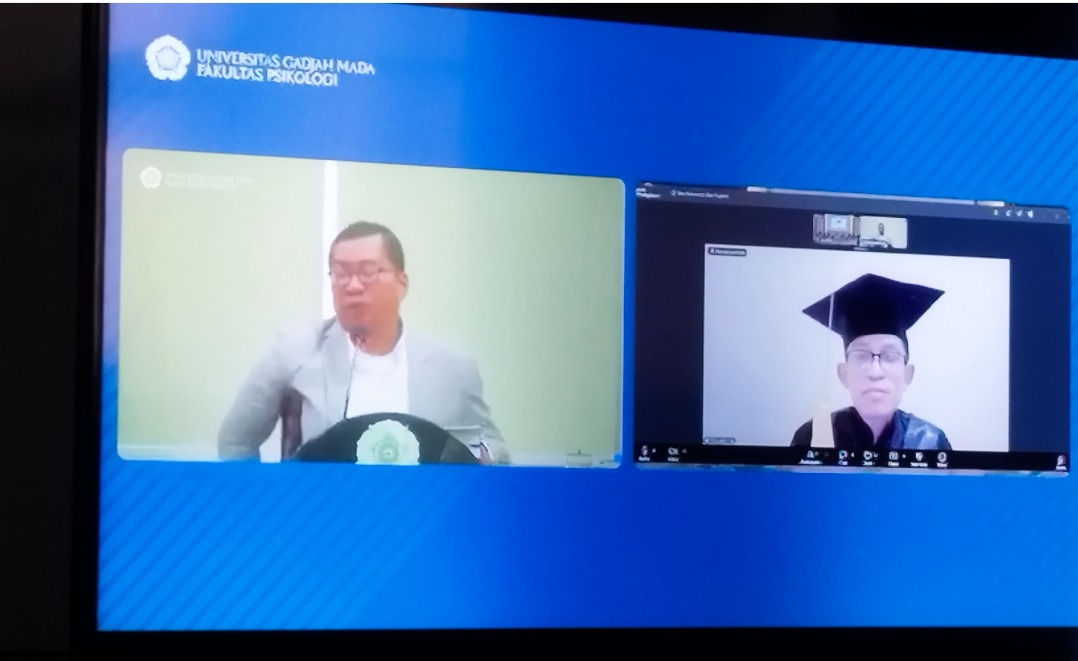
‘The presence of the MTT concept does not aim to negate the practical identities of humans, but rather to reposition them merely as functional tools for daily use, rather than something essential that must be defended at all costs,’ Ryan stated during his open doctoral examination at the UGM Faculty of Psychology on Wednesday (17/6).
Through in-depth observation, the research successfully formulated the key characteristics of an individual who has achieved the MTT inner state. These characteristics manifest as a person who is calm, balanced, harmonious, neutral, and non-judgmental. Furthermore, individuals with this awareness are characterised by authentic empathy, an attitude of acceptance (nrimo-semeleh), the ability to think objectively, and profound compassion towards others.
To reconstruct this awareness, the research maps out what is called ‘soul technology’, a process of deconstructing ego identity that proceeds through four linear and grounded stages. The first stage begins with ‘Weruh Dewe’ (Self-Awareness), which is the initial ability of an individual to identify internal turmoil or obstacles (reribet). At this stage, a person learns to create a pause so as not to respond to external stimuli reactively and automatically.
The internal process continues to the second stage, ‘Krasa Dewe’ (Self-Feeling). In this phase, individuals are required to be honest in acknowledging their emotions and engaging in deep emotional dialogue (kanda takon). This stage reaches its peak at an existential moment called ‘Ngeh!’—a flash of awareness where all ego attachments suddenly dissolve, leaving a sense of vast and profound inner freedom.
Following this moment, the individual moves to the ‘Ngerti Dewe’ (Self-Understanding) stage to dissect the origins of desires (karep). Here, a new awareness emerges that true peace is achieved when humans are able to distance themselves from their identity. This phase concludes with the ‘Nlakoni’ (Living/Practising) stage, where this markerless awareness is actualised into wise daily behaviour, referred to as ‘Kramadangsa luhur’.
Theoretically, these findings provide a significant contribution by performing a radical reversal of modern Western identity theories that have long dominated psychology textbooks. While classical theories, such as those by James Marcia, emphasise the importance of a strong commitment to a single identity to overcome crisis, the MTT concept suggests the opposite: dismantling identity attachments to prevent destructive in-group vs. out-group bias.
Furthermore, the MTT concept is considered to go further than the Deconstruction Theory of postmodern philosopher Jacques Derrida, which tends to remain within the realm of conceptual and intellectual discourse. Through the Post-Identity Theory and Contextual Psychospiritual approach offered by this research, Nusantara’s local wisdom proves its academic prowess. The Kawruh Jiwa teachings are able to transform theoretical deconstruction into practical action (nglakoni) experienced directly by the body, feelings, and daily conduct to address the stagnation crisis of modern humanity.
Source: jawawa.id (https://jawawa.id/newsitem/ugm-doctoral-research-manungsa-tanpa-tenger-concept-as-a-path-to-liberation-from-modern-identity-crisis-1781675432)
Originally published by Media Indonesia (https://mediaindonesia.com/humaniora/901346/riset-doktoral-ugm-konsep-manungsa-tanpa-tenger-cara-membebaskan-diri-dari-krisis-identitas-modern), translated from Indonesian