
UGM Boosts the Competitiveness of Indonesia’s Leather Industry Through EU Erasmus+ Project
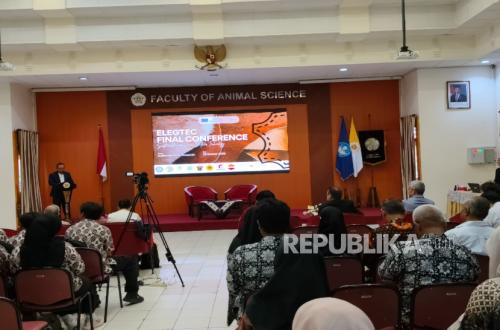
YOGYAKARTA — The leather and leather-goods industry has significant potential to support the national economy, particularly through its contribution to exports. However, the sector still faces a range of challenges, including sustainable supplies of raw materials, the development of environmentally friendly processing technology, and competition from products made from non-leather materials.
To address these challenges, Universitas Gadjah Mada (UGM) is developing human-resource capacity and technology for the leather industry through the Enhancing Sustainability and Green Leather Technology in Indonesia (ELEGTEC) project, supported by funding from the European Union’s Erasmus+ programme.
Indonesia’s leather and footwear exports reached US$4.85 billion in the first half of 2026, up 5.28 per cent on the same period a year earlier. The increase highlights the sector’s potential and the importance of strengthening Indonesia’s leather-industry ecosystem so it can remain resilient and improve its competitiveness amid shifts in the global market.
UGM Faculty of Animal Science Dean Prof Bambang Suwignyo said the development of the leather industry deserved greater attention, including from universities. He said the sector was an important part of making use of livestock products, with economic potential and a contribution to the country’s foreign-exchange earnings.
“UGM’s Faculty of Animal Science has long developed the Livestock Product and Waste, and Leather Technology Laboratory to support the national leather-industry ecosystem. Through the development of knowledge and technology, and collaboration with various parties, we hope Indonesia’s leather industry will grow stronger, become more sustainable and compete globally,” Bambang said at the ELEGTEC Final Conference at the faculty on Monday (26 October 2026).
International collaboration to strengthen the national industry
The ELEGTEC project is co-ordinated by Prof Yuny Erwanto of UGM’s Faculty of Animal Science. It was conceived in response to the need to build the capacity of academics, students, education staff and industry players to develop sustainable, environmentally friendly leather-processing technology.
UGM established an international consortium with Ege University in Türkiye, the National Technical University of Athens in Greece, and the University of Pisa in Italy. In Indonesia, the project involves the Indonesian Tanners Association, the Leather, Rubber and Plastics Testing and Standardisation Centre, and Hasanuddin University and Mataram University.
ELEGTEC secured EU Erasmus+ funding after repeated rounds of applications and revisions. The approximately Rp3 billion (US$) grant is being used for capacity-building activities and the development of an internationally accredited leather-product testing laboratory.
“The proposal failed twice. Thankfully, after continuing to revise it and submitting it again for the third selection round, we finally secured funding,” said Yuny, who is also the faculty’s vice-dean for research, community service and co-operation.
Over the project’s three-year implementation, lecturers, students, education staff and members of Indonesia’s leather industry have had the opportunity to take part in training in Türkiye, Greece and Italy. The activities have provided access to knowledge, experience and industry practices that can be adapted to Indonesia’s needs.
Alongside developing human-resource capacity, stronger leather-product testing facilities are expected to support product quality, the adoption of standards and more sustainable technological innovation.
Yuny said Erasmus+ projects were managed through a competitive process and subject to ongoing evaluation. Success therefore depended not only on securing funding, but also on meeting targets, the quality of implementation and the benefits delivered to partners and the public.
Addressing challenges in the tanning industry
Indonesian Tanners Association Secretary-General Arifin Kusniawan highlighted the challenges facing the country’s tanning industry over roughly the past decade. One problem for businesses has been weak uptake of their products amid changing market demand and competition from non-leather alternatives.
Arifin said the industry also faced difficulties maintaining stable supplies of raw materials. Leather, a by-product of livestock farming, needs to be managed and used effectively to create added value. At the same time, businesses must adapt to technological developments and regulatory requirements that increasingly emphasise environmental protection and sustainability.
He said there were around 140 tanning businesses in Indonesia. This made sustained support important to help operators maintain their businesses, improve efficiency and meet market needs.
Arifin said he hoped ELEGTEC would provide more concrete support to industry, not only through training for academics and expanded laboratory capacity, but also by involving companies directly in consortium activities.
“Technology support and stable supplies of raw materials are essential for the tanning industry. We hope the ELEGTEC consortium will involve industry more closely in its activities so that the technologies developed genuinely address businesses’ needs,” Arifin said.
He also stressed the need to make better use of domestically produced cattle hides and develop the potential of sheep and goat skins. In his view, strengthening raw-material supply chains must go hand in hand with developing processing technology, improving product quality and expanding market access, including export markets.
Source: jawawa.id (https://jawawa.id/newsitem/ugm-boosts-the-competitiveness-of-indonesias-leather-industry-through-eu-erasmus-project-1792997461)
Originally published by Republika (https://rejogja.republika.co.id/berita/tni2g6291/ugm-perkuat-daya-saing-industri-kulit-nasional-lewat-proyek-erasmus-eropa), translated from Indonesian