
UGM Anti-Corruption Centre Proposes Special Agency Under President to Manage Seized Assets
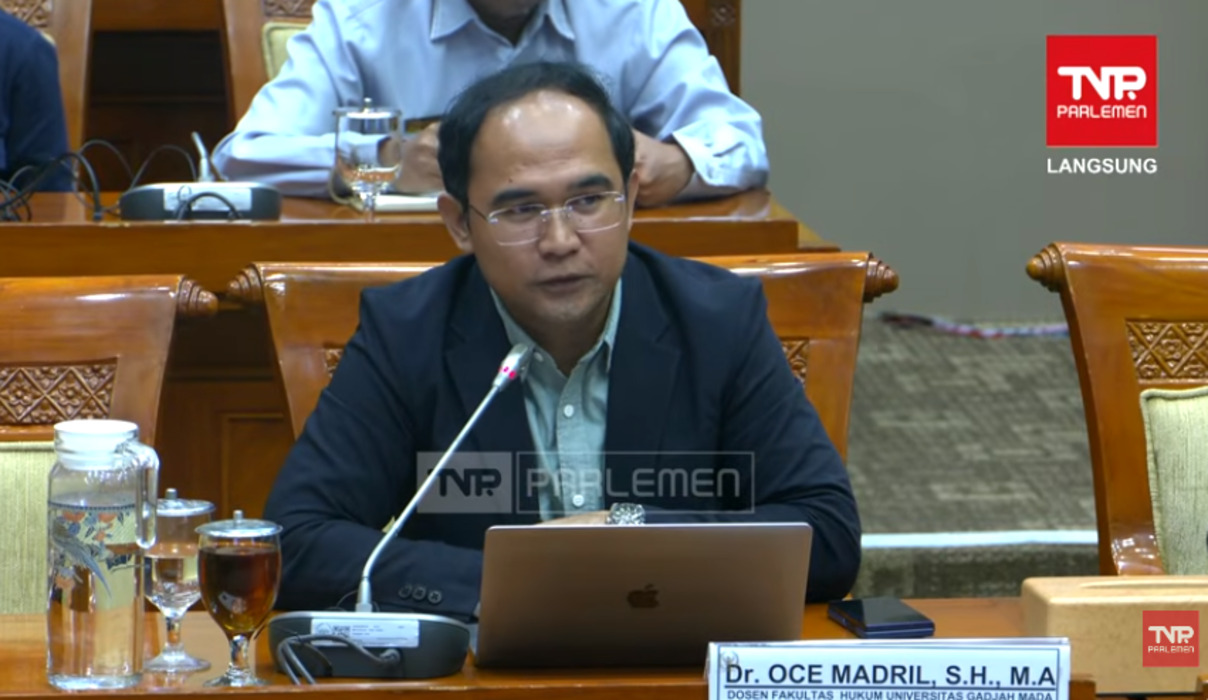
The Chairman of the University of Gadjah Mada’s Anti-Corruption Study Centre (Pukat UGM), Oce Madril, presented several critical notes on the Asset Seizure Bill, particularly regarding institutional aspects. This was conveyed during a Public Hearing with Commission III of the House of Representatives (DPR RI) on Monday (6/4).
Oce assessed that the formation of the Asset Seizure Bill would impact the expansion of authorities for law enforcement agencies, from investigators to prosecutors, including in the stage of managing seized assets.
“When this law is drafted and enacted, there will certainly be strengthened authorities, both for investigators, state prosecutors, and downstream when we discuss the management of seized assets,” said Oce.
He highlighted that to date, there is no specific regulation that comprehensively governs the management of state-seized assets. According to him, the mechanisms in operation are still scattered across various institutions.
“So far, we have used a scattered model, there is Rupbasan, there is the asset recovery agency, as well as the role of the Ministry of Finance. But there is no single system that is truly integrated,” he stated.
Oce also added that the large value of state-seized assets is a pressing reason for institutional reform. He cited data from the Attorney General’s Office showing that the value of seized assets could reach hundreds of trillions of rupiah.
“I quote one data point, the value can reach around Rp800 trillion, in the form of land, buildings, shares, to mining concessions. This is a very large figure,” he explained.
Meanwhile, he also mentioned the achievements of the Corruption Eradication Commission in returning assets amounting to Rp2.5 trillion in the 2020-2024 period.
With the potential for increasing asset values in the future, Oce assessed that institutional capacity must be strengthened, both in terms of authority, structure, and legal basis.
“If this law is passed, logically the assets to be managed will certainly be much larger. Therefore, the capacity of the institution must also be strengthened, both in authority, structure, and its legal basis,” he emphasised.
He proposed the formation of a special agency directly under the President to handle the management of those seized assets.
“I propose that it would be better if this agency is under the President, to demonstrate the importance of this function while strengthening the institutional and authority aspects,” said Oce.
Furthermore, he stressed the importance of managing assets from upstream to downstream, from storage to utilisation, so that assets do not experience a decline in value.
“Do not let seized assets decrease in economic value, become damaged, or even worthless. Therefore, a good management model must be considered, including if there are third parties acting in good faith, the assets must be returned,” he said.
Oce affirmed that the Asset Seizure Bill should not only focus on law enforcement aspects but also provide economic benefits for the state and society.
“This bill should not be seen merely as a criminal law, but must also have economic value for broad public interests,” he concluded.