
Udayana University Partners with Timor Leste to Preserve Memory for Reconciliation
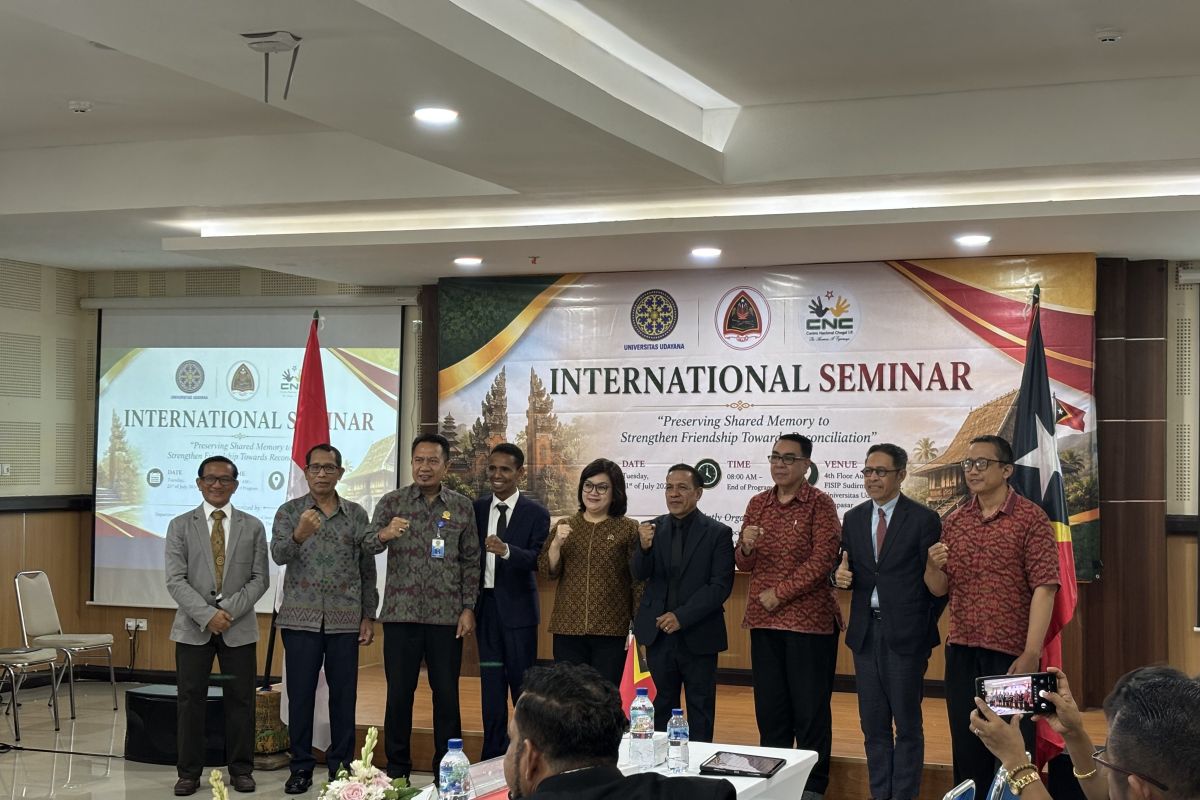
Denpasar (ANTARA) - Universitas Udayana (Unud), through the Political Science Study Programme of its Faculty of Social and Political Sciences, has partnered with the Consulate-General of Timor-Leste to hold a discussion on preserving memory as a path towards reconciliation.
“We remember the past to safeguard our collective memory, but this is not mere reflection. The past has passed, yet there are positive things we must take from it to build a better future,” said Rector of Universitas Udayana, I Ketut Sudarsana.
Speaking in Denpasar on Tuesday, Sudarsana explained that through this dialogue it is hoped that Indonesia and Timor-Leste will no longer dwell on who was right or wrong in past disputes.
This echoes the slogan Jas Merah popularised by the proclamator Ir Soekarno — never once leave history behind — making it the duty of the present and future generations to care for the memory of the past and to live side by side in peace.
“If we view memory from its negative side, there is much collective memory that holds wounds. But in the art of politics, we acknowledge that true reconciliation cannot be achieved through forgetting, but rather through remembering together, remembering honestly,” said Sudarsana.
Executive Director of the Institute for Peace and Democracy (IPD) and lecturer in Political Science at Universitas Udayana, I Ketut Putra Erawan, opened the discussion session by presenting a portrait of the political elite’s agenda.
He began with a question: is the reconciliation expected of the two states about remembering the past as one moves towards the future, or about forgetting the past altogether?
According to this United States-trained academic, the reconciliation process cannot rest solely on narratives of friendship without first being preceded by acknowledgment of the truth.
Various official reports have provided an important foundation for both countries to build a more mature relationship, yet the greatest challenge now is ensuring that historical memory remains alive in the public sphere as part of education in humanity.
“There is far too much friendship, and truth remains rare. Several books and articles discuss friendship that, in fact, sacrifices justice,” he said.
Executive Director of Centro Nacional Chega, Hugo Maria Fernandes, shared the view that a long process of reconciliation has been under way since independence.
However, he said, reconciliation must still be built through the disclosure of truth, acknowledgment, remorse and requests for forgiveness.
“In addition, the political commitment of both countries to follow up on the various reconciliation recommendations that have been produced is also important,” he said.
Representative of the National Human Rights Commission (Komnas HAM), Atnike Nova Sigiro, added that while the positive aspects of the past should indeed be taken on board in preserving memory, the disclosure of truth, the tracing of families separated by the conflict, and the implementation of recommendations from various joint commissions are essential parts of fulfilling human rights.
Responding to the dialogue, Representative of the Timor-Leste Consulate-General in Bali, Joel Maria da Costa, expressed his appreciation, saying that opening this memory reflects a determination to reflect on the pages of history with courage.
The Chega! report compiled by the Commission for Reception, Truth and Reconciliation (CAVR), together with the report of the Commission of Truth and Friendship (KKP), were once historic milestones as well as fundamental academic-political documents in the bilateral journey of the two countries.
These documents are not merely records of past events, but a strong moral foundation for restoring trust, healing historical wounds, and strengthening the bonds of brotherhood that transcend the geopolitical boundaries between Indonesia and Timor-Leste.
“Our presence here is tangible proof of our continuing commitment to implementing the strategic reconciliation set out in those two reports. We hope that the constructive dialogue held today will serve as an evaluation and mapping of the challenges still faced in preserving our collective memory,” he said.