
UBSI Management Programme Strengthens Curriculum to Meet Workplace Needs
JAKARTA — University curricula need to do more than keep pace with the dynamic development of knowledge. They must also ensure that the competencies students acquire are genuinely relevant to the needs of business and industry.
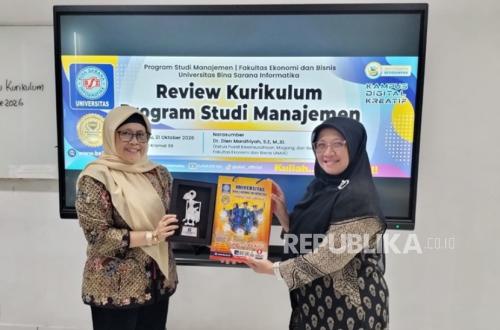
That is the focus of the Management Programme in the Faculty of Economics and Business at Universitas Bina Sarana Informatika (UBSI). The university held a curriculum review on Wednesday (21 October 2026) at its Kramat 98 campus in Jakarta.
The review formed part of UBSI’s efforts to evaluate and refine the Management Programme’s curriculum so that it remains relevant to developments in academic knowledge and technology, as well as changes in the workplace. It was attended by lecturers from the Academic Development Unit and programme administrators.
Dr Dien Mardhiyah of the Department of Management at the Faculty of Economics and Business, Universitas Airlangga (UNAIR), was the speaker. She shared academic perspectives and good practices in developing high-quality higher-education curricula.
The event was also attended by Dr Eka Dyah Setyaningsih, head of UBSI’s Management Programme. The presence of programme leaders demonstrated the institution’s commitment to maintaining education quality on an ongoing basis.
Dr Dien explained that a curriculum encompasses more than a list of courses. It includes learning objectives, subject matter, teaching strategies, assessment and evaluation, all of which are interconnected to ensure that graduates attain the required competencies.
“Curriculum evaluation therefore needs to be conducted systematically, taking into account a range of inputs, from graduate employers and alumni to tracer-study results, developments in knowledge, higher-education policy and changing competency requirements in business and industry,” Dr Dien said on Friday (23 October 2026).
The discussion also highlighted the importance of aligning graduate profiles with Programme Learning Outcomes (PLOs), or Graduate Learning Outcomes (CPL). These should be developed with reference to the Indonesian National Qualifications Framework (KKNI), the National Standards for Higher Education, the institution’s vision and mission, and input from stakeholders.
The links between graduate profiles, CPLs, subject matter and courses were a key consideration in the revision process. Clear mapping is expected to ensure that every course makes a measurable contribution to the competencies students need to master.
Dr Eka said the review also covered the adoption of student-centred teaching methods, alongside curriculum structure. Approaches under consideration included case-based learning, project-based learning and role-play.
“Through case-based learning, students can practise analysing business problems and developing possible solutions. Project-based learning encourages them to build skills in planning and producing work. Role-play can be used to develop communication, negotiation and decision-making skills,” Dr Eka said.
These methods need to be supported by assessment systems aligned with CPLs and Course Learning Outcomes (CPMK). Assessment may take the form of examinations, essays, reports, presentations or projects, depending on the competencies being measured.
“Another aspect discussed was the completeness of the curriculum redesign documentation. This should include an evaluation of the previous curriculum, tracer-study results, stakeholder-needs analysis, academic foundations, graduate profiles, CPLs, subject matter, course structure and descriptions, teaching strategies, assessment and evaluation mechanisms,” she explained.
Semester Learning Plans (RPS) should also comprehensively demonstrate the relationship between CPLs, CPMKs and Sub-CPMKs. In addition, they should specify teaching methods, student learning experiences, achievement indicators, assessment criteria, grade weightings and supporting references.
An interactive discussion gave lecturers and other participants the opportunity to put questions, share views and offer feedback to the speaker. Participants explored a range of issues to ensure the curriculum would be practical in application.
Topics included adapting the curriculum to industry needs, mapping CPLs to courses, applying case- and project-based learning, and conducting continuous curriculum quality evaluation. The constructive feedback will inform the refinement of UBSI’s Management Programme curriculum.
Planned follow-up measures include reviewing the curriculum structure, mapping CPLs, revisiting subject matter, improving RPS documents, and strengthening teaching methods and assessment systems. These steps are intended to achieve a high standard of education.
Through the event, UBSI, which describes itself as a Creative Digital Campus, reaffirmed its commitment to academic quality through collaboration between universities. It is also continuing efforts to strengthen the connection between education and professional needs in the workplace.
The initiative is expected to help produce graduates who not only understand management concepts but can also apply their knowledge in practice. Graduates are also being prepared to adapt to change, uphold integrity and meet the challenges of the modern business world.