
UBSI Lecturers' Creativity Turns Cassava Leaves into Dendeng, Opening New Business Opportunities
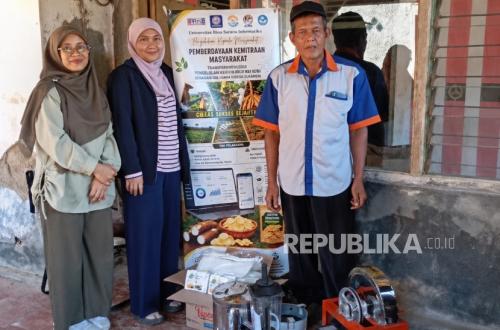
Lecturers from Universitas Bina Sarana Informatika (UBSI), known as a creative digital campus, have transformed cassava leaves—typically used as a vegetable—into a value-added food product through a community service programme. The innovation was introduced to residents of Cikeas Village, Sukaraja District, Bogor Regency, West Java, on Wednesday (1/7/2026), as an effort to increase the value of local agricultural produce. The programme was a collaboration between the Faculty of Engineering and Informatics and the Faculty of Economics and Business, involving two students. Led by Teni Agustina, the activity was attended by 10 participants comprising PKK members and local micro, small, and medium enterprise (UMKM) actors. During the training, participants were taught techniques to process cassava leaves into a plant-based dendeng with a savoury flavour and texture resembling traditional dendeng. The process includes boiling, mashing, mixing with spices, and frying to produce a market-ready product. Besides utilising the abundant cassava leaves in the area, participants also received training in making cassava chips with various flavours, such as balado, cheese, grilled corn, and original. The team also provided guidance on packaging and labelling techniques to enhance the products’ market value. Teni Agustina, head of the UBSI community service team, stated that the activity aims to encourage the community to leverage local food potential into products with higher economic value. ‘We want the community to see that cassava leaves can be processed not only as a vegetable but also into innovative products with business potential. We hope these skills can help increase community income through the utilisation of local agricultural products,’ she said. Student participant Shafira noted the residents’ enthusiasm throughout the training, observing that they actively practised each production stage and discussed marketing opportunities. Wahyu, a representative of the Cikeas Village farmer group, appreciated the UBSI team’s initiative, saying the innovation of turning cassava leaves into dendeng provides a new alternative to increase the value of the community’s harvests. To support the programme’s sustainability, the team donated several pieces of production equipment to the farmer group, including an automatic cassava slicer, an oil drainer, a vacuum sealer, a stove, steaming equipment, frying utensils, initial raw materials, as well as product packaging and labels. Teni explained that the equipment grant was intended to enable the community to start production independently immediately after the training. ‘We hope this training does not stop at the learning process. With the production equipment, the community can directly apply the skills they have acquired and develop them into a sustainable business,’ she said. Through this community service programme, UBSI hopes the innovation of processing cassava leaves into dendeng can become a business alternative for village communities. Going forward, the service team will also provide further assistance regarding business legality, packaging development, and marketing strategies so that local products can compete in a wider market.