
UBSI and BBSPJIKB Collaborate to Develop the Craft and Batik Industry
Universities and the industrial world often travel along separate paths. Yet, when the two are brought together, the space for producing knowledge, experience and innovation more relevant to society’s needs becomes far more open.
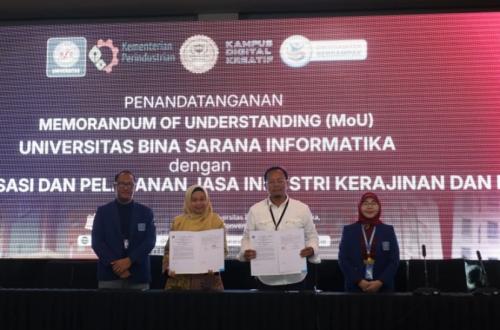
That spirit underpins the collaboration between Universitas Bina Sarana Informatika (UBSI) and the Centre for Standardisation and Service of the Craft and Batik Industry (BBSPJIKB), marked by the signing of a memorandum of understanding (MoU) on 29 August 2026 at the BSI Convention Center Kaliabang in Bekasi.
The MoU was signed by UBSI Rector Prof. Dr. Ir. Mochamad Wahyudi and BBSPJIKB Head Zya Labiba. The partnership forms the foundation for both parties to develop various collaborative programmes in education, student research, community service and human resource development.
The collaboration is directed not only at exchanging knowledge but also at optimising the potential each party holds. UBSI and BBSPJIKB agreed to encourage development and innovation in science, technology and the arts by leveraging available resources to benefit society.
In education, the collaboration can take shape through industrial placements or student internships, lecturer industrial attachments to enhance competence, knowledge sharing, and the involvement of industry practitioners as lecturers. Through such schemes, students and lecturers alike can gain experience closer to the needs and dynamics of the industrial world.
Meanwhile, in student research, the cooperation can be directed towards supervising final-year projects or theses, particularly research related to crafts and batik. In community service, both parties can develop empowerment programmes, training and social responsibility activities targeting societal needs.
Prof. Wahyudi said the collaboration is expected not to stop at the signing of a document, but to be genuinely translated into activities that benefit various parties.
“This cooperation is expected not to end with the signing of documents, but to be realised through various activities that deliver real benefits for students, lecturers, society, and the development of the craft and batik industry,” said Prof. Wahyudi in a press release received on Monday (14/9).
According to him, working with an institution possessing industrial expertise also opens space for the university to contribute more relevantly to the needs of industry. This aligns with UBSI’s efforts to strengthen the implementation of the three pillars of higher education — education, research and community service — so they not only take place within the campus but also deliver broader impact.
Echoing this, BBSPJIKB Head Zya Labiba said the collaboration with UBSI can become a space to strengthen synergy between higher education institutions and government bodies, particularly in developing human resources, science and technology to support the craft and batik industry.
“The collaboration between BBSPJIKB and UBSI is expected to strengthen synergy in developing human resources, knowledge and technology, thereby benefiting the development of the craft and batik industry in Indonesia,” said Zya in a press release received on Monday (14/9).
BBSPJIKB is a government implementing agency tasked with industrial standardisation, optimising the use of industrial technology and Industry 4.0, green industry, and craft and batik industry services. UBSI, meanwhile, carries out the three pillars of higher education through education, research and community service.
Collaboration does not stop at the MoU
Interestingly, the cooperation between UBSI and BBSPJIKB has also begun to be directed towards more concrete activities. As an initial implementation, both parties agreed to hold a national seminar entitled “Collaboration for the Development of the Craft and Batik Industry in Indonesia”, formalised through a cooperation agreement (PKS) on organising the national seminar for UBSI lecturers.
Under the agreement, BBSPJIKB will provide seminar speakers, whilst UBSI will prepare the event organisation along with supporting facilities and infrastructure. This scheme serves as one example of how the mutual understanding built by both parties is beginning to be translated into academic activity.
The collaboration between UBSI and BBSPJIKB is expected to continue developing through programmes that connect the needs of higher education with industrial developments. From the classroom to the world of work, from student research to community empowerment, the partnership opens opportunities for knowledge and technology not to remain as theory, but to be used to address real problems, including strengthening the craft and batik industry in Indonesia.