
UBSI 2026 Digital Learning Innovation Materials Receive Expert Review, Pedagogical Quality Highlighted
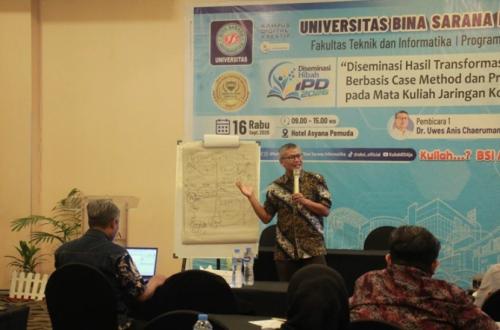
The Learning Object Materials (LOM) developed by the 2026 Digital Learning Innovation (IPD) Grant Team at Universitas Bina Sarana Informatika (UBSI) have received feedback from digital learning expert, Dr Uwes Anis Chaeruman. The review was presented during a programme results dissemination event held at the Asyana Hotel Pemuda, Jakarta, on Wednesday (16/09/202cap).
In his review, Dr Uwes emphasised that the development of instructional videos should not merely focus on technical production quality. He noted that pedagogical quality is a vital aspect, as instructional videos must ultimately assist students in understanding the material and achieving targeted competencies.
This was evident when the team presented three instructional videos. Dr Uwes observed that while some videos had technical shortcomings, they possessed strengths in terms of content and delivery. “Video one has poor technical quality, but the content is good. Pedagogically, video one is the best,” Dr Uwes stated on Wednesday.
He noted that these findings demonstrate that technical and pedagogical qualities must be viewed as two distinct aspects in the development of LOM. A well-produced video does not necessarily possess the most appropriate delivery strategy for students’ learning needs.
From Examples to Explanations
One of the suggestions provided by Dr Uwes concerned the pattern of material delivery. He suggested that instructional videos should not always begin with direct conceptual explanations, but could instead start with examples or cases closely related to the subject matter.
“Example First Then Explain,” he asserted.
This approach is considered capable of strengthening the application of Case-Based Teaching and Learning within the LOM developed by the UBSI IPD Grant team. The cases used do not always have to be incorrect problems; they can include best practices, erroneous practices, or real-world issues that serve as a context for explaining concepts.
With this pattern, students do not merely receive an explanation of a concept, but are first invited to observe a problem or situation that serves as an entry point to the learning material.
Instructional Videos are More Than Just Moving Theory to the Screen
He also highlighted the use of audio-visual media in LOM. In his view, instructional videos should not merely be used to transfer theoretical explanations from the classroom into a digital format.
Audio-visual media has the potential to help transform abstract material into something more concrete. Its use can be adapted to various types of knowledge, ranging from facts, concepts, and rules to procedures and problem-solving.
This means that video development needs to consider its pedagogical function from the outset. The choice of visuals, the method of explanation, the examples used, and the flow of delivery must be tailored to the type of material and the learning experience intended to be built.
Communication Style Should Adapt to Self-Paced Learning
In addition to content and learning strategies, Dr Uwes provided input regarding the communication style used in LOM for self-paced learning. He noted that students learning independently could be better assisted if the material is presented in a less formal style.
“For those learning independently, research shows that less formal is better,” he explained.
This feedback indicates that digital learning requires a different communication approach compared to face-to-face learning. When students access material independently, a more relaxed and communicative delivery style can be part of the effort to build a learning experience that feels more accessible to students.
For the UBSI IPD team, this review serves as evaluation material to refine the developed LOM. The input from the digital learning expert provides the perspective that the quality of learning tools is determined not only by production technology or visual appearance, but also by the suitability of learning strategies, delivery methods, material context, and student needs.
Through this review and refinement process, it is hoped that the LOM resulting from the 2026 IPD Grant by the UBSI team will evolve into digital learning tools that are more effective, communicative, and supportive of students in independent learning.
Source: jawawa.id (https://jawawa.id/newsitem/ubsi-2026-digital-learning-innovation-materials-receive-expert-review-pedagogical-quality-highlighted-1790344406)
Originally published by Republika (https://news.republika.co.id/berita/tlx7aw423/lom-ipd-2026-ubsi-dapat-review-pakar-kualitas-pedagogis-jadi-sorotan), translated from Indonesian