
UB’s IT Directorate develops local AI for campus network management
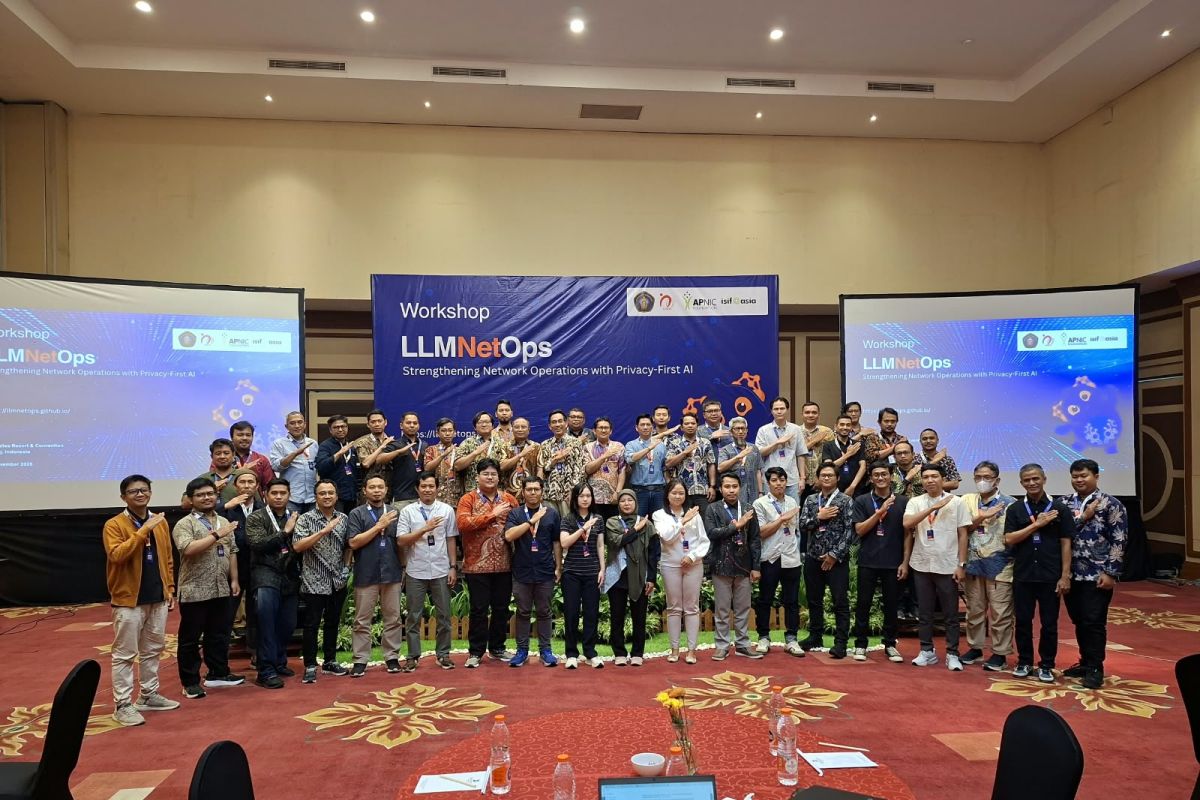
Malang (ANTARA) - The Information Technology Directorate (DTI) of Universitas Brawijaya (UB) is developing an artificial intelligence (AI) system to support the management and operation of university networks through an innovation called Large Language Model for Network Operations (LLMNetOps).
LLMNetOps is designed to help network administrators detect disruptions, analyse devices and prepare reports more efficiently. It was introduced during an event held on 6-7 November 2026 at a hotel in Malang, East Java.
UB DTI Director Dr Raden Arief Setyawan said in Malang on Friday that the development of LLMNetOps stemmed from the various challenges faced by educational and research institutions in Indonesia in managing network infrastructure.
“Limited technical staff, the large number of devices that need to be managed, and uneven levels of network-administration expertise are issues that require attention,” Raden Arief said on the sidelines of the LLMNetOps workshop.
He said network management at universities presented particular challenges. There were many devices to manage, while the availability of technical staff and the expertise of network administrators varied between institutions.
AI technology could help with these tasks, he said, from analysing logs to tracing network disruptions. UB therefore developed LLMNetOps as a solution for educational and research institutions.
Through LLMNetOps, UB has introduced an AI system that can run locally within an institution, meaning configuration data and network information do not need to be sent to external servers.
LLMNetOps received US$30,000 in funding from the Information Society Innovation Fund (ISIF) Asia/APNIC Foundation in 2025 and is being implemented by UB in collaboration with the Indonesia Research and Education Network (IDREN).
The system acts as an AI co-pilot for network teams through three main components: a local LLM running on an institution’s server; NetOpsAgent, an AI agent that converts questions into commands for network devices; and NetOpsUI, a web-based interface for conversational interaction.
For example, a network administrator who receives a report that users are not getting IP addresses on the local network in a particular building can ask the system to check the router’s status. The AI then helps trace the relevant network devices, read their status and report the findings without staff having to log in to each device.
On the first day, participants learned about challenges in network management and the potential for AI to help address them. They were then guided through building and activating a local AI system step by step on their own laptops.
On the second day, Saturday, 7 November 2026, participants practised using LLMNetOps to handle common network-disruption scenarios on campus, including AI-based cyber security and the broader use of generative AI in campus operations.
The workshop aimed to help participants understand the concepts and architecture of local generative AI, install and operate LLMNetOps independently, and develop implementation plans based on their institutions’ priorities and available hardware capacity.
“We hope the system will not stop at training, but will be implemented and developed further at each institution. We want to build a community of practitioners across universities so they can share experience, knowledge and solutions to network-management challenges,” he said.
The LLMNetOps team will also hold an online workshop to monitor and support implementation at participating institutions.
All materials, technical guides and tools used are available openly and free of charge, allowing institutions to develop them further or use them for in-house training of technical staff.
Through LLMNetOps, UB is seeking to promote AI that not only improves network-operational efficiency but also safeguards data and institutional autonomy. “This collaboration is a step towards strengthening the education and research network ecosystem in Indonesia,” Arief said.