
Ubaya Students Create Healthy Snack from Mango Leaves and Peanut Skins
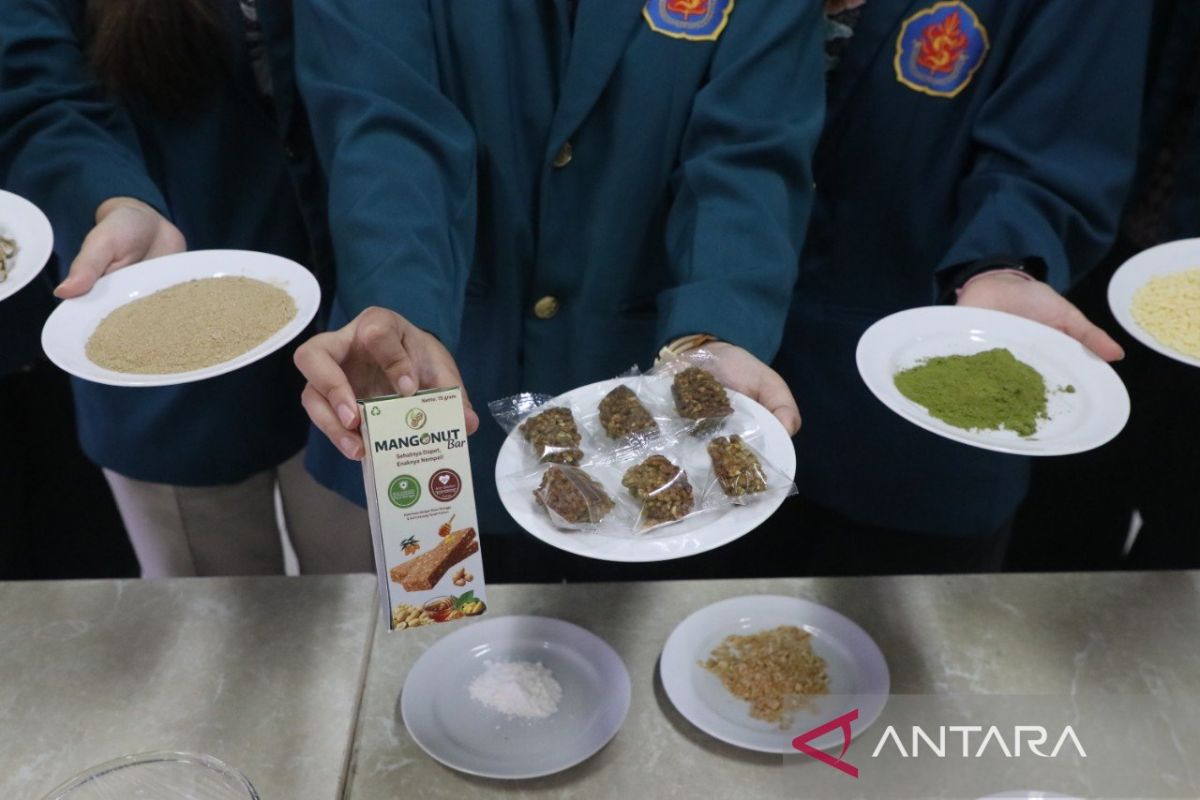
Surabaya (ANTARA) - Five students from the University of Surabaya (Ubaya) have created Mangonut Bar, a healthy snack made from mango leaves and peanut skins that utilises food waste whilst offering potential functional food benefits to the public.
Team leader Josephine Aprilia said in Surabaya on Friday that the idea originated from concern over the number of people with type one and type two diabetes mellitus in Indonesia, which ranks sixth highest in the world.
“After doing some research, we found that mango leaves contain an antidiabetic compound called mangiferin. Using mango leaf extract can prevent spikes in blood sugar levels by reducing glucose absorption,” she said.
Apart from Josephine Aprilia, the Mangonut Bar development team consists of Felicia Tiffany T, Jovianne Vevina, Sabina Ananda V, and Edwin Tirtana, from Ubaya’s Faculty of Biotechnology and the Faculty of Business and Economics.
Beyond the mangiferin content in mango leaves, the team also saw potential in peanut skins, which have so far been underutilised.
Josephine said the product development process took around three months before it became a ready-to-eat snack.
During that period, the team faced challenges in coordinating schedules, as members came from different faculties, whilst also conducting numerous trials to achieve the right texture, taste, and aroma.
“The main challenge was that we came from different faculties, so adjusting schedules and commitments was quite difficult. In addition, it took several attempts to produce a product with a pleasant texture, taste, and aroma,” said Josephine.
The Mangonut Bar was developed under the supervision of Dr Gabriel Tirtawijaya through a drying process for the mango leaves and peanut skins to reduce water content without damaging their nutritional value.
The mango leaf and peanut skin powder was then mixed with butter, the sweetener erythritol, pure honey, eggs, maize starch, roasted peanuts, and rice crisps.
The mixture was baked for 15 minutes at 120 degrees Celsius until ready to be cut into snack bars.
Josephine hopes the innovation can inspire the creation of food products with wider benefits for society whilst improving the utilisation of agricultural waste.
“Moreover, the Mangonut innovation has great potential to be produced on an industrial scale because the raw materials are easy to find, the production process is simple, and the required capital is not too high,” she said.
Previously, the Mangonut Bar innovation won a gold medal in the Food category, a Favourite Poster award in the Food category, and third runner-up across all categories at the Mandalika Essay Competition 8.