
UB Researcher Describes New Bark Beetle Species in Japan
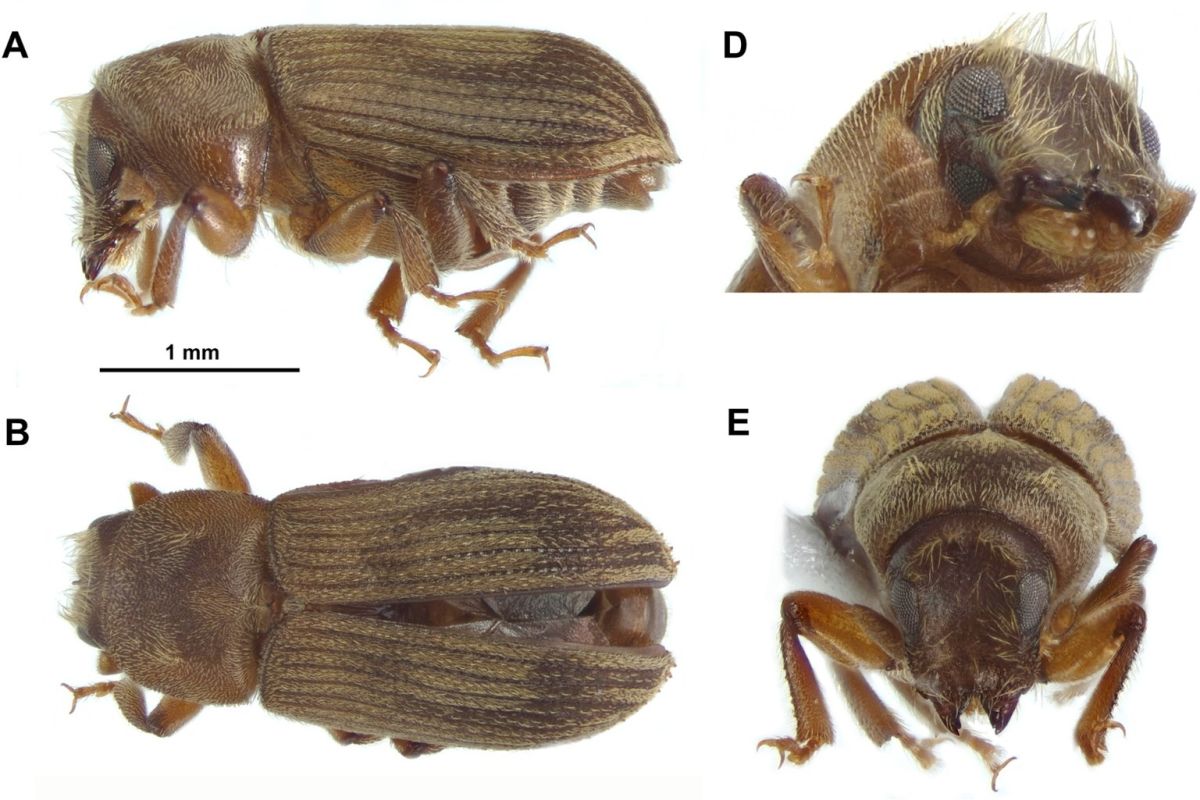
The main distinguishing feature of the new species lies in the morphological character of the epistoma, which has a broad horn or tubercle, as well as a pattern of setae and vestiture on the elytra that differs from other species in the genus Hyorrhynchus.
A researcher from the Faculty of Bio-industry, Agriculture and Forestry at Universitas Brawijaya (FBiPK UB), Yogo Setiawan, S.P., M.P., has successfully described a new species of bark beetle and reported two new records of ambrosia beetle species in Japan.
The findings form part of his doctoral research at The United Graduate School of Agricultural Sciences, Kagoshima University, Japan. The new species has been named Hyorrhynchus takakumaensis Setiawan, Hata & Smith, sp. nov.
“The name takakumaensis is taken from the location where it was found, namely Takakuma Experimental Forest, a research forest area belonging to Kagoshima University in the Takakuma Mountains, Kagoshima Prefecture, Japan. This species also has a common name in Japanese, namely タカクマオオキクイムシ (Takakuma-ōkikuimushi),” said Yogo in a statement received in Malang, East Java, Monday.
Yogo said the two ambrosia beetle species that had never been recorded in Japan are Anisandrus auratipilus Smith, Beaver & Cognato, 2020 and Debus shoreae (Stebbing, 1907).
The finding of A. auratipilus is the second record of this species in the world after it was first described from Fujian Province, China. Meanwhile, D. shoreae is known to be distributed in tropical areas of East Asia and Southeast Asia.
“I carried out sampling for one year, from summer 2024 to summer 2025, covering four seasons. Samples were collected every two weeks in Takakuma Experimental Forest to examine the diversity and community dynamics of bark beetles and ambrosia beetles in the forests of southern Japan, which have a warmer climate compared to the central and northern regions,” said Yogo.
During the identification process, Yogo found one specimen with morphological characters different from other species in the genus Hyorrhynchus.
The finding was consulted with an ambrosia beetle taxonomy expert from Michigan State University and compared with collections in several museums, including the National Agriculture and Food Research Organization (NARO) in Tsukuba, Japan.
“During the identification process, I found one specimen that had not been identified to species level, because its morphological characters differed from other species in the same genus. After consulting with a taxonomy expert at Michigan State University and comparing it with collections in several museums, we concluded that the specimen had indeed never been described before,” said Yogo.
He explained that the main distinguishing feature of the new species lies in the morphological character of the epistoma, which has a broad horn or tubercle, as well as a pattern of setae and vestiture on the elytra that differs from other species in the genus Hyorrhynchus.
Before this research, the genus Hyorrhynchus consisted of only ten species worldwide. The discovery increases the number to eleven species, while the record of Hyorrhynchus species in Japan increases from two to three.
According to Yogo, describing a new species requires a long process, from sampling, identification, consultation with experts, to the preparation of detailed morphological descriptions.
During the research, he faced challenges such as specimen containers in traps freezing during winter, humid and hot summer weather that could reach temperatures of 36 degrees, as well as a research location that required a ferry journey of about 45 minutes and a one-hour overland trip.
Nevertheless, the discovery of new species and new distribution records is important for documenting biodiversity as well as expanding knowledge about the biogeographical distribution of bark beetles and ambrosia beetles.
“Ambrosia beetles play an important role in wood decomposition and nutrient recycling in forests. However, some species are also important pests in the forestry and agricultural sectors. Therefore, documenting the diversity of this beetle group is very important,” said Yogo.
This research is a collaboration between Kagoshima University, Saga University, Universitas Brawijaya, and Michigan State University.
The results have been published on 14 July 2026 in the reputable international journal ZooKeys through an article entitled A new species of Hyorrhynchus Blandford, 1894 (Coleoptera, Curculionidae, Scolytinae, Hyorrhynchini) and two new records of xyleborine ambrosia beetles from Japan.
Source: jawawa.id (https://jawawa.id/newsitem/ub-researcher-describes-new-bark-beetle-species-in-japan-1786359318)
Originally published by Antara (Indonesian) (https://www.antaranews.com/berita/5687664/peneliti-fbipk-ub-deskripsikan-spesies-baru-kumbang-di-jepang), translated from Indonesian