
UB Bestari Saintek Team Turns Poultry Waste into Organic Fertiliser
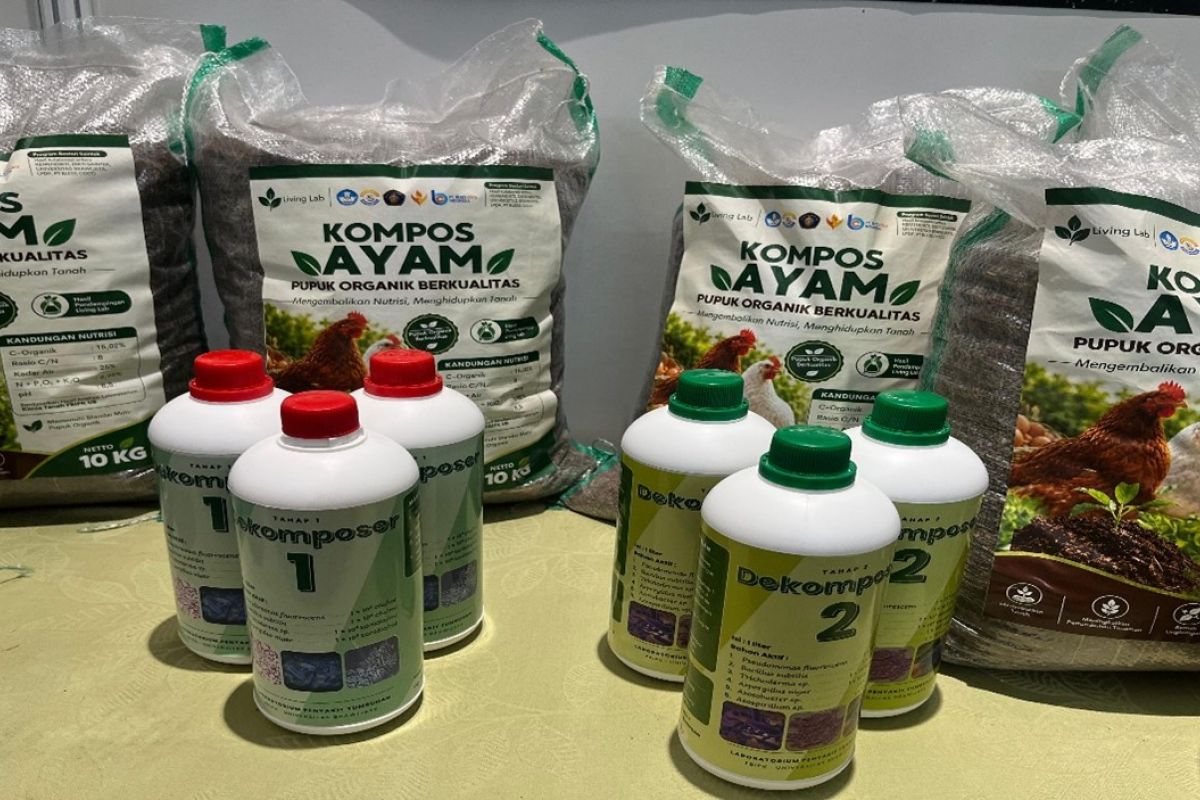
Malang (ANTARA) - The 2026 Bestari Saintek team at Universitas Brawijaya (UB), led by Professor Setyono Yudo Tyasmoro, is turning chicken-farm waste into organic fertiliser while developing a circular-economy ecosystem in Bluri Village, Solokuro district, Lamongan regency.
The innovation was presented to Deputy Minister of Higher Education, Science and Technology Fauzan during a visit to the UB Living Lab exhibition at the university auditorium on Friday (30 October).
Professor Yudo said in a statement from Malang, East Java, on Wednesday that one outcome of the programme was the use of chicken-farm waste, previously an environmental problem, as a raw material for organic fertiliser.
He said the circular-economy concept was intended not only to produce organic fertiliser but also to connect the livestock and agriculture sectors through a Living Laboratory approach.
“Chicken-farm waste has so far been regarded as a by-product of livestock operations that requires treatment. However, if processed appropriately, it has the potential to become a raw material for organic fertiliser,” he said.
Using an approach based on research and community needs, the UB Bestari Saintek team has developed a solution to an environmental problem as well as a product that can be reused in agriculture.
The programme uses a Living Lab approach, with the community and partners playing an important role in developing the innovation.
UB is responsible for technology development, assistance and product-quality testing. PT Bless Coco Indonesia is a partner in product development and processing.
The chicken farmers’ association supplies the raw material, while the Loh Jinawi Bluri Farmers’ Group plays an important role in developing the use of the organic fertiliser.
The collaboration also involves the Lamongan Regency Livestock and Animal Health Agency as a supporting partner in developing the programme’s ecosystem.
A key stage of the programme is developing a process to treat chicken-farm waste using a decomposer to help break down organic material. The raw material comes from waste produced by both layer and broiler farms, and is then processed and monitored regularly.
During processing, the team monitors several parameters, including temperature, pH and the condition of the material. These observations track progress and ensure that fermentation proceeds according to the planned stages.
The resulting organic fertiliser is also tested at UB’s Faculty of Agriculture soil chemistry laboratory. The tests assess its characteristics and contents against standard quality parameters for solid organic fertiliser, allowing the product’s quality to be evaluated scientifically.
The next phase of the programme will refine the fertiliser formulation by adding biochar and supporting microorganisms, including Azospirillum sp. and Azotobacter sp.
This phase is designed to improve the fertiliser’s characteristics and test its potential effectiveness in supporting crop growth and yields.
“The programme aims not only to produce organic fertiliser, but also to build a sustainable system of cooperation,” he said.
In the ecosystem being developed, farmers supply the chicken-farm waste, processing partners handle production and product development, and farmers’ groups use the organic fertiliser for cultivation.
The chain is expected to establish mutually beneficial economic links. Waste that previously required treatment can become a valuable raw material, while farmers gain an alternative source of organic fertiliser developed through research.
Source: jawawa.id (https://jawawa.id/newsitem/ub-bestari-saintek-team-turns-poultry-waste-into-organic-fertiliser-1793789706)
Originally published by Antara (Indonesian) (https://www.antaranews.com/berita/5831715/tim-bestari-saintek-ub-olah-limbah-kandang-jadi-pupuk-organik), translated from Indonesian