
UAE Ambassador States Iran Attacks Civilian Infrastructure, Not Just Military Facilities
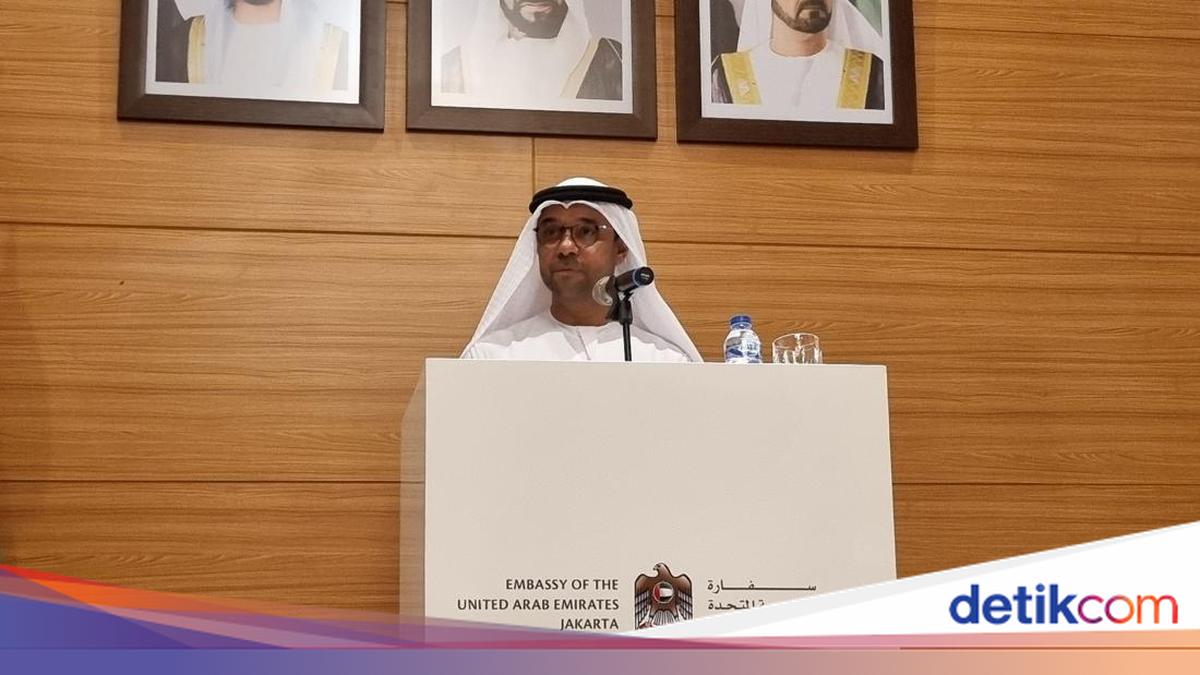
The UAE Ambassador to Indonesia, Abdulla Salem Al-Dhaheri, has described the situation in the Middle East conflict involving Iran, Israel, and the United States. According to him, Iran is not only targeting military facilities but also destroying public infrastructure.
“There are many casualties and injuries, as well as damage to vital civilian infrastructure, airports, ports, energy facilities, and residential areas. These facts clearly show that the attacks are not limited to military targets,” said Al-Dhaheri during a press conference at his residence in the Kuningan area, South Jakarta, on Wednesday (8/4/2026).
To that end, Al-Dhaheri refuted claims that Iran’s attacks only target military facilities. According to him, this is to damage the economic order.
“What we are witnessing is a dangerous shift towards targeting civilian infrastructure with the aim of undermining economic stability, rather than achieving legitimate military objectives,” he stated.
Furthermore, according to Al-Dhaheri, Iran’s conflict against Israel and the United States is not a religious war. He said the conflict is related to law and sovereignty.
“Additionally, allow me to clarify this point. Efforts to frame this conflict as a religious war are misleading and do not reflect reality. This is a matter of security, sovereignty, and international law, not religion. I repeat, this is not a religious war,” he emphasised.
Al-Dhaheri assessed that Iran wants a larger war by expanding its attacks to neighbouring countries. He even noted that its attacks on Israel are only a small part.
“Iran directs most of its attacks towards neighbouring countries, countries that do not provoke escalation and do not want this war. The latest statistics show that 85% of Iran’s missiles and drones are launched towards Muslim countries, while only 15% target Israel,” he revealed.
To that end, Al-Dhaheri asked the global community, especially Indonesia, to assess this conflict in a balanced manner. He does not want a narrative that is one-sided.
“Without being influenced by emotional narratives that contradict the facts. I urge neutrality and solidarity, as well as support for the Arab world and Muslim countries affected by the ongoing war in the Middle East,” he explained.
“The UAE, GCC, and Jordan have shown restraint, responsibility, and discipline. We do not retaliate in the same way despite repeated attacks from Iran, because we are firmly convinced that leadership is not measured by escalation, but by the ability to prevent a wider conflict,” he continued.
He went on to say that the UAE is currently actively communicating with world leaders, including President Prabowo Subianto, to achieve the goal of de-escalating the conflict.
“Under the leadership of Sheikh Mohammed bin Zayed Al Nahyan, President of the United Arab Emirates, the UAE has actively engaged in dialogue with global leaders, including His Excellency Prabowo Subianto, President of the Republic of Indonesia, to promote de-escalation and international coordination,” he said.
Al-Dhaheri revealed that the situation in the UAE remains safe amid the conflict and previous Iranian aggression. According to him, his country’s defence is still effective.
“I want to assure you, the United Arab Emirates remains safe, stable, and fully prepared. The same applies to Bahrain, Qatar, Jordan, and Kuwait. Our defence systems are highly effective. Our institutions are operating fully,” he emphasised.
He explained that the economy in the UAE is still strong. However, the global economy is affected, including Indonesia, due to disrupted oil supplies.
“Rising energy prices, increased shipping and transportation costs, and pressure on global supply chains. Here, I want to say that Indonesia is not immune. Like many other Asian economies, Indonesia is directly affected due to rising fuel prices, increased costs of goods, and supply chain disruptions,” he said.