
Two Years of Prabowo’s Government: Fertiliser Prices Cut by up to 20%
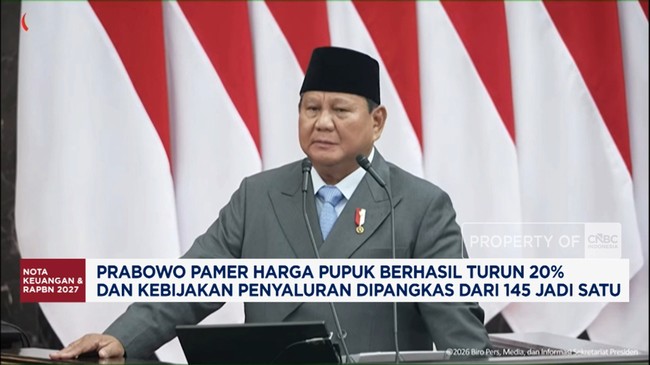
Jakarta, CNBC Indonesia – The government’s efforts to strengthen the national agricultural sector have begun to show tangible results over the past two years. The administration of President Prabowo Subianto has succeeded in lowering production costs and improving farmers’ welfare. One notable measure is a cut of up to 20% in the maximum retail prices (HET) of subsidised fertilisers, accompanied by simpler regulations and distribution reforms to make fertiliser more accessible to farmers.
The policy, in effect since 22 October 2025, marks a turning point in the management of subsidised fertilisers. For the first time in Indonesia’s history, the government has reduced the HET for every type of subsidised fertiliser, giving farmers greater scope to lower their farming costs.
President Prabowo said the policy was made possible by the government’s willingness to reform rules that had previously obstructed fertiliser distribution to the public.
“We have succeeded in cutting fertiliser prices by 20%. This is the first time in the history of the Unitary State of the Republic of Indonesia. For the first time, we have been able to lower fertiliser prices for the people, while at the same time increasing the volume available to them,” Prabowo said, according to a written statement on Tuesday (27 October 2026).
His remarks underscore the government’s policy direction: fertiliser should not only be cheaper, but also available in sufficient quantities and accessible to farmers when needed. The price reduction is therefore intended not merely to save costs, but also to help sustain agricultural productivity and strengthen national food security.
The reduction in the HET for subsidised fertiliser was set out in Agriculture Ministerial Decree No. 1117/Kpts./SR.310/M/10/2025, dated 22 October 2025, amending provisions on the types, maximum retail prices and allocations of subsidised fertiliser for the agricultural sector in the 2025 fiscal year.
The policy covers all types of subsidised fertiliser used by farmers. The price of urea has fallen from Rp2,250 to Rp1,800 per kilogram. NPK fertiliser has dropped from Rp2,300 to Rp1,840 per kilogram, while NPK for cocoa has decreased from Rp3,300 to Rp2,640 per kilogram.
The price adjustment also applies to ZA fertiliser for sugar cane, down from Rp1,700 to Rp1,360 per kilogram, and organic fertiliser, down from Rp800 to Rp640 per kilogram.
The cuts amount to a direct 20% saving on the reference price of each type of subsidised fertiliser. For farmers who rely on fertiliser to maintain land productivity, lower input costs can ease the burden of farming, particularly when demand for fertiliser rises ahead of the planting season.
The policy is intended to benefit more than 155 million people, including farmers and their families across Indonesia. Its wide reach highlights the importance of fertiliser policy to rural communities and the continued production of food nationwide.
However, the government is not relying on lower prices alone. Simplifying regulations and improving the distribution system are also crucial to ensuring that the policy benefits reach eligible farmers.
145 regulations cut as distribution is overhauled
A longstanding concern in the distribution of subsidised fertiliser has been the lengthy bureaucratic chain and the risk of irregularities. To address this, the government has scrapped 145 regulations relating to the distribution of subsidised fertiliser.
The deregulation is intended to simplify administration, speed up delivery and make it easier for farmers to obtain the fertiliser they need. With fewer and simpler rules, distribution is expected to become more efficient without compromising oversight or proper targeting.
The government has also stepped up law enforcement against parties misusing subsidised fertiliser. Ministry of Agriculture data show that 2,231 licences held by problematic subsidised-fertiliser retailers and distributors were revoked in various regions during the first half of 2026.
The measure forms part of efforts to clean up distribution channels, prevent the diversion of subsidised fertiliser and protect farmers’ entitlements. The government has also acted against counterfeit fertiliser found to contain no nutrients; its use was reportedly linked to crop failures and estimated losses of Rp3.2 trillion to Rp3.3 trillion.
Meanwhile, the government is continuing to strengthen digitalisation through the electronic Group Needs Definitive Plan (e-RDKK) system. The system digitally records farmers’ details, land area, crops and fertiliser requirements, with the aim of making registration and distribution more transparent and accountable.
Agriculture Minister Andi Amran Sulaiman said that easy access to fertiliser and clean distribution channels were essential to increasing production and farmers’ profits.
“When fertiliser is easy to obtain and distribution is clean, production rises, farmers profit and national food security grows stronger. That is the main goal we continue to pursue,” he said.
His remarks highlight the link between fertiliser reform and farmers’ welfare. More affordable prices can help reduce production costs, while better-organised distribution is expected to ensure fertiliser is available as needed. Together, the measures are intended to sustain land productivity and the viability of farming.
Farmer Exchange Rate rises
Alongside reforms in the agricultural sector, indicators of farmers’ welfare have also shown positive developments. Statistics Indonesia (BPS) reported that the national Farmer Exchange Rate (NTP) reached 129.19 in August 2026, up 1.05% from 127.84 in July.
The NTP compares the price index received by farmers with the index of prices they pay. An increase indicates that, on average, prices received by farmers have performed better than the prices they pay for production and household needs.
In August 2026, the index of prices received by farmers rose by 1.14%, while the index of prices paid by farmers increased by just 0.09%. This gap lifted the NTP and indicated an improvement in farmers’ terms of trade during the month.
The NTP rose in most agricultural subsectors. Food crops recorded the largest increase, at 1.62%, followed by smallholder plantation crops at 1.53%, livestock at 0.96% and fisheries at 0.69%.
The trend was not uniform, however. The NTP for horticulture fell by 2.84%. This shows that price and cost movements differ between commodities, and that efforts to improve farmers’ welfare need to take account of the specific circumstances of each subsector.
Geographically, the improvement covered most of Indonesia. Of the 38 provinces monitored by BPS, 33 recorded an increase in NTP. West Sulawesi saw the largest rise, at 6.87%, driven mainly by higher palm oil prices.
Cumulatively, the national NTP from January to August 2026 was 3.18% higher than in the same period a year earlier. This development underscores agriculture’s continuing role in supporting the rural economy and the purchasing power of people who depend on farming.
Although the NTP is not the only measure of welfare, and an increase does not automatically mean that every farmer’s income has risen, the indicator provides an overview of changes in farmers’ purchasing power in aggregate.
Lower subsidised-fertiliser prices, simpler regulations, tighter distribution controls and digitalised registration form an interconnected set of policies. The aim is not merely to make fertiliser cheaper, but to build an agricultural system in which farmers can produce at more manageable cost and obtain better access to farming inputs.
Amid challenges from commodity prices and production costs, as well as the need to maintain food supplies, these policies represent one of the government’s efforts to strengthen the foundations of national agriculture.
Savings from the lower HET can help farmers manage costs, while more transparent distribution is expected to reduce obstacles to obtaining subsidised fertiliser.
At the same time, the rise in the national NTP offers a positive signal about farmers’ terms of trade. The next challenge is to ensure that improvements are felt more evenly by farmers across regions and subsectors, including those facing price pressures or persistently high production costs.
In its second year, the Prabowo-Gibran administration has thus made fertiliser reform one component of a broader agenda to increase production, safeguard food security and improve the welfare of agricultural communities.
Ultimately, the success of this agenda will depend on consistent implementation on the ground. When fertiliser is available at affordable prices, distribution is orderly and farming yields better economic returns, farmers have greater opportunities to raise productivity and improve their families’ livelihoods.
With farmers serving as one of the main pillars of food security, improving access to fertiliser and protecting their purchasing power are important investments in the future of Indonesian agriculture.
Source: jawawa.id (https://jawawa.id/newsitem/two-years-of-prabowos-government-fertiliser-prices-cut-by-up-to-20-1793080299)
Originally published by CNBC Indonesia (https://www.cnbcindonesia.com/news/20261027120449-4-779804/dua-tahun-pemerintahan-prabowo-harga-pupuk-turun-hingga-20), translated from Indonesian