
Two Years of Prabowo-Gibran: School Revitalisation from Aceh to Papua
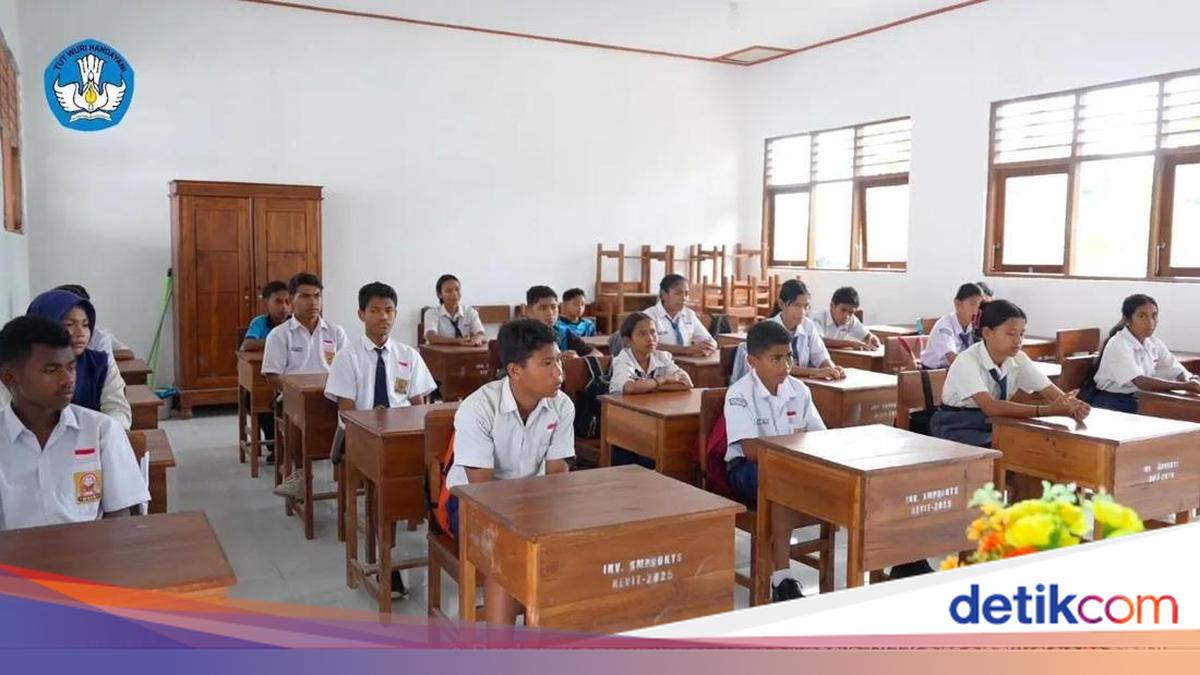
Thousands of school buildings remain damaged, learning facilities are limited in remote and outermost regions (3T), and teaching is disrupted by a shortage of classrooms. These remain fundamental challenges for education in Indonesia.
To address the infrastructure crisis, the government, through the Ministry of Primary and Secondary Education (Kemendikdasmen), has positioned the Education Unit Revitalisation Programme as a strategic national solution.
In 2026, the programme will reach 35,769 education units, from early childhood education (PAUD) to senior secondary schools, across Indonesia. It is being implemented through a self-managed scheme, with a total budget allocation of Rp26 trillion, and is targeted for completion by the end of the year.
In his state address on 14 August, President Prabowo Subianto said improvements to education facilities were the largest school renovation programme in the country’s history, intended to ensure adequate access to learning, including in 3T areas.
“Our children must receive a good education. That is why we are carrying out the largest school improvement programme in our history. As of this year, we have repaired more than 71,744 schools,” Prabowo said, according to a statement cited on Monday (26 October 2026).
“Next year our target is 100,000; in 2028, 100,000; and by 2029, all schools across Indonesia—primary, junior secondary, senior secondary and vocational schools, including Islamic boarding schools—must have completed renovations,” he added.
Prabowo said a dedicated task force had been established to accelerate the target, with teams operating from Sabang to Merauke.
“There is now a special task force for the outermost and most remote islands—in Sabang, Indonesia’s westernmost island, in Merauke, and throughout Indonesia,” he said.
Education Minister Abdul Mu’ti said the first two years of the Prabowo-Gibran administration had focused on strengthening and organising the foundations of education quality nationwide.
“I call these first two years a period of foundation-building. We are establishing a framework to make improvements and ensure that all the programmes we implement have a direct impact,” Mu’ti said, as quoted by RRI.
One of the ministry’s priorities is the revitalisation of education units to strengthen school facilities. The government is also expanding the digitalisation of education so that technology can support learning.
Mu’ti said digital devices had been distributed to schools in various regions, including outside Java. Support also includes electricity and internet facilities for schools without adequate access.
“For schools that do not have electricity, we are helping to build the network. The same applies to schools without internet,” Mu’ti said.
The Education Unit Revitalisation Programme is mandated by Presidential Instruction No. 7 of 2025 and forms part of the Quick Best Results Programme (PHTC), implemented by Kemendikdasmen.
Funding continues to be disbursed. To date, beneficiaries have received around Rp20 trillion. The programme covers not only repairs to existing school buildings but also the construction of new school units (USB), including 66 PAUD facilities and 28 senior secondary schools.
Progress varies across regions. In Aceh, hundreds of schools have completed construction, while work is continuing at education units in East Nusa Tenggara (NTT) and Jakarta.
In Aceh, the programme covers 2,891 education units at PAUD, primary, junior secondary and senior secondary levels, with a total budget of Rp2.5 trillion. Around Rp2.1 trillion, or 83 per cent of the allocation, has been disbursed.
Construction has been completed at 755 schools. A further 615 schools are between 70 and less than 100 per cent complete, while 578 have reached 50–70 per cent completion.
In NTT, the programme covers 1,660 education units, supported by a budget of Rp1.3 trillion. Around Rp1 trillion has been disbursed. Physical work at 205 schools is 50–70 per cent complete; the programme also includes the construction of six PAUD facilities and one senior secondary school as new school units.
In Jakarta, the programme is being implemented at 114 education units at PAUD, primary, junior secondary and senior secondary levels, with a total budget of Rp61 billion. Around Rp48 billion, or 78.7 per cent, has been disbursed.
Construction has been completed at 21 schools, while 46 others are at up to 25 per cent completion. One of the projects is a new PAUD school unit.
Gogot Suharwoto, Director General of Early Childhood, Primary and Secondary Education at Kemendikdasmen, stressed the importance of safe and accountable facilities delivered through self-management and SIPLah digital procurement, which he said could also support economic growth among residents living near schools.
“Safe and comfortable classrooms are a prerequisite for effective learning,” Gogot said.
Self-management boosts economic activity around schools
The education unit revitalisation programme uses a self-managed mechanism, giving schools flexibility to manage their project budgets. After a cooperation agreement is signed, Kemendikdasmen transfers the revitalisation funds directly to the school’s account. This needs-based management model is measurable and makes its effectiveness easier to evaluate.
Under this arrangement, schools can decide which resources to use and who will take part in the work. For example, a school can appoint planning and supervision consultants and establish a Preparatory Education Unit Development Team (P2SP).
Community leaders and parents with experience in construction and civil engineering can also be included on project committees.
Building materials are sourced, where possible, from shops near the school. Payments for materials are made electronically through the School Procurement Information System (SIPLah) application.
This makes the use of revitalisation funds transparent and accountable, as the digital record—including tax payments—can be tracked. The process can also reduce the risk of corruption and budget inflation.
Schools are not left to manage projects alone. Local education offices and Kemendikdasmen technical implementation units provide support, while progress is monitored from planning and implementation through to evaluation.
Local prosecutors’ offices also provide legal guidance. This support is intended to give schools confidence that the use of the substantial revitalisation funds is being properly overseen.
The self-managed system has also had a significant effect on economic activity around schools. It generates business for local workers, including labourers, and for building-material suppliers.
A study by the Institute for Social, Educational and Economic Research and Information (LP3ES) found that the 2025 Education Unit Revitalisation Programme had a positive and significant impact on regional economic growth, local economic activity and provincial gross regional domestic product (GRDP).
The revitalisation policy therefore concerns more than education: it also contributes to local economic activity. The study said: “School revitalisation is not merely education-sector spending, but a strategic instrument for regional economic development. The programme’s continuation is important to ensure more equitable improvements in education quality and support sustainable national economic development.”
Schools report benefits from the revitalisation programme
Schools in the regions are directly experiencing the benefits of the renovation programme. One example is SMAN 7 Pontianak in West Kalimantan, which received Rp1.05 billion in 2026 to repair its laboratories and classrooms.
The school’s head, Ibrahim, said the school, established in 1973, urgently needed repairs to damaged facilities to protect the safety of its community.
“That is why we are prioritising the most urgent work first, for the comfort and safety of learning,” Ibrahim said, according to the Kemendikdasmen website.
The repairs are expected to help the school provide more suitable learning facilities. A shortage of adequate classrooms has also affected how lessons are organised there.
For the past two years, SMAN 7 Pontianak has run classes in two sessions, morning and afternoon, to accommodate its student groups.
Reza Pratama, the school’s deputy head for facilities and infrastructure, said improvements to physical facilities would have a significant bearing on the quality and scope of students’ learning in the future.
“We really need support for this construction, because with good facilities and infrastructure we can go further,” Reza said.
Pupils have also welcomed the benefits of school-building improvements. SD Negeri 39 Sungai Raya in Kubu Raya regency, West Kalimantan, received a revitalisation allocation of Rp2.2 billion for rehabilitation and new classrooms.
Aqila Viandra, a Year 6 pupil at the school, was enthusiastic about the planned use of the new classroom facilities.
“Wow, I’m really happy, because there’s a new room too—it makes me even happier,” she said.
Through the revitalisation programme, Kemendikdasmen aims to provide pupils with a safe and comfortable learning environment and help schools meet their needs for education facilities.
Source: jawawa.id (https://jawawa.id/newsitem/two-years-of-prabowo-gibran-school-revitalisation-from-aceh-to-papua-1793249623)
Originally published by detikcom (https://news.detik.com/berita/d-8729078/2-tahun-prabowo-gibran-revitalisasi-sekolah-dari-aceh-hingga-papua), translated from Indonesian