
Two Years of Prabowo-Gibran Leadership: Focus on Strengthening the Rural Economy
Jakarta, CNBC Indonesia – Prabowo Subianto and Gibran Rakabuming Raka are approaching their second year in office after being formally inaugurated as President and Vice-President of Indonesia on Sunday, 20 October 2024, at the DPR/MPR building.
Since his first speech, Prabowo has said the government would prioritise the interests of all Indonesians. The administration is committed to fulfilling the public’s mandate, particularly by improving people’s welfare.
“With a deep sense of responsibility, and with all the strength in our minds and bodies, we will lead the Government of the Republic of Indonesia and the Indonesian state and nation sincerely, prioritising the interests of all Indonesians,” he said, as quoted on Thursday, 15 October 2026.
In his view, cooperatives are one way to lift people out of poverty and powerlessness.
“That is why cooperatives must be strengthened; cooperatives must rise,” Prabowo said.
Micro, small and medium-sized enterprises have also received considerable attention. The government considers MSMEs capable of creating jobs and driving economic activity in the regions.
“We must strengthen small and medium-sized businesses, and villages must become new centres of economic growth,” he said.
Through this approach, the government hopes economic activity will no longer be concentrated in only a handful of areas. Instead, villages are expected to become centres of production, distribution and new value creation.
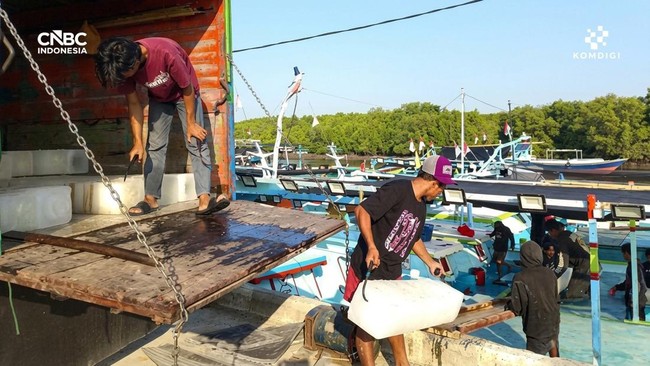
One initiative to strengthen communities in the regions is the Kampung Nelayan Merah Putih (KNMP), or Red-and-White Fishing Village programme. Its impact is already apparent in Tongke-Tongke Village, Sinjai Regency, South Sulawesi.
One of the most noticeable changes has been an increase in the sale price of fishermen’s catch. Emil Salim, head of the Indonesian Fishermen’s Association (HNSI) branch in Sinjai Regency and manager of the KNMP Tongke-Tongke Fish Processing Unit (UPI), said the price of tuna had risen from around Rp30,000 per kilogram to Rp45,000 per kilogram.
“Since the KNMP was established, the value of our fishermen’s catch has increased. Before the programme, the price was Rp30,000 per kilogram. Since the KNMP began operating, tuna prices in Sinjai have continued to rise. They are now at Rp45,000 per kilogram, an increase of Rp15,000 over a period of four to five months,” Emil said.
Hairul Mukmin, a boat owner at KNMP Tongke-Tongke, also said fishermen’s incomes had risen by about 40–50% since the programme began. He attributed the change to a shorter fish-trading chain: fishermen no longer have to sell their catch through agents, collectors or middlemen before it reaches companies.
“Before the KNMP, fishermen sold their catch to agents, collectors or middlemen. The collectors then took it to Java or Makassar, to the companies. Now, with the KNMP, there are no longer second or third parties, or all those steps. The catch goes straight from the fishermen to the KNMP, at the company price. That means income has increased by up to 50% compared with before,” he explained.
Emil, who also heads the HNSI branch in Sinjai, said the catch no longer needed to be taken to Makassar before being marketed elsewhere.
Before the KNMP was established, he said, fishermen’s catch had to be transported to Makassar for processing, a journey of about four to five hours.
“Before the KNMP, fishermen’s catch was taken to Makassar, which is about a four-to-five-hour journey,” he said.
Now, the catch can be delivered directly to the processing unit in the KNMP Tongke-Tongke complex. After being handled and processed, the tuna is shipped according to market orders.
According to records from the Ministry of Marine Affairs and Fisheries, KNMP Tongke-Tongke has made several shipments of tuna to other regions. In total, it has sent about 65 tonnes in six shipments, worth approximately Rp2.55 billion.
Jakarta is one of the main destinations. In July 2026, KNMP Tongke-Tongke recorded a container shipment of tuna to Jakarta via the Makassar–Jakarta route. It was the programme’s fourth domestic shipment from Tongke-Tongke.
This means the catch from Tongke-Tongke is now sold not only in markets around Sinjai and Makassar. With a fish-processing unit at the KNMP site, tuna can be consolidated and sent directly to markets elsewhere. KNMP Tongke-Tongke has consequently become a collection point for fishermen’s catch before it is dispatched to destination markets, including Jakarta.
Source: jawawa.id (https://jawawa.id/newsitem/two-years-of-prabowo-gibran-leadership-focus-on-strengthening-the-rural-economy-1792659045)
Originally published by CNBC Indonesia (https://www.cnbcindonesia.com/news/20261022145047-4-778620/2-tahun-kepemimpinan-prabowo-gibran-fokus-memperkuat-ekonomi-desa), translated from Indonesian