
Two Years of Prabowo-Gibran Government See BKPM Record Rp 3,923.2 Trillion in Investment
JAKARTA — The Ministry of Investment and Downstreaming/Investment Coordinating Board (BKPM) reported investment realisation of Rp 3,923.2 trillion during the two years of President Prabowo Subianto and Vice-President Gibran Rakabuming Raka’s administration, from October 2024 to September 2026.
The total is equivalent to 30.1% of the national investment requirement for 2025–2029, set at Rp 13,032.8 trillion. The investment generated employment for 5,485,944 people. Java accounted for 48.2%, or Rp 1,892.2 trillion, while regions outside Java contributed 51.8%, or Rp 2,031 trillion.
Investment and Downstreaming Minister and BKPM head Rosan Roeslani said the figures reflected investment’s vital role in national economic growth, expanding employment opportunities and promoting more even development across regions.
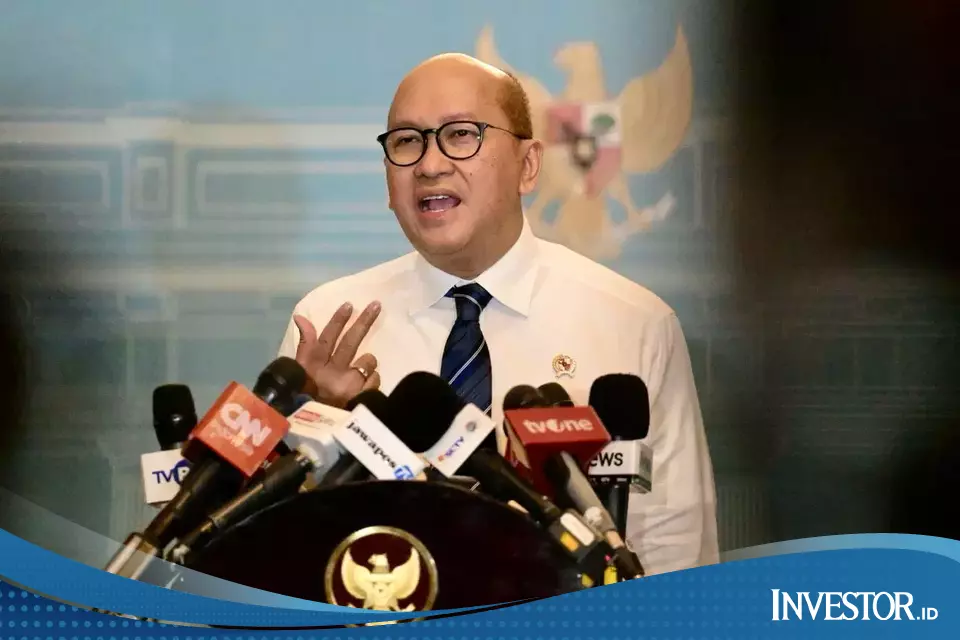
“We must continue to proactively engage with investors and listen to their input so that our investment and industrial climates improve,” Rosan said at a press conference at the State Palace on Tuesday (20 October 2026).
Investment performance during the two years of President Prabowo’s administration provides a foundation for further strengthening the national investment climate, accelerating downstream development and improving investment quality so that the public feels greater benefits.
Alongside overall investment growth, downstreaming has made positive progress as one of the drivers of national investment.
From January to September 2026, downstreaming investment totalled Rp 480 trillion, up 11.3% from the same period a year earlier and accounting for 31.2% of total national investment realisation.
Minerals dominated downstreaming investment, with Rp 335.1 trillion in realised investment. This included nickel at Rp 118.9 trillion, bauxite at Rp 115.7 trillion, iron and steel at Rp 40.8 trillion, copper at Rp 39.5 trillion, and silica sand at Rp 7 trillion. Downstreaming’s share stood at 26% in 2024 and reached 34% in the third quarter of 2026.
“We will continue to encourage investment to grow and become higher quality, while also having a positive impact, such as through job creation,” Rosan said.
Outside the minerals sector, downstreaming investment from January to September 2026 included plantations and forestry, at Rp 83.6 trillion; oil and gas, at Rp 54 trillion; and fisheries and marine industries, at Rp 7.3 trillion. The figures point to the expanding development of downstream processing across Indonesia’s potential commodities.
By region, 78% of downstreaming investment, or Rp 373.1 trillion, was realised outside Java. The five provinces with the largest totals were Central Sulawesi, at Rp 100.4 trillion; North Maluku, at Rp 84.1 trillion; West Java, at Rp 36.9 trillion; West Kalimantan, at Rp 35.4 trillion; and Southeast Sulawesi, at Rp 27.9 trillion.
In the third quarter of 2026, downstreaming investment reached Rp 179.9 trillion, a year-on-year increase of 19.4%. The growth shows that downstreaming is playing an increasingly significant role in raising the value added of commodities domestically.
By country of origin, Singapore was the largest source of foreign direct investment (FDI) from January to September 2026, with US$14 billion, or 29.6% of total FDI. It was followed by Hong Kong, China, with US$12.8 billion; China with US$5 billion; the United States with US$3.4 billion; and Japan with US$2.6 billion.
Together, the five countries accounted for 80% of total foreign investment realised in Indonesia during the first nine months of 2026.
The government has also implemented Government Regulation No. 28 of 2025 on the Implementation of Risk-Based Business Licensing. Under the system, the government will apply a positive fictitious approval mechanism, which is expected to shorten the time required to obtain permits.
“What investors want is certainty. We are trying to reduce uncertainty in licensing, processing times and the investment climate,” Rosan said.