
Two UMJ Experts Examine the Gibran Diploma Controversy: Political Ethics and the Legal Perspective
JAKARTA — The controversy over Vice-President Gibran Rakabuming Raka’s diploma has come under renewed scrutiny after the Constitutional Court (MK) delivered its ruling on Tuesday (6 October 2026). The court said it had found no convincing evidence of an overseas diploma, certificate or degree that could serve as the basis for recognising Gibran’s education as equivalent to upper-secondary education or its equivalent. However, it ruled the petition inadmissible because the petitioners lacked legal standing.
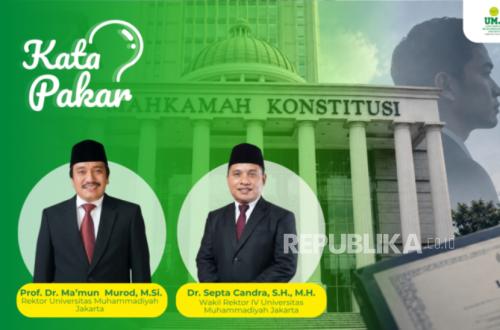
The ruling has prompted discussion about the ethics of public office, fulfilment of candidacy requirements and the authority of state institutions to follow up on the matter. Universitas Muhammadiyah Jakarta (UMJ) Rector Prof Dr Ma’mun Murod, M.Si., considered the controversy from the perspective of political ethics and the possibility of impeachment. UMJ Vice-Rector IV Dr Septa Candra, S.H., M.H., addressed it from a legal perspective, focusing on the limits of the Constitutional Court’s authority.
Political ethics and the integrity of public officials
For Ma’mun, the controversy is not merely about whether education documents are complete. He sees it as a test of public officials’ ethics, particularly their honesty and integrity.
“Ethics comes above everything else. If someone can so easily violate ethical standards, they will certainly find it even easier to break the law, especially if that person is a state official,” Ma’mun said.
He explained that ethics concerns morality and character. Morality relates to society’s judgements of right and wrong, while character is rooted in religious teachings. In this controversy, Ma’mun said, honesty is fundamental because it concerns not only a person’s relationship with God but also their responsibility to the public.
Ma’mun also said the Constitutional Court’s ruling should be considered from a political perspective. He suggested that political messages and interference may have been involved in the proceedings. In assessing the substance of the ruling, he highlighted the absence of evidence of overseas educational documents that could form the basis for equivalence with an upper-secondary diploma or its equivalent. In his view, the issue is directly connected to a public official’s ethics and responsibility to meet candidacy requirements.
“If someone has sound character and integrity, they should resign because they do not meet the requirements to stand as a vice-presidential candidate,” said the professor of political science.
Impeachment and the responsibility of election administrators
The UMJ professor of political science said the controversy should provide grounds to pursue impeachment if constitutional requirements are met. He said the process could proceed through the House of Representatives (DPR), but would depend heavily on the political alignment of the parties and the willingness of lawmakers to take a position.
“From a political perspective, this issue should be able to provide grounds for pursuing impeachment. Our laws allow such a process if, for example, the president falls into a category involving a criminal offence. That could open the way to an impeachment process,” he said.
Alongside the possibility of impeachment, Ma’mun said the General Elections Commission (KPU) should also be held responsible for verifying vice-presidential candidates’ qualifications. He said election administrators must have moral integrity and must not disregard issues concerning the completeness of candidacy documents.
“This controversy is certainly a major lesson for the KPU. If it had high moral integrity, its members should resign now. In my view, the KPU deliberately concealed the fact that Gibran did not have a diploma. Morally, its members should resign over this issue,” he said.
Nevertheless, Ma’mun said what happens next depends largely on the political balance among parties in the DPR and their willingness to act. He said lawmakers’ political decisions would determine whether the matter proceeds to impeachment mechanisms.
The Constitutional Court ruling and the limits of its legal authority
Unlike Ma’mun, who emphasised ethics and political dynamics, Septa Candra discussed the controversy in terms of judicial authority and the applicable legal procedures.
“In my view, the Constitutional Court acted correctly, because it has no authority to disqualify Gibran. The party challenged in this case is Gibran, whose status is already that of vice-president, not vice-presidential candidate,” said the UMJ legal expert.
He explained that disqualification procedures concern whether a person met the requirements while still a candidate. Once an elected candidate has been inaugurated, the procedure for removing a president or vice-president is different: it is impeachment, involving the DPR, the Constitutional Court and the People’s Consultative Assembly (MPR), in accordance with the Constitution.
According to Septa, the process begins with the DPR submitting an opinion concerning an alleged violation by the president or vice-president. The proposal must meet constitutional requirements before being examined by the Constitutional Court. If those stages are completed, the process moves to the MPR, which decides whether to dismiss the office-holder. The removal of an inaugurated official therefore cannot be treated as equivalent to overturning a candidacy.
Septa also addressed the Constitutional Court’s consideration of the petitioners’ legal standing. The court ruled the petition inadmissible because the petitioners lacked standing. Accordingly, the ruling cannot be interpreted as a decision disqualifying Gibran from his position.
Source: jawawa.id (https://jawawa.id/newsitem/two-umj-experts-examine-the-gibran-diploma-controversy-political-ethics-and-the-legal-perspective-1791867105)
Originally published by Republika (https://news.republika.co.id/berita/tmtw7o370/dua-pakar-umj-soroti-polemik-ijazah-gibran-antara-etika-politik-dan-perspektif-hukum), translated from Indonesian