
Two Train Crashes Kill 115, Minister Resigns
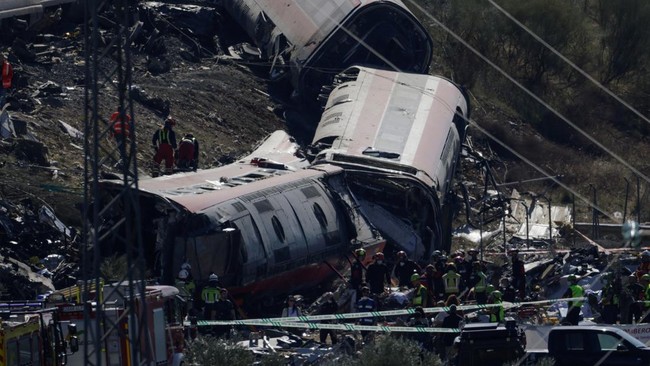
Spain’s government is facing political pressure ahead of the general election after two high-speed train crashes killed a total of 115 people this year. Transport Minister Óscar Puente has resigned following calls for the government to take responsibility for the safety of the country’s rail network.
Prime Minister Pedro Sánchez announced on Wednesday (4 November 2026) that Deputy Prime Minister and Economy Minister Carlos Cuerpo would temporarily take over the Transport Ministry.
The announcement came a day after Puente said he was stepping down on Tuesday evening, six days after the latest crash to shock Spain.
In a brief televised speech, Sánchez praised Puente’s decision as an act of political responsibility, saying it could help restore public confidence in the national rail system.
“Cuerpo has demonstrated exceptional management ability and integrity during this government’s term,” Sánchez said as he announced the appointment, Reuters reported.
Puente’s resignation came as a surprise because he had repeatedly said he would remain in office to oversee the crash investigations and address weaknesses in the rail system.
The decision followed four hours of questioning by members of an ad hoc parliamentary committee. During the tense hearing, most parties demanded that he take responsibility for the two crashes, which killed 115 people.
Puente, 57, said he had in fact decided to resign immediately after last week’s train crash in Urda, central Spain. He had told only his family about the decision, without even informing Sánchez.
“Politicians like Puente bring honour to our country and show that we are not all the same. While some people only preach, others give everything,” Sánchez said after the resignation was announced.
But Sánchez’s remarks drew a sharp response from Alberto Núñez Feijóo, leader of the opposition People’s Party (PP).
Responding to Sánchez’s post on X praising Puente’s decision, Feijóo urged the prime minister to do the same.
“Apply that to yourself,” he wrote.
Political setback ahead of election
Puente’s departure is a new challenge for Sánchez’s Socialist Party ahead of the 29 November general election.
Puente had been one of the government’s most loyal ministers and among Sánchez’s most vocal defenders. His combative political style frequently brought him into heated exchanges with the opposition, both in parliament and on social media.
Some political commentators even dubbed him Sánchez’s “attack dog” because of his confrontational stance towards political opponents. He had also been mentioned as a possible successor to Sánchez in the future.
Independent political analyst Eduardo Bayón said Puente’s resignation had deprived the People’s Party of one of its main targets for criticism. Political debate was now likely to shift from calls for officials to resign towards concrete measures to improve rail safety.
“The government needs to fill that vacuum with concrete measures on rail safety and investment. Confidence in high-speed rail will remain a campaign issue,” Bayón said.
Opinion polls taken after last Wednesday’s fatal crash showed a slight fall in support for the Socialist Party. The party had previously hoped to focus its campaign on its record of preserving public services and efforts to tackle the housing crisis.
Puente confirmed that he would not stand in the 29 November election. His resignation will formally take effect once it is published in Spain’s official state gazette.
Rail safety under scrutiny
Before becoming a minister, Puente was known as a lawyer, a former mayor and a stage actor. He took charge of the Transport Ministry in November 2023.
During his time in office, Puente oversaw the expansion of Spain’s rail network and the implementation of infrastructure investment projects, some of them supported by European Union recovery funds.
His transport policies nevertheless faced criticism. Trade unions and opposition parties have for years accused the government of underinvesting in rail network maintenance, as operational disruptions have become more frequent.
Pressure on Puente mounted after a fatal crash in February on the Madrid–Seville line. The incident prompted Spain’s Senate to pass a motion calling for his resignation.
Last Wednesday’s latest crash also occurred on the same line, reinforcing concerns about the safety of Spain’s high-speed rail system.