
Two-Thirds of Java's North Coast Severely Eroded, BRIN Reveals Alarming Data
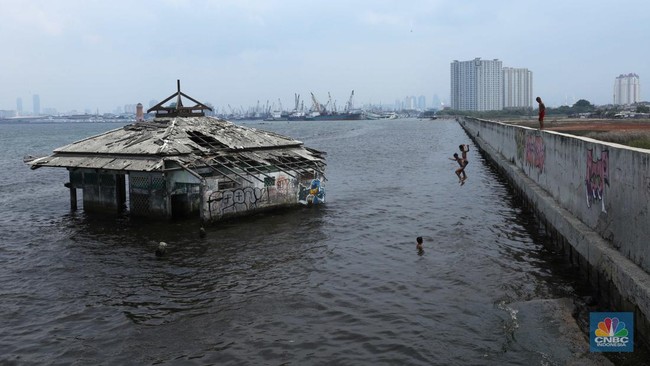
Erosion is posing a real threat to the northern coast of Java. The National Research and Innovation Agency (BRIN) has recorded that nearly two-thirds of the coastline stretching from Serang Regency to Situbondo Regency is affected by abrasion, covering 65.8% of the area. This high rate of erosion is causing a decline in the quality of the coastal environment, while simultaneously increasing the risk of losing residential areas and damaging local economic infrastructure.
This comprehensive assessment was revealed by Tubagus Solihuddin, a researcher at BRIN’s Climate and Atmosphere Research Centre, during an Expose of the Earth and Maritime Research Organisation and a Focus Group Discussion themed ‘Resilient Pantura, Sustainable Indonesia for the Integration of Science, Innovation, and Coastal Resilience’ at the B.J. Habibie Building in Jakarta. Tubagus highlighted that massive development of settlements and economic centres along the Pantura route has been driven by high demographic pressure, leading to uncontrolled extraction of marine and coastal resources.
‘84% of Java’s north coast is composed of pluvial and deltaic sediments. Geologically, these deposits are still unconsolidated. They are not yet strongly compacted, making them highly susceptible to erosion and compression,’ he explained. This vulnerability is worsened by morphological conditions, as 83% of the northern coastline consists of low-relief plains with elevations of less than 10 metres.
Analysis of shoreline changes using Sentinel satellite imagery from 2000 to 2024 reveals a worrying trend. Tubagus detailed that erosion dominates the shoreline changes at a rate of 65.8%, while accretion accounts for only 34.2%. He noted an anomaly in the data: massive erosion is occurring in delta environments, which are naturally sediment deposition areas. This is closely linked to upstream modifications such as canalisation, river diversion, and dam construction, which ultimately cut off sediment supply to coastal estuaries.
The impact of these anthropogenic modifications is clearly recorded at various locations. At Tanjung Pontang in Serang, 1.72 square kilometres of land have been lost due to erosion caused by the diversion of the Ciujung Baru River. In the Pantai Bahagia area of Muara Gembong, Bekasi, seawater has intruded up to 4 kilometres inland, permanently submerging public infrastructure and flooding more than 1,000 hectares of community fishponds. Similar conditions are recorded in Legonkulon, Subang, where 2 kilometres of seawater intrusion has submerged 700 hectares of ponds. Abrasion has also eroded village roads stretching 500 metres to 1 kilometre in Krangkeng, Indramayu.
Regarding the Demak region, Tubagus provided a historical note that the area was once the Muria Strait in the 15th and 16th centuries before sedimentation turned it into land. Today, seawater has re-entered up to 5 to 6 kilometres inland in Demak, swallowing rice fields and residential areas. This situation is exacerbated by sea level rise and land subsidence. Based on altimetry data modelling from 1993 to 2025, the trend of sea level rise along the Pantura coast reaches an average of 0.41 to 0.42 centimetres per year, resulting in an accumulated rise of up to 15.5 centimetres over 32 years.
In addition to erosion and rising sea levels, the coastal areas are also facing land subsidence. Citing geospatial data from 2017 to 2023, Tubagus explained that the highest rate of land subsidence was recorded in Demak at 16 cm per year, followed by Jakarta (15 cm/year), Sidoarjo (14 cm/year), and Pekalongan (11 cm/year). Land subsidence was also identified in Surabaya (8 cm/year), Brebes (7 cm/year), and Serang, Cirebon, and Indramayu (each 6 cm/year). ‘The northern coast of Java is facing a real crisis. The challenges are not just erosion, abrasion, and flooding, but also sea level rise and land subsidence. And this is not a local issue, it is a national issue, considering that the Pantura is the backbone of the national economy,’ Tubagus stressed.