
Two Suspects in Subsidised Rice Misuse Case in NTB Face Up to Five Years in Prison
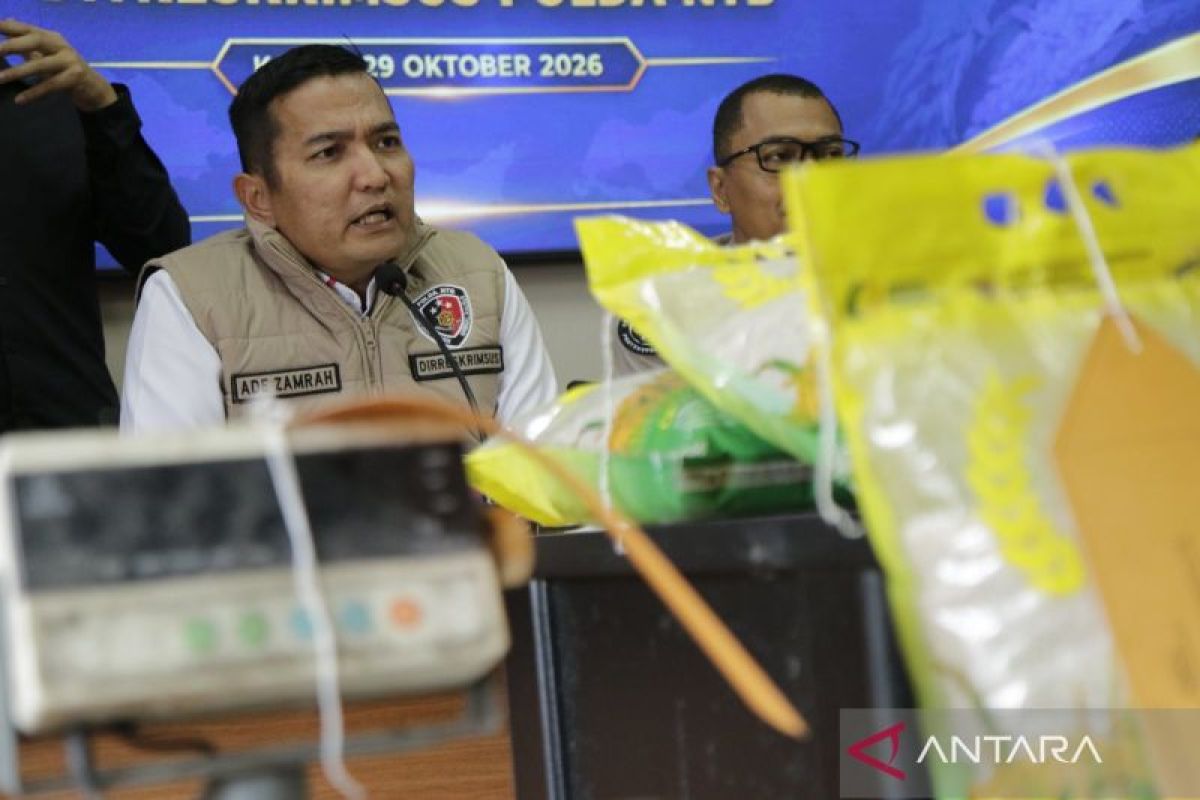
Mataram (ANTARA) – Two suspects in an alleged misuse of rice subsidised under Bulog’s Food Supply and Price Stabilisation (SPHP) programme in West Nusa Tenggara (NTB) face a maximum prison sentence of five years and a fine of up to Rp5 billion.
Ade Zamrah, director of special criminal investigation at the NTB Police, said at a press conference in Mataram on Thursday that the penalties are set out in Law No. 8 of 1999 on Consumer Protection and Law No. 7 of 2014 on Trade.
“For their suspect status, we are applying Article 62(1) in conjunction with Article 8(1)(a) and (i) of the Consumer Protection Law, which carries a maximum prison sentence of five years and a fine of Rp2 billion,” he said.
The maximum fine of Rp5 billion is stipulated in Article 110 in conjunction with Article 36 of the Trade Law, which carries a prison sentence of up to five years.
Given the maximum potential prison sentence, investigators have not detained the two suspects.
“They have also been co-operative during the investigation; whenever we have needed their statements, they have attended,” he said.
Ade said the cases remain at the investigation stage and are being handled in accordance with the applicable rules.
The suspects, identified by the initials HM and Z, allegedly engaged in the practices in West Lombok and Central Lombok regencies.
The first case concerns activity in Babussalam village, Gerung district, West Lombok, allegedly carried out by HM, the owner of a rice mill.
HM allegedly bought 400 five-kilogramme packs of Bulog SPHP rice—equivalent to two tonnes—from Gerung Market. He paid Rp60,000 per pack, or Rp12,000 per kilogramme.
HM then opened the subsidised rice packages and mixed the rice with rice from his mill. The mixture was repacked into plain 50-kilogramme sacks and sold to traders or rice distributors.
The repacked rice was sold for Rp650,000 per sack, or Rp13,000 per kilogramme. HM allegedly made a profit of Rp1,000 per kilogramme. The practice is believed to have begun in early June 2026.
The second case was uncovered in Ungga village, Praya Barat Daya district, Central Lombok, where police apprehended Z.
Like HM, Z, a rice mill operator, allegedly bought 300 five-kilogramme packs of Bulog SPHP rice—equivalent to 1.5 tonnes—from an SPHP rice distributor in Ungga. He paid Rp60,000 per pack, or Rp12,000 per kilogramme.
Z then opened the subsidised rice packages and repacked the rice in plain 25-kilogramme sacks for sale in Bali.
The repackaged rice was sold for Rp312,500 per sack, or Rp12,500 per kilogramme, giving Z a profit of Rp500 per kilogramme.
Investigators believe Z carried out the activity four times from early August 2026.
In the West Lombok case, investigators seized 440 five-kilogramme sacks of Bulog SPHP rice, 396 opened SPHP packaging sheets, 165 white sacks labelled UD Sri Ayu, and 99 50-kilogramme rice sacks labelled UD Sri Ayu. Police also seized digital scales and a sack-sewing machine.
In Central Lombok, investigators seized 51 sacks containing SPHP rice repackaged into plain 25-kilogramme sacks, 45 five-kilogramme packs of Bulog SPHP rice, 200 plain 25-kilogramme sacks and 1,600 used five-kilogramme SPHP rice packaging sheets. Other evidence included digital scales, a sack-sewing machine and scissors.