
Two Months into the War: Prabowo's Strategy to Maintain Indonesia's Energy Resilience
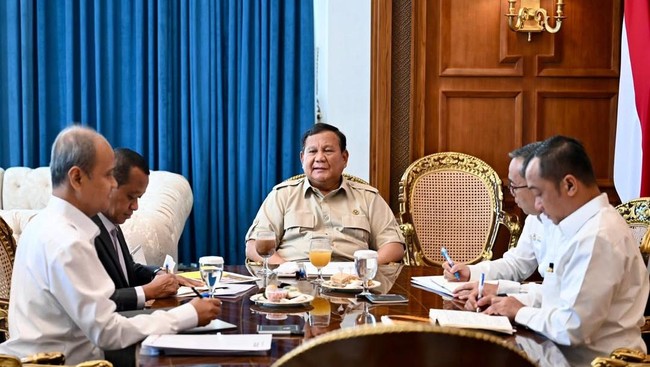
Jakarta, CNBC Indonesia - President of the Republic of Indonesia Prabowo Subianto summoned the Minister of Energy and Mineral Resources (ESDM) Bahlil Lahadalia to the State Palace on Monday (27/4/2026). This was to discuss national energy developments amid ongoing global geopolitical dynamics that continue to pressure the world’s energy supply chain.
As is known, geopolitical tensions in the Middle East, particularly between Iran and the United States & Israel, have entered their second month following the initial attack on 28 February 2026.
Bahlil conveyed several strategic conditions of the national energy sector, including the availability of fuel oil (BBM), crude oil stocks, and the government’s strategic measures to strengthen national energy independence.
He emphasised that the national energy supply remains stable, with the quality of national BBM, both diesel and petrol, above the national minimum standards.
“Both in terms of BBM products, whether diesel or petrol. From all aspects, alhamdulillah, everything is above the national minimum standards. So alhamdulillah, it’s been almost two months since the geopolitical incident in the Middle East regarding the Strait of Hormuz, and we are still stable,” said Bahlil, quoted on Tuesday (28/4/2026).
In addition, the government has ensured that crude oil stocks for the development of national refineries remain safe and above the national minimum threshold, so the overall national energy supply is relatively free from constraints.
On that occasion, Bahlil also reported efforts to reduce reliance on liquefied petroleum gas (LPG) imports. Currently, national LPG consumption reaches around 8.6 million tonnes per year, while domestic production is only about 1.6 to 1.7 million tonnes, meaning approximately 7 million tonnes must still be met through imports.
To reduce this dependency, the government continues to evaluate several substitution alternatives, including the development of Dimethyl Ether (DME) based on low-calorie coal and the utilisation of Compressed Natural Gas (CNG). According to Bahlil, CNG is one of the strategic options because it utilises C1 and C2 gases, whose production is substantial domestically, thereby strengthening the use of domestic gas while curbing LPG import reliance.
Its utilisation is also considered more efficient as it can be used for hotels, restaurants, and public gas stations (SPBG), some of which are already operational. “Right now, it’s still under discussion, what I reported earlier is that we are making CNG. But this is still in discussion, I need to finalise it, and this is one of the best alternatives for us to push for energy independence in the LPG sector,” he stated.
The government is also preparing several strategic measures to address potential global energy crises, ranging from optimising oil and gas lifting, strengthening the B50 biodiesel programme to reduce diesel imports, to developing bioethanol-based fuels through E20.
“We have three things that we must do to face the current global energy crisis. The first is to optimise our lifting. The second is to seek diversification, such as B50. B50 reduces our diesel imports. The third is to push for E, for petrol. Ethanol, E20. That is part of the strategy,” Bahlil stressed.
To support the implementation of B50, the Ministry of ESDM is currently conducting road tests across various user sectors. Road test results in the automotive sector show that B50 usage is safe, with no significant issues, and engine performance, fuel filters, and lubricant quality remain within the standards recommended by manufacturers.
This success forms the basis for expanding implementation to the railway sector through locomotive road tests as part of preparations for mandatory national B50 rollout. This step is an important part of efforts to reduce diesel imports while strengthening national energy resilience through more optimal use of domestic energy.
“Through a combination of securing short-term energy supplies and accelerating domestic energy diversification, the government reaffirms its commitment to maintaining national energy resilience while strengthening Indonesia’s energy sovereignty amid global uncertainties.”